
Key takeaways
- The 1-per-Hour Transit Formula: Count the total hours from leaving your front door to arriving at your destination hotel, then pack one diaper for every hour, plus a baseline buffer of four extra diapers to safeguard against runway delays or flight cancellations.
- The Grab-and-Go Diaper Clutch: Never haul your full 25-liter backpack into a miniature airplane lavatory. Pack a detachable pouch containing two diapers, travel wipes, a foldable changing pad, and disposable diaper sacks for swift changing trips down the aisle.
- The Ziploc Wet/Dry Segregation System: Pack all spare clothing inside gallon-sized transparent sliding zipper bags. They compress fabric volume, shield clean outfits from accidental formula leaks, and serve as odor-locking containment for soiled clothes after messy incidents.
- Dedicated Perimeter Liquid Access: Position water bottles, insulated formula thermos flasks, and liquid hand sanitizers in exterior slip pockets so you never open the main compartment during transit checks.
What's inside
- The Golden Rules of Packing a Travel Diaper Bag
- Step-by-Step: How to Pack and Organize Your Bag
- Complete Travel Diaper Bag Packing Checklist
- Airport Security and Airplane Cabin Strategies
- 5 Best Travel Diaper Bags for Seamless Trips
- Travel Diaper Bag Buying Guide: Key Criteria
- Frequently Asked Questions
- Conclusion
Traveling with an infant or toddler turns routine outings into logistical operations where every square inch of storage matters. Mastering how to pack and configure a travel diaper bag transforms chaotic transit delays and airplane diaper blowouts into smooth, manageable hurdles. Whether you are navigating long airport security lines, managing cramped cabin lavatories, or taking a weekend family road trip, organizing your essentials by access priority guarantees that feeding supplies, sanitized pacifiers, and emergency changes of clothes remain within immediate reach. This comprehensive guide outlines the exact packing framework, TSA airport strategies, and top-tier features every traveling parent needs for stress-free journeys.
- The Golden Rules of Packing a Travel Diaper Bag
- Step-by-Step: How to Pack and Organize Your Bag
- Complete Travel Diaper Bag Packing Checklist
- Airport Security and Airplane Cabin Strategies
- 5 Best Travel Diaper Bags for Seamless Trips
- Travel Diaper Bag Buying Guide: Key Criteria
- Frequently Asked Questions
- Conclusion
The Golden Rules of Packing a Travel Diaper Bag
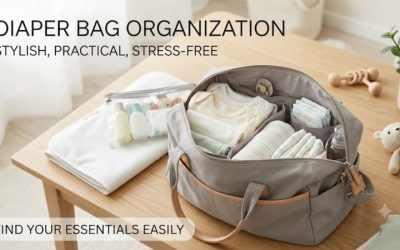
Packing efficiently requires ditching bulky retail containers and grouping gear into compartmentalized zones. You must prioritize vertical stacking and rapid single-hand retrieval so you never have to rummage through buried clothes during mid-flight turbulence or sudden emergencies. Keep everyday care streamlined and intuitive.
- The 1-per-Hour Transit Formula: Count the total hours from leaving your front door to arriving at your destination hotel, then pack one diaper for every hour, plus a baseline buffer of four extra diapers to safeguard against runway delays or flight cancellations.
- The Grab-and-Go Diaper Clutch: Never haul your full 25-liter backpack into a miniature airplane lavatory. Pack a detachable pouch containing two diapers, travel wipes, a foldable changing pad, and disposable diaper sacks for swift changing trips down the aisle.
- The Ziploc Wet/Dry Segregation System: Pack all spare clothing inside gallon-sized transparent sliding zipper bags. They compress fabric volume, shield clean outfits from accidental formula leaks, and serve as odor-locking containment for soiled clothes after messy incidents.
- Dedicated Perimeter Liquid Access: Position water bottles, insulated formula thermos flasks, and liquid hand sanitizers in exterior slip pockets so you never open the main compartment during transit checks.
Step-by-Step: How to Pack and Organize Your Bag
Executing a systematic packing method prevents overstuffing and ensures balanced weight distribution. By grouping baby gear into modular pouches and assigning dedicated zones within your pack, you create an effortless workflow that saves critical minutes during stressful airport checks or crowded highway rest stops on family journeys.
Step 1: Lay Down the Heavy Foundation Base Layer
Place non-urgent, high-density gear at the very bottom of the bag. This includes surplus diapers, backup packs of sealed baby wipes, and spare footwear. Anchoring dense gear against the lower back panel keeps the center of gravity stable, preventing painful backward tugging on your shoulders while walking through terminals.
Step 2: Insert the Mid-Tier Modular Wardrobe Cube
Position your sealed gallon clothing bags directly in the middle interior tier. Include two complete infant outfits (onesies, footies, and socks) along with one lightweight spare shirt for yourself. Spit-up and diaper blowouts often soil caregiver clothing; having a compressed adult top ready avoids traveling in soiled garments.
Step 3: Configure the Insulated Feeding Station
Load prepared baby bottles, pumped breast milk bags, pre-measured formula powder dispensers, and clean baby spoons into dedicated insulated thermal pockets. Using reusable ice packs maintains milk freshness below $40^\circ\text{F}$ ($4^\circ\text{C}$) during multi-hour road commutes or international layovers.
Step 4: Assemble the Top-Tier Emergency Quick-Grab Zone
Reserve the top interior zone for immediate soothing tools and snacks. Place teethers, silicone bibs, sound machines, pacifiers in hygienic pods, and travel snacks (puffs or fruit pouches) directly beneath the main zipper. This placement lets you unzip the bag by two inches under an airplane seat to soothe a crying infant instantly.
Step 5: Exterior Security Pocket and Document Management
Stow boarding passes, pediatric health insurance cards, vaccination records, passports, and charging cords inside exterior zippered anti-theft pockets. Keeping personal electronics and transit documents separate from infant wipes protects sensitive devices from moisture while speeding up gate check inspections.
Complete Travel Diaper Bag Packing Checklist
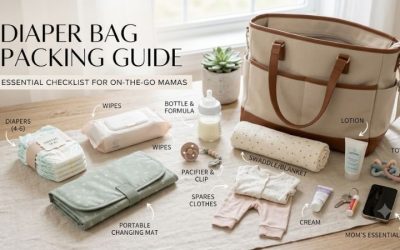
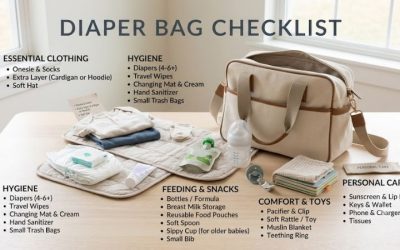
Calculating the exact inventory for transit hinges on travel duration plus planned contingencies. Packing one diaper per hour of transit alongside two complete wardrobe changes protects against major delays without burdening your shoulders. Review this comprehensive packing list to assemble your necessary travel essentials with ease.
Diapering and Hygiene Essentials
- Diapers: 1 diaper per hour of travel $+ 4$ emergency reserve diapers.
- Travel Wipes: 1 large flip-top pack ($64\text{ count}$) plus 1 travel pack of antibacterial hand wipes.
- Changing Surface: Water-resistant, wipe-clean cushioned changing mat ($20 \times 30\text{ inches}$).
- Barrier Cream: Travel-size diaper rash ointment ($1.5\text{–}2\text{ oz}$) packed in a leakproof pouch.
- Disposal Bags: 1 roll of scented or biodegradable disposable diaper trash sacks.
- Sanitization: Alcohol-free surface disinfectant wipes and travel-sized hand sanitizer.
Infant Nutrition and Feeding Supplies
- Bottles: 2–3 sterilized bottles with leakproof travel caps and collar rings.
- Formula or Breast Milk: Pre-measured formula stacking dispenser or insulated chilled breast milk bags.
- Thermos: Insulated stainless container holding warm water for reconstituting powdered formula.
- Burp Cloths and Bibs: 2 absorbent muslin burp cloths and 1 wipeable silicone roll-up bib.
- Toddler Snacks: 2 fruit/vegetable purée pouches and an anti-spill snack cup.
Spare Clothing and Comfort Items
- Baby Outfits: 2 full zippered footie onesies with two-way zippers for rapid diaper changes.
- Parent Top: 1 dark-colored, wrinkle-resistant t-shirt rolled into a quart bag.
- Weather Layers: 1 breathable cotton cardigan or baby jacket and 1 pair of infant mittens/socks.
- Comfort Gear: 2 pacifiers on clip attachments and 1 compact sensory crinkle book or silicone teether.
Airport Security and Airplane Cabin Strategies
Navigating airport checkpoints with infant nourishment and bulky accessories demands strict preparation under TSA exceptions. Breast milk, distilled water, and infant purées are medically necessary liquids exempt from standard liquid rules. Knowing how to present these items accelerates screening and protects your travel timetable.
1. Leverage the Medically Necessary Liquids Exemption
The standard TSA 3-1-1 liquids rule does not apply to baby food, infant formula, breast milk, or sterile water intended for an infant. Inform security screening officers at the beginning of the queue that you carry baby nourishment in excess of $3.4\text{ ounces}$ ($100\text{ ml}$). Pack these containers together inside a clear zip-top bag to remove them quickly for vapor testing or X-ray inspection.
2. Streamline the Stroller and Carry-On Stacking Setup
Always choose a travel diaper bag equipped with an integrated rear luggage trolley strap. Threading this sleeve over the telescoping handle of your rolling carry-on luggage or gate-checked stroller keeps your shoulders completely unburdened as you traverse expansive international terminal concourses.
3. Master Under-Seat In-Flight Placement
Stow your main travel diaper bag beneath the seat directly in front of you rather than within the overhead bin. Overhead bins become inaccessible during extended taxiing periods and prolonged turbulence encounters. Orient the bag with the primary zipper handle facing outward toward your feet for effortless, one-handed retrieval during nighttime cabin blackouts.
5 Best Travel Diaper Bags for Seamless Trips
Choosing a carrier built specifically for transit requires balancing durability, specialized compartments, and versatile luggage integration. We evaluated the top five travel diaper bags across several functional designs, comparing their comfort hardware, pocket layout, and resilience against demanding long-distance transit schedules.
1. BabbleRoo Diaper Bag Backpack
The BabbleRoo Diaper Bag Backpack is a 26-liter workhorse constructed from tear-resistant, water-repellent polyester engineered specifically for high-capacity organizational efficiency.
- Best For: Overall travel value, multi-pocket organizational flexibility, and day-long carrying comfort.
- Key Features: 26-liter volume capacity; dual main zippered compartments; 5 insulated bottle pockets; padded laptop sleeve ($15.6\text{ inches}$); cushioned back panel with luggage sleeve; wipe-clean foldable changing mat.
- Pros:
- Multiple thermal insulation chambers fit wide-neck bottles alongside tall thermos flasks.
- Reinforced shoulder strap stitching prevents seam separation when packed to maximum capacity.
- Luggage trolley sleeve slips securely over standard suitcase handles without tilting.
- Cons:
- Polyester textile has a utilitarian appearance rather than a designer look.
- Deep bottom sections require systematic packing to prevent items from settling at the base.
- Use Case: Cross-country air travel and extended family road trips requiring heavy supply reserves.
- Who It’s For: Practical parents looking for maximum organization and durable construction at an accessible price.
2. Dagne Dover Indi Neoprene Diaper Backpack (Large)
The Dagne Dover Indi pairs water-resistant performance neoprene with high-end aesthetic engineering, delivering a modern travel bag that transitions effortlessly between parent duties and professional travel.
- Best For: Sleek minimalist styling, premium tactile comfort, and luxury airport travel.
- Key Features: 100% water-resistant performance neoprene body; integrated luggage trolley pass-through; removable diaper clutch; interior tablet/laptop sleeve; exterior slip phone pocket; matching insulated bottle holder and laundry bag.
- Pros:
- Performance neoprene cushions sensitive electronic gear while feeling soft against the body.
- Included modular zip accessories eliminate the need to purchase separate packing cubes.
- Luggage strap integrates flush with the rear panel, maintaining a clean visual profile.
- Cons:
- Neoprene fabric adds empty base weight ($3.5\text{ lbs}$) before packing any gear.
- Can absorb stubborn moisture stains if liquid spills dry without immediate spot cleaning.
- Use Case: High-end boutique travel, commercial airline flights, and urban parent commutes.
- Who It’s For: Style-conscious travelers who want a luxury aesthetic that conceals technical parenting gear.
3. Petunia Pickle Bottom Boxy Backpack
The Petunia Pickle Bottom Boxy Backpack is an iconic travel staple featuring a signature zip-out diaper changing station that provides a sanitized surface anywhere on the go.
- Best For: Rapid airport diaper changes and hands-free transit versatility.
- Key Features: Integrated zip-out fold-down changing station with removable mat; water-resistant glazed coated canvas exterior; dual insulated side bottle compartments; convertible backpack-to-crossbody strap system; magnetic front flap closure.
- Pros:
- Built-in changing station unzips in seconds, providing a sterile surface without touching public counters.
- Glazed exterior canvas repels spills and wipes clean with a standard antibacterial cloth.
- Spacious interior cavity holds bulky cold-weather infant blankets and spare outerwear.
- Cons:
- Magnetic flap latch can pop open if the main body is overstuffed beyond nominal capacity.
- Boxy exterior silhouette feels rigid when stowed under tight economy airline seats.
- Use Case: Flying through terminals with minimal changing tables and taking day trips to theme parks.
- Who It’s For: Parents who prioritize instant, hygienic diaper changing capabilities without unpacking their bag.
4. Skip Hop Forma Lightweight Diaper Backpack
The Skip Hop Forma utilizes an ultralight quilted water-resistant fabric paired with custom front-loading packing cubes to deliver modular, hassle-free gear organization.
- Best For: Ultralight carrying, modular organization, and parents who experience shoulder strain.
- Key Features: Water-resistant quilted polyester fabric; dual front packing cubes (one breathable mesh cube, one insulated cube); elasticized side bottle pockets; cushioned changing pad; stroller attachment clips.
- Pros:
- Featherlight empty weight ($1.4\text{ lbs}$) eliminates unnecessary lumbar and shoulder fatigue.
- Dedicated front packing cubes slide out instantly for TSA security inspections.
- Wide-open frame structure provides clear visibility down to the bottom seams.
- Cons:
- Lacks a dedicated luggage trolley sleeve for rolling suitcase integration.
- Soft exterior quilted shell provides minimal structural impact protection for delicate electronics.
- Use Case: Quick regional flights, weekend car getaways, and everyday stroller-based city errands.
- Who It’s For: Caregivers who dislike heavy structured packs and prefer featherlight, modular organization.
5. Itzy Ritzy Boss Plus Large Diaper Bag Backpack
The Itzy Ritzy Boss Plus provides expansive 27-pocket storage rendered in textured vegan leather, delivering heavy-duty storage for multiple children or international travel.
- Best For: Twin travel, multi-child packing, and parents demanding extensive interior pockets.
- Key Features: Premium vegan leather exterior; 19 total pockets (6 insulated); dual full-zip main compartments; patent-pending rubber traction bottom; includes matching headrest/changing pad.
- Pros:
- Molded rubber bottom prevents the bag from absorbing dirty liquids on airport lavatory floors.
- Dual full-unzip clamshell opening lays completely flat for rapid packing and item retrieval.
- High pocket count assigns a dedicated home for every small accessory, cord, and pacifier.
- Cons:
- Large structural profile can exceed under-seat allowances on smaller regional commuter aircraft.
- Premium vegan leather hardware increases empty pack weight to approximately $3.8\text{ lbs}$.
- Use Case: Extended international voyages, twin infant travel, and winter excursions requiring heavy layers.
- Who It’s For: Families managing multiple young children who require maximum capacity and protective floor bases.
Travel Diaper Bag Buying Guide: Key Criteria
Selecting an exceptional travel diaper bag requires weighing structural materials against your intended travel methods. Evaluate these four core buying criteria using our structured decision framework to pinpoint the ideal pack that delivers ergonomic comfort, seamless luggage compatibility, and rugged exterior fabric resilience.
1. Luggage Sleeve and Carry Architecture
- What: The physical carrying system, encompassing padded backpack straps, sternum support buckles, crossbody slings, and dedicated rear luggage trolley sleeves.
- Why: Maneuvering strollers, handling ticketing kiosks, and carrying tired toddlers leaves zero hands free; securing the bag to rolling luggage eliminates physical shoulder fatigue.
- Who: Air travelers and frequent flyers who navigate large airport terminals or train platforms.
- Trade-off: Integrating heavy luggage sleeves and thick padded harnesses adds minor baseline bulk, whereas streamlined totes save weight but must be carried entirely by hand.
2. Capacity and Modular Compartmentalization
- What: Internal volume ($20\text{ to }30\text{ liters}$) paired with dedicated divisions such as clamshell openings, mesh organizer cubes, and exterior quick-access pockets.
- Why: Unstructured cavernous bags cause small essentials to sink to the bottom, forcing parents to empty their gear during high-stress mid-flight emergencies.
- Who: Parents managing long flights ($6+\text{ hours}$) or traveling with twins who require structured compartmentalization.
- Trade-off: Bags with high pocket counts add internal fabric seams that reduce open bulk space for large blankets or winter coats.
3. Thermal Insulation and Liquid Management
- What: Dedicated foil-lined insulated bottle pockets, waterproof wet/dry separation zones, and exterior drink sleeves.
- Why: Infant formula and expressed breast milk spoil rapidly at room temperature, while wet washcloths or soiled clothes can ruin dry electronic chargers and travel documents.
- Who: Caregivers using prepared formula or carrying pumped breast milk over extended travel durations.
- Trade-off: High-density insulation material increases pocket stiffness and reduces flexibility for storing non-beverage gear when bottles are not required.
4. Textile Durability and Water-Resistant Coatings
- What: Heavy-duty outer materials like Cordura nylon, glazed coated canvas, waterproof vegan leather, and reinforced rubberized bottom feet.
- Why: Travel bags regularly sit on germ-laden airport security belts, sticky lavatory countertops, and wet tarmac surfaces without warning.
- Who: Parents who travel in varying climates and prioritize hygienic sanitization with simple antibacterial wipes.
- Trade-off: Waterproof coated textiles offer wipe-down sanitization but weigh noticeably more than untreated, breathable cotton canvas bags.
Frequently Asked Questions
Parents venturing on initial flights or long road trips face specific logistical queries regarding cabin allowances, sanitization, and bag maintenance. Below are clear, field-tested answers addressing standard airline carry-on policies, packing calculations, and practical methods to keep your travel gear clean and functional.
Does a travel diaper bag count as a carry-on or personal item?
Most major domestic and international airlines allow one diaper bag per ticketed infant as a free addition to standard passenger baggage allowances. However, budget carriers maintain varied regulations; verify with your specific airline whether the diaper bag is categorized as an exempt infant care item or counts toward your standard personal item limit.
How do you keep baby bottles cold inside a diaper bag during long flights?
Use double-walled vacuum-insulated stainless steel bottles or pack refrigerated plastic bottles inside dedicated insulated diaper bag pockets alongside frozen solid ice packs. Under TSA guidelines, frozen liquid items like freezer packs are fully permitted through security checkpoints as long as they are completely frozen solid when presented at screening.
What is the best way to sanitize a diaper bag after traveling?
Empty all compartments, invert the interior lining over a trash bin to dislodge loose debris, and wipe down interior seams using child-safe disinfectant or alcohol-free antibacterial wipes. For water-resistant nylon or glazed canvas exteriors, wash the surface with warm water and mild dish soap, then allow the bag to air-dry completely before storage.
Should I choose a backpack or a tote for air travel?
Backpack diaper bags are vastly superior for air travel because they distribute pack weight symmetrically across both shoulders while keeping both hands entirely free to steer strollers, hold child hands, or present passports. Totes often slip off shoulders during swift movements and place uneven strain on your cervical spine.
Conclusion
Equipping yourself with a purpose-built travel diaper bag and an organized packing system transforms family travel from an intimidating trial into an enjoyable, rewarding adventure. By grouping items into functional modular kits, leveraging luggage trolley sleeves, and planning for travel contingencies, you maintain complete composure whether seated in cramped airplane cabins or navigating crowded terminals. Investing in a reliable, ergonomic pack tailored to your transit routine ensures that your child remains dry, comfortable, and fed, giving you the peace of mind to focus on creating unforgettable family memories together wherever your travels take you.


Write Your Review
No reviews yet. Be the first to share your experience!