
Key takeaways
- Feature: The carrier must provide a wide base of support stretching from one knee hollow to the other.
- Meaning: The fabric actively lifts and sustains the baby’s thighs.
- Benefit: The baby’s knees sit noticeably higher than their buttocks, creating a distinct “M” alignment. This relieves pressure on the hip joints and supports the natural C-curve of their spine.
- Limitation: Narrow-based carriers fail to support the thighs, leaving legs dangling straight down, which increases the risk of dysplasia.
- Use Case: This position is strictly non-negotiable for the first six months of life and remains highly recommended through toddlerhood.
What's inside
Keeping your newborn close promotes deep bonding, but understanding hip healthy babywearing is crucial for proper joint development. Correct positioning prevents hip dysplasia by supporting their natural physical structure. This complete guide reveals how to safely wear your baby while maintaining the ideal ergonomic posture.
What Exactly Is Hip Healthy Babywearing?
Understanding the mechanics of infant joint development is the first step toward safe baby carrying. When a newborn arrives, their joints are mostly soft cartilage that requires proper support to harden correctly. Hip healthy babywearing specifically utilizes ergonomic techniques to prevent developmental dysplasia while keeping the baby secure.
To fully grasp the concept, it is essential to understand the biological transition of your infant. Inside the womb, a baby spends months in the fetal position, with knees bent and tucked toward their chest. After birth, forcing their legs straight before the joints have fully formed can cause the ball of the hip joint to slip out of the socket.
Hip healthy practices ensure that any carrying device mimics that natural fetal curve, allowing the hip joints to develop naturally and safely over the first six months of life.

Mastering the Ergonomic M-Shape Position
The foundation of safe carrying lies in achieving the correct anatomical posture for your infant. Medical professionals universally recommend the spread-squat position for early development. This specific alignment ensures that the thigh bones rest naturally in the hip sockets, minimizing unnecessary strain on their delicate and growing cartilage.
When executing the M-shape, caregivers must look for specific visual cues.
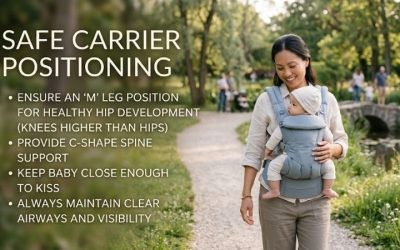
- Feature: The carrier must provide a wide base of support stretching from one knee hollow to the other.
- Meaning: The fabric actively lifts and sustains the baby’s thighs.
- Benefit: The baby’s knees sit noticeably higher than their buttocks, creating a distinct “M” alignment. This relieves pressure on the hip joints and supports the natural C-curve of their spine.
- Limitation: Narrow-based carriers fail to support the thighs, leaving legs dangling straight down, which increases the risk of dysplasia.
- Use Case: This position is strictly non-negotiable for the first six months of life and remains highly recommended through toddlerhood.
Step-by-Step Guide to Safe Baby Positioning
Properly securing your child requires attention to both structural support and breathable space. While achieving the correct hip posture is essential, caregivers must also ensure the infant remains visible and kissable at all times. Following established safety protocols guarantees a comfortable experience while protecting their vulnerable airways.
The internationally recognized T.I.C.K.S rule is the gold standard for babywearing safety:
- Tight: The carrier should be tight enough to hug your baby close to you. Any slack can allow them to slump, hindering breathing and putting unnecessary weight on your back.
- In view at all times: You should always be able to see your baby’s face by simply glancing down.
- Close enough to kiss: Your baby’s head should be positioned high on your chest.
- Keep chin off the chest: Ensure there is always a gap of at least two fingers under your baby’s chin.
- Supported back: In an upright carry, the baby’s back should be supported in its natural ergonomic curve.
Top Hip Healthy Baby Carriers Evaluated
Finding the perfect balance between caregiver comfort and infant joint support often requires examining certified products. The International Hip Dysplasia Institute rigorously tests and acknowledges carriers that promote healthy development. These top-rated selections provide exceptional ergonomic support tailored to different parenting lifestyles.
1. Ergobaby Omni 360 All-Position Carrier
The Ergobaby Omni 360 stands out as a premium structured option for growing families. This versatile product adapts seamlessly to your child’s rapid growth while maintaining absolute structural integrity. Acknowledged by the IHDI, it delivers exceptional lumbar support while ensuring the critical spread-squat position is achieved effortlessly.
- Best For: All-in-one versatility from newborn to toddler.
- Key Features: Adjustable bucket seat, crossable shoulder straps, detachable storage pouch, UPF 50+ baby hood.
- Pros: IHDI certified; supports front inward, front outward, hip, and back carries; exceptional lower back support for the wearer.
- Cons: The heavy-duty structure can feel bulky for petite caregivers; higher price point.
- Use Case: Ideal for long walks, hiking, or extended daily wear where maximum back support is required.
- Who It’s For: Active parents looking for a single, durable investment that lasts from week one until their child reaches 45 pounds.
2. Boba Classic Infant Wrap
For the critical fourth trimester, soft structured wraps provide unmatched comfort and intimacy. This specific blend of cotton and spandex stretches perfectly to contour around your newborn’s fragile frame. It naturally creates a customized pouch that supports early spinal development without utilizing rigid structures or hard mechanical buckles.
- Best For: Newborn bonding, skin-to-skin contact, and indoor comfort.
- Key Features: 95% French Terry cotton and 5% spandex construction, machine washable, universally sized.
- Pros: IHDI certified; provides a flawless, custom-tailored fit; highly affordable; incredibly soft against newborn skin.
- Cons: Steep learning curve to master the tying technique; the thick fabric can become overly warm during peak summer months.
- Use Case: Calming a fussy newborn at home, early postpartum recovery periods, and hands-free nursing.
- Who It’s For: New parents prioritizing maximum physical closeness and those who want a softer alternative to buckled backpacks.
3. Tula Free-to-Grow Baby Carrier
Streamlining the carrying experience, this carrier eliminates the need for bulky infant inserts entirely. The adjustable panel precisely modifies both width and height to mirror your child’s specific dimensions. This intelligent design guarantees continuous joint support from the newborn stage through the toddler years without compromising safety.
- Best For: Seamless and simple infant-to-toddler transition.
- Key Features: Three-position variable width settings, two-position height panel, extra padding around leg openings.
- Pros: IHDI certified; highly intuitive setup; available in countless aesthetic prints; incredibly lightweight profile.
- Cons: Does not offer a front outward-facing position.
- Use Case: Quick grocery runs, navigating crowded airports, and everyday errands where speed of use is critical.
- Who It’s For: Caregivers who prefer the intimacy of inward-facing carries and want a straightforward, plug-and-play ergonomic solution.
Buying Guide: Selecting the Right Gear
Choosing the ideal carrying equipment requires analyzing your specific daily routines and physical needs. The market provides distinct categories tailored to varied climates, infant ages, and caregiver body types. Understanding these fundamental criteria ensures your final purchase delivers maximum safety, anatomical support, and daily comfort.
- What to Look For: Always check for the “IHDI Acknowledged” seal. Look for wide-base designs that support from knee to knee.
- Why It Matters: A non-certified, narrow-base carrier (often called a “crotch dangler”) forces the legs straight, multiplying the risk of joint dislocation.
- Who Needs What: Parents of premature babies or fragile newborns should look toward soft stretchy wraps. Active parents trekking outdoors require soft structured carriers (SSCs) with heavy lumbar padding.
- The Trade-off: Wraps are infinitely adjustable and incredibly soft, but they take time to tie and can trap heat. Structured carriers are fast and supportive for heavy toddlers, but they are bulkier and more expensive.
Frequently Asked Questions
Navigating the nuances of ergonomic infant transport often leaves new parents with specific concerns about positioning. Addressing these common inquiries helps build confidence in daily carrying routines. Below are expert answers to the most prevalent questions regarding safe carrying practices, developmental timelines, and structural support methods.
Can I wear my baby facing outward? Yes, but only when they demonstrate strong, independent head and neck control (usually around 6 months). Even then, you must use an ergonomic carrier designed to support the thighs in an outward-facing position. Avoid prolonged outward facing to prevent overstimulation and back strain.
What happens if a baby’s legs dangle? When legs dangle straight down without thigh support, the femur (thigh bone) acts as a lever, pulling on the hip joint. In infants with loose ligaments, this pressure can cause the joint to deform or dislocate, leading to hip dysplasia.
How do I know if my wrap is too tight? A wrap is too tight if the baby’s natural breathing rhythm is restricted or if they cannot maintain the natural C-curve of their spine. However, it should be snug enough that leaning forward does not cause the baby’s body to pull away from your chest.
Conclusion
Mastering hip healthy babywearing ensures your little one stays secure, comfortable, and physically supported during their most critical developmental stages. By prioritizing ergonomic positions and certified carriers, you protect their growing joints. Start practicing these safe carrying methods today for a happier, healthier bonding experience.








Write Your Review
No reviews yet. Be the first to share your experience!