
Key takeaways
- T – Tight: The carrier must be snug enough to hold your baby firmly against your torso. Slack fabric allows the baby to slump, which can restrict their breathing passages.
- I – In View at All Times: You should always be able to glance down and see your baby’s face without opening fabric folds or unbuckling panels.
- C – Close Enough to Kiss: Your infant’s head should rest as close to your chin as comfortable. By tipping your head forward, you should easily kiss the top of their head.
- K – Keep Chin Off Chest: Ensure there is always a space of at least one finger-width beneath your baby’s chin to preserve an open airway.
- S – Supported Back: In an upright carrier, the baby’s back should be supported in its natural convex curve (the gentle “C-spine” shape) with tummy and chest pressed gently against you.
What's inside
Carrying your infant close strengthens emotional attachment while freeing your hands for daily tasks. Our complete babywearing guide simplifies safe positioning, breaks down hip dysplasia prevention with the ergonomic M-position, and reviews the five highest-rated baby carriers to help you navigate newborn care with confidence.
Essential Babywearing Safety and Ergonomics
Proper babywearing promotes healthy infant hip development and soothes crying by keeping newborns close to a caregiver’s heartbeat. Understanding the anatomical foundations of spinal support and infant airway protection ensures both parent comfort and essential infant safety every single time you fasten straps or tie soft fabric.
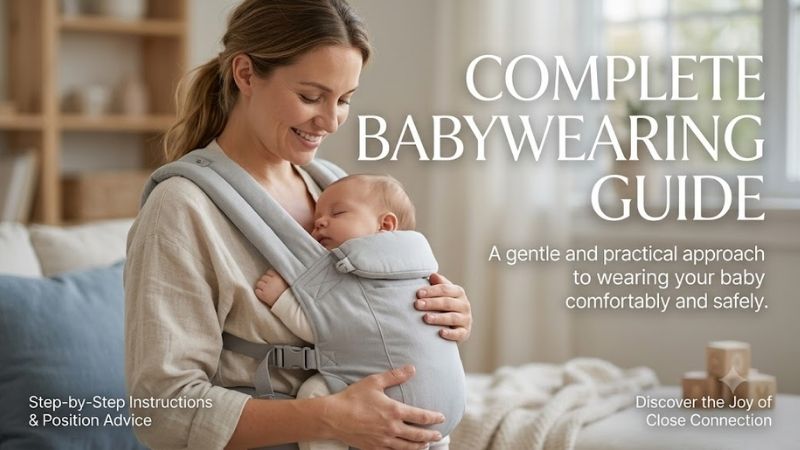
The TICKS Rule for Infant Airway Safety
Newborns lack head and neck muscular control, making them vulnerable to positional asphyxiation if slumped chin-to-chest. Follow the universally recognized TICKS checklist:
- T – Tight: The carrier must be snug enough to hold your baby firmly against your torso. Slack fabric allows the baby to slump, which can restrict their breathing passages.
- I – In View at All Times: You should always be able to glance down and see your baby’s face without opening fabric folds or unbuckling panels.
- C – Close Enough to Kiss: Your infant’s head should rest as close to your chin as comfortable. By tipping your head forward, you should easily kiss the top of their head.
- K – Keep Chin Off Chest: Ensure there is always a space of at least one finger-width beneath your baby’s chin to preserve an open airway.
- S – Supported Back: In an upright carrier, the baby’s back should be supported in its natural convex curve (the gentle “C-spine” shape) with tummy and chest pressed gently against you.
Preventing Hip Dysplasia: The Ergonomic “M-Position”
The International Hip Dysplasia Institute (IHDI) recommends carrying infants in the spread-squat position, commonly referred to as the “M-position” or “jockey position.”
         ( Head )
        /        \
   ( Knee )    ( Knee )    <-- Knees elevated higher than hips
       \___( Bum )___/     <-- Bottom seated deep in fabric
- Thigh Support: The seat base must span from knee-pit to knee-pit (knee-crease to knee-crease) to support the entire femur.
- Knee Elevation: The knees should rest higher than the buttocks, creating an “M” contour when viewed from behind or in front.
- Why It Matters: Allowing an infant’s legs to dangle straight down places abnormal mechanical leverage on the hip socket (acetabulum), increasing the risk of developmental hip dysplasia.
5 Best Ergonomic Baby Carriers Reviewed
Finding the right baby carrier requires balancing ergonomic lumbar support, ease of fastening, and breathable textiles for everyday outings. We evaluated the top five baby carriers across multiple design categories, comparing their safety engineering, ease of cleaning, and long-term versatility from infancy to toddlerhood.
1. Ergobaby Omni Breeze Baby Carrier
The Ergobaby Omni Breeze is an all-in-one soft-structured carrier engineered with lightweight SoftFlex Mesh to optimize airflow during warm weather and long-distance walks.
- Best For: All-around ergonomic versatility and high-breathability daily carry.
- Key Features: Full-coverage SoftFlex Mesh fabric; four carry positions (inward, outward front, hip, back); integrated lumbar support belt; crossable padded shoulder straps; tuck-away UPF 50+ privacy hood; side storage pockets.
- Pros:
- Exceptional airflow keeps both caregiver and baby dry during hot outdoor excursions.
- Dedicated lumbar support pad disperses lumbar shear force evenly across the pelvis.
- Adjusts from newborn ($7\text{ lbs}$) to toddler ($45\text{ lbs}$) without needing a separate infant insert.
- Cons:
- Complex array of sliders, tabs, and buckles requires a learning curve for first-time parents.
- Bulky waist belt padding makes compact diaper-bag storage challenging.
- Use Case: Outdoor family hikes, neighborhood walks, and extended travel trips where parent back comfort is paramount.
- Who It’s For: Active parents looking for a single, durable carrier that supports every stage from hospital discharge to toddlerhood.
2. BabyBjörn Baby Carrier Mini
The BabyBjörn Carrier Mini is a streamlined, two-part front carrier crafted specifically for the physiological proportions of the fourth trimester ($0\text{ to }12\text{ months}$).
- Best For: Fourth-trimester indoor bonding and effortless midnight infant transfers.
- Key Features: Detachable front unbuckling panel; OEKO-TEX Standard 100 certified 3D jersey fabric; adjustable head and neck buckle supports; front-inward and front-outward carrying modes.
- Pros:
- Unlatches entirely at the front, letting you lay a sleeping infant into a crib without waking them.
- Ultra-soft cotton and jersey blends protect delicate newborn facial skin from chafing.
- Minimal webbing straps eliminate waistline pressure points after cesarean deliveries.
- Cons:
- Lacks a load-bearing waist belt, directing all infant weight solely to caregiver shoulders.
- Upper weight limit caps at $24\text{ lbs}$, necessitating an upgrade once the child grows.
- Use Case: Soothing colicky newborns around the house while tackling basic household tasks.
- Who It’s For: New parents seeking a lightweight, hassle-free carrier designed exclusively for the first year of life.
3. Boba Classic Baby Wrap
The Boba Classic Wrap provides continuous custom-molded swaddling using a durable blend of $95\%$ French terry cotton and $5\%$ spandex for supportive elasticity.
- Best For: Newborn skin-to-skin contact, premature infant bonding, and budget-friendly comfort.
- Key Features: 5-meter continuous wrap textile; dual-stretch fabric blend; universal tying method; hands-free nursing capability; machine washable material.
- Pros:
- Custom contours to any parent body type without pressure points or rigid buckle edges.
- Spandex retention prevents the fabric from sagging loose under continuous baby weight.
- Allows discreet on-the-go breastfeeding and soothing chest-to-chest contact.
- Cons:
- Long fabric tails easily drag across dirty floors or parking lots during parking-lot wrapping.
- Dense knit weave can become warm during mid-summer humidity.
- Use Case: Calm skin-to-skin newborn snuggling and hands-free desk work while working from home.
- Who It’s For: Caregivers who appreciate natural fabric wraps and desire custom ergonomic support without plastic clips.
4. Baby Tula Explore Baby Carrier
The Baby Tula Explore offers ergonomic front-outward facing capabilities alongside traditional inward and back carries, distinguished by artistic prints and padded leg openings.
- Best For: Ergonomic outward-facing exploration and expressive textile designs.
- Key Features: Three-width adjustable base settings; two-height neck pillow; padded shoulder straps and wide waistband; front-inward, front-outward, and back-carry modes ($7\text{–}45\text{ lbs}$).
- Pros:
- Unique button-adjustment base maintains the IHDI-approved M-position even when baby faces outward.
- Generous padded leg openings prevent fabric edge marks on chunky baby thighs.
- Wide, structured waistband stabilizes heavy toddler carries over long walking sessions.
- Cons:
- Shoulder straps do not cross in an “X” configuration on the back, limiting fit preference.
- Canvas weave breathes less effectively than technical open-cell sports mesh.
- Use Case: Trips to zoos, family gatherings, and community events where an older infant wants visual stimulation.
- Who It’s For: Parents who want the developmental fun of outward-facing carry without sacrificing healthy pelvic ergonomics.
5. Nalakai Luxury Ring Sling
The Nalakai Luxury Ring Sling pairs sustainable bamboo and unbleached linen with matte aluminum rings to deliver rapid hip and front carries for fast daily errands.
- Best For: Quick grocery trips, hip carrying toddlers, and hot-weather climates.
- Key Features: Custom blend of bamboo fiber and French flax linen; seamless aluminum rings; wide shoulder drape fabric; built-in UV-protective tail.
- Pros:
- Bamboo-linen blend feels naturally cooling and wicks moisture rapidly in humid weather.
- Compact footprint folds flat into a purse or compact diaper bag compartment.
- The flowing tail doubles as a sunshade, nursing cover, or lightweight blanket.
- Cons:
- Asymmetrical single-shoulder carry leads to upper-body fatigue during long walks.
- Threading the rings properly demands manual dexterity and patience to master.
- Use Case: Swift grocery store transitions, doctor office visits, and carrying energetic toddlers who frequently demand up-and-down mobility.
- Who It’s For: Parents on the go who prioritize fast loading, packability, and breathable organic fabrics.
Baby Carrier Buying Guide: How to Choose
Navigating the baby carrier market becomes straightforward when you evaluate structural engineering against your lifestyle routines. Consider these four critical buying pillars to ensure your carrier provides optimal pediatric spine support, seamless adjustability, and lasting comfort through every developmental growth spurt.
1. Carrier Type and Architecture
- What: The physical configuration, categorized into Soft-Structured Carriers (SSCs), stretchy wraps, woven wraps, ring slings, and meh dais.
- Why: Structure determines setup speed, weight distribution balance, and parent learning curve.
- Who: SSCs serve parents wanting fast clip-and-go convenience; wraps serve newborns requiring skin-to-skin swaddling; slings serve busy parents needing fast in-and-out hip carry.
- Trade-off: Structured carriers fasten quickly with buckles but add bulk in luggage, whereas wraps pack down small but demand tying practice.
2. Weight Capacity and Infant Lifecycle
- What: The certified minimum and maximum weight ratings, along with newborn neck insert requirements.
- Why: Utilizing a carrier below its minimum weight threshold risks infant suffocation, while exceeding maximum weight strains seams and causes severe back fatigue.
- Who: Parents seeking a one-and-done solution need a $7\text{–}45\text{ lb}$ range; parents prioritizing newborn comfort often choose dedicated $7\text{–}25\text{ lb}$ mini carriers.
- Trade-off: Broad lifespan carriers ($7\text{–}45\text{ lbs}$) require ongoing mechanical adjustments via snaps or sliders, while baby-sized models offer simpler setups but must be replaced by month twelve.
3. Fabric Breathability and Climate Control
- What: Textile composition, ranging from multi-layered cotton canvas to 3D air-mesh and linen-bamboo blends.
- Why: Trapped heat between parent and child raises core body temperature and leads to infant fussiness and sweat rash.
- Who: Caregivers in hot, humid climates or those who run warm require breathable synthetic technical mesh or moisture-wicking linen.
- Trade-off: Mesh fabrics offer superior temperature regulation but feel less soft against bare skin compared to brushed organic cotton wraps.
4. Adjustability and Caregiver Sharing
- What: Webbing adjustability, crossable shoulder straps, and waistband circumference range.
- Why: Multiple caregivers of differing heights and builds often share one primary infant carrier throughout the week.
- Who: Families with partners of divergent heights or body structures need dual-adjust sliders and wide waistbands.
- Trade-off: Extensive adjustment webbing accommodates all family members but leaves long dangling straps that require careful roll-up elastic management.
Frequently Asked Questions
Parents frequently have questions about safety regulations, usage timelines, and developmental postures when beginning their babywearing journey. Below are clear, pediatric-backed answers to the most common questions regarding newborn carriage, hip protection, and healthy carrier habits for active daily living routines.
When can I start babywearing my newborn?
You can start babywearing on day one, provided your full-term baby meets the carrier’s minimum weight rating (typically $7\text{–}8\text{ lbs}$) and has no medical complications. For low-birth-weight babies or premature infants, consult your pediatrician before using fabric wraps to verify adequate airway stability and muscular tone.
How long can a baby safely stay in a carrier at one time?
Most pediatric physical therapists recommend limiting continuous carrier sessions to around two hours. Pausing every two hours allows you to feed, change, and give your baby floor tummy time, which relieves localized skin pressure and encourages natural motor skill progression.
When can a baby face forward in a baby carrier?
Babies should only face outward once they demonstrate complete, steady head and neck control, which generally occurs around five to six months of age. Furthermore, their chin must clear the top of the carrier panel, and outward carrying should be limited to 20–30 minutes at a time to prevent sensory overstimulation and lower back sway.
Can babywearing cause back pain for the parent?
Carrying an infant can trigger upper back or lumbar pain if the waistband sits too low or shoulder straps are slack. Fastening the waistband high around your natural waist (above your hips) and pulling straps tight enough to anchor the baby’s center of mass flush against your chest prevents spinal strain.
Conclusion
Mastering safe infant carriage transforms your parenting routine into a calm, hands-free journey filled with deep emotional connection. By choosing an ergonomic carrier tailored to your baby’s weight and honoring healthy hip alignment, you protect your body while offering your little one the ultimate warmth, security, and developmental support.






Write Your Review
No reviews yet. Be the first to share your experience!