
Key takeaways
- Car Seats: Must meet Federal Motor Vehicle Safety Standard (FMVSS) 213 and carry clear NHTSA rating documentation.
- Sleep Spaces: Must comply with ASTM International standards (ASTM F2194 for bassinets, ASTM F1169 for full-size cribs) and 16 CFR Part 1218 / 1219 CPSC mandatory regulations.
- Chemical Safety: Look for GREENGUARD Gold or OEKO-TEX Standard 100 certifications to confirm low volatile organic compound (VOC) emissions in mattresses, fabrics, and plastics.
What's inside
A newborn gear comparison helps parents cut nursery costs and avoid registry overwhelm by vetting baby essentials against four pillars: safety crash-test certifications, usable weight limits, room clearance, and easy cleaning. Use this step-by-step guide to compare top car seats, strollers, and cribs before buying.
Step-by-Step: How to Structure a Newborn Gear Comparison
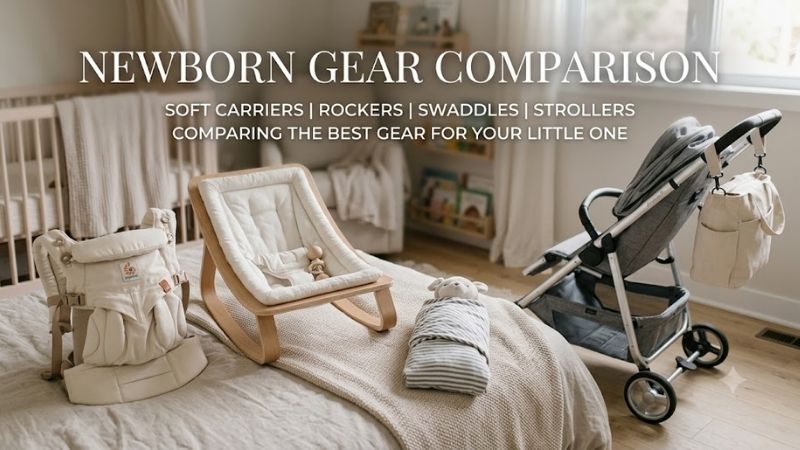
Building a reliable newborn gear comparison requires prioritizing safety certifications, physical dimensions, and practical longevity over flashy marketing. When you benchmark infant gear across standardized functional metrics, you eliminate emotional purchases and focus your budget on certified gear that simplifies daily parenting routines.
Step 1: Establish Non-Negotiable Safety Baselines
Never compare baby gear on aesthetics or secondary luxury features until safety credentials are verified. Check for mandatory approvals:
- Car Seats: Must meet Federal Motor Vehicle Safety Standard (FMVSS) 213 and carry clear NHTSA rating documentation.
- Sleep Spaces: Must comply with ASTM International standards (ASTM F2194 for bassinets, ASTM F1169 for full-size cribs) and 16 CFR Part 1218 / 1219 CPSC mandatory regulations.
- Chemical Safety: Look for GREENGUARD Gold or OEKO-TEX Standard 100 certifications to confirm low volatile organic compound (VOC) emissions in mattresses, fabrics, and plastics.
Step 2: Calculate Usable Lifespan and Weight Limits
Products that seem inexpensive upfront often carry strict weight cutoffs that force an early secondary purchase.
- Compare the lower threshold (e.g., whether an infant car seat supports low birth-weight infants down to 4 lbs without buying aftermarket inserts).
- Examine the upper threshold (e.g., an infant car seat rated to 35 lbs and 32 inches accommodates infants through 12–16 months, whereas a 30-lb/30-inch model requires replacement around month 9).
- Calculate your true Cost Per Month: Divide the retail price by the expected months of safe utility.
Step 3: Assess Physical Fit Within Your Environment
A top-rated product that does not fit your daily footprint is a liability:
- Vehicle Compatibility: Measure your car’s back seat depth from backrest to front seat. Large car seat shells can force front passengers into the dashboard.
- Doorway and Elevator Clearance: Check stroller chassis widths (under 24 inches is optimal for urban sidewalks, standard interior doorways, and public transit turns).
- Folded Dimensions: Ensure the stroller folds compactly enough to leave usable trunk space for groceries and diaper bags.
Step 4: Audit Cleaning and Maintenance Protocols
Newborn gear encounters daily spit-up, reflux, and diaper blowouts. When comparing two similar models, review the care manual:
- Prioritize machine-washable, easily removable fabrics over spot-clean-only textiles.
- Check whether harness straps require manual re-threading through rear slots or feature a smooth, one-handed no-rethread harness adjustment.
Core Category Face-Off: Comparing High-Impact Essentials
Navigating primary gear categories requires examining how competing models perform in everyday scenarios. By contrasting car seats, strollers, and sleep spaces side-by-side, you can clearly identify functional trade-offs between portability, long-term durability, and overall physical footprint within your home or vehicle.
+---------------------------------------------------------------------------------------------------------+
|                                    GEAR ARCHITECTURE COMPARISON MATRIX                                  |
+----------------------+---------------------------+---------------------------+--------------------------+
| CATEGORY             | OPTION A                  | OPTION B                  | OPTIMAL SCENARIO         |
+----------------------+---------------------------+---------------------------+--------------------------+
| Infant Car Seats     | Dedicated Infant Capsule  | All-In-One Convertible    | Infant capsule wins for  |
|                      | (e.g., Chicco KeyFit 35)  | (e.g., Graco 4Ever DLX)   | mobility & stroller click|
+----------------------+---------------------------+---------------------------+--------------------------+
| Stroller Systems     | Modular Full-Size System  | Ultra-Compact Travel      | Modular for daily walking|
|                      | (e.g., UPPAbaby Cruz V2)  | (e.g., Babyzen YOYO2)     | Travel for flights/subway|
+----------------------+---------------------------+---------------------------+--------------------------+
| Newborn Sleeping     | Bedside Bassinet          | Direct Full-Size Crib     | Bassinet for room-share  |
|                      | (e.g., HALO BassiNest)    | (e.g., DaVinci Kalani)    | Crib for nursery budget  |
+----------------------+---------------------------+---------------------------+--------------------------+
| Babywearing          | Structured Ergonomic      | Fabric Wrap / Ring Sling  | Structured for back support|
|                      | (e.g., Ergobaby Omni 360) | (e.g., Solly Baby Wrap)   | Wrap for fourth-trimester|
+----------------------+---------------------------+---------------------------+--------------------------+
1. Infant Car Seat vs. All-in-One Convertible Car Seat
- Dedicated Infant Car Seat: Weighs between 9 and 11 pounds (carrier only). It docks into an in-car stay-in-place base and clicks directly onto stroller chassis via adapters. Crucial for transferring a sleeping baby without disturbing them. However, it is retired after roughly 12 to 15 months.
- All-In-One Convertible Seat: Stays permanently installed in your vehicle. It accommodates children from 4 lbs up to 100+ lbs in booster mode. While it saves substantial money by eliminating a secondary seat, you forfeit the ability to carry your baby in a lightweight capsule or use click-in travel systems.
2. Full-Size Modular Stroller vs. Compact Lightweight Stroller
- Modular Stroller: Equipped with all-wheel suspension, large puncture-proof polyurethane tires, a high-capacity storage basket (holding up to 25–30 lbs), and reversible seating (parent-facing or forward-facing). The trade-off is overall weight (21–27 lbs) and larger folded bulk.
- Compact Stroller: Weighs between 13 and 16 lbs and fits into airplane overhead bins. However, smaller wheels struggle over grass, gravel, and cracked pavements, and newborn compatibility usually requires purchasing separate bassinet attachments.
3. Bedside Swivel Bassinet vs. Full-Size Crib
- Bassinet: Sits directly alongside your mattress, enabling immediate post-delivery recovery access for nighttime feeds without standing up. The critical limitation is its brief 4- to 6-month lifespan (must be discontinued once baby rolls or pushes up).
- Full-Size Crib: Invests in a sleep surface lasting from birth through age 4 (with toddler rail conversions). However, room-sharing during the AAP-recommended first 6 months can be physically challenging if the nursery crib does not fit inside your master bedroom.
Top 5 Newborn Gear Contenders Evaluated
Evaluating top-tier baby gear requires inspecting real engineering, verified certifications, and true usability. Below, we compare five standard-setting baby products across critical safety metrics, long-term utility, and practical limitations so you can invest with clarity and avoid common first-time buyer regrets.
+------------------------------------------------------------------------------------+
|                         RECOMMENDED GEAR PICKS AT A GLANCE                         |
+------------------------------------+------------------+----------------------------+
| PRODUCT                            | CATEGORY         | BEST FOR                   |
+------------------------------------+------------------+----------------------------+
| Chicco KeyFit 35 Infant Car Seat   | Car Travel       | Safe Base Installation     |
| UPPAbaby Cruz V2 Stroller          | Daily Transport  | Urban Versatility          |
| HALO BassiNest Swivel Sleeper 3.0  | Safe Sleep       | C-Section & Night Feeds    |
| Ergobaby Omni 360 Carrier          | Babywearing      | Long-Term Lumbar Support   |
| Newton Baby Breathable Mattress    | Crib Sleeping    | Maximum Airflow & Wash     |
+------------------------------------+------------------+----------------------------+
1. Chicco KeyFit 35 Infant Car Seat
- Best For: Foolproof vehicle base installation and extended rear-facing fit.
- Key Features: Integrated anti-rebound bar, SuperCinch force-multiplying LATCH tightener, no-rethread harness integrated with headrest, extended 32-inch and 35-lb limits.
- Pros:
- Anti-rebound bar enhances structural stability and provides an additional 1.5 inches of rear-facing legroom.
- SuperCinch system allows parents of any strength to achieve an immovable installation (under 1 inch of play).
- Smooth no-rethread harness eliminates the hassle of taking straps apart as your newborn grows.
- Cons:
- Carrier weight is roughly 10 lbs, which feels heavy when paired with a growing 6-month-old.
- Canopy fabric can snag on the carry handle if rotated too quickly.
- Analysis:
- Feature: Integrated anti-rebound bar on the stay-in-car base.
- Meaning: A rigid steel-reinforced brace that contacts the vehicle backrest.
- Benefit: Reduces rotational forces and rebound movement by up to 40% during a rear impact.
- Limitation: Extends the overall base depth slightly in compact vehicle back seats.
- Use Case: Primary vehicle installation for daily commuting and seamless stroller travel system transfers.
- Who It’s For: Parents who prioritize clinical installation precision and want maximum rear-facing longevity before moving to a convertible seat.
2. UPPAbaby Cruz V2 Stroller
- Best For: All-around daily modular strolling without the excessive bulk of double strollers.
- Key Features: Dual-action rear suspension, independent front-wheel shocks, reversible toddler seat, extra-large 30-lb cargo basket, compact standing fold.
- Pros:
- Puncture-proof polyurethane wheels glide effortlessly over rough sidewalks, grass, and curbs.
- Deep extendable UPF 50+ canopy with zip-out mesh ventilation panels.
- Direct car seat compatibility with UPPAbaby Mesa or other leading brands using simple adapters.
- Cons:
- Premium price point represents a significant nursery budget investment.
- Requires purchasing an Infant SnugSeat insert or bassinet accessory for use under 3 months.
- Analysis:
- Feature: Dual-action all-wheel suspension system with aluminum chassis.
- Meaning: Mechanical springs operate independently on both axle assemblies.
- Benefit: Absorbs road vibrations, ensuring smooth rides that prevent jostling fragile newborn necks.
- Limitation: Total weight of 25.5 lbs requires two hands for vehicle trunk loading.
- Use Case: Daily walking routines, city errands, and long-term outings across suburban and urban terrain.
- Who It’s For: Caregivers seeking an everyday modular stroller that balances premium suspension with an easy maneuverable frame.
3. HALO BassiNest Swivel Sleeper 3.0
- Best For: Bedside room-sharing, night feeds, and mothers recovering from childbirth or C-sections.
- Key Features: 360-degree rotation swivel arm, patented lowering bedside wall with lock, breathable mesh side walls, stable low-profile four-point base.
- Pros:
- Swivels completely over the adult bed mattress, positioning your infant right beside you.
- Retractable side wall enables parents to lift the baby without sitting upright or straining abdominal muscles.
- Detachable nest component allows portable nap usage around the living area.
- Cons:
- Wide leg footprint can cause tripping hazards in small bedrooms.
- Discontinued once baby reaches 20 lbs or starts pushing up on hands and knees.
- Analysis:
- Feature: Spring-loaded lowering front wall.
- Meaning: Front barrier compresses downward under gentle forearm pressure and locks automatically.
- Benefit: Eliminates painful bending and spinal torque during 2:00 AM nursing sessions.
- Limitation: Mattress surface is intentionally firm and thin to satisfy strict pediatric sleep safety rules.
- Use Case: Dedicated master bedroom bedside sleep station for the initial 3 to 5 months.
- Who It’s For: Postpartum parents prioritizing rapid physical access to their newborn during recovery and night feeding routines.
4. Ergobaby Omni 360 All-Position Baby Carrier
- Best For: Ergonomic hands-free babywearing from 7 lbs up to 45 lbs without extra inserts.
- Key Features: Padded lumbar support belt, crossable shoulder straps, ergonomic “M-shape” hip positioning, tuck-away UPF baby hood.
- Pros:
- Certified “Hip Healthy” by the International Hip Dysplasia Institute across all carry modes.
- Adjusts via internal hook-and-loop sliders from newborn width up to toddler sizing without purchasing separate inserts.
- Padded lumbar belt disperses child weight evenly across the parent’s pelvis, preventing lower back fatigue.
- Cons:
- Bulkier structured waistband takes practice to adjust when switching between differently sized caregivers.
- Learning curve for solo rear-clip fastening.
- Analysis:
- Feature: Sliding seat width tabs on an ergonomic pelvic bucket seat.
- Meaning: Deep seat base supports the infant’s thighs from knee-to-knee.
- Benefit: Prevents leg dangling and supports the natural infant spinal curve (“C-spine”).
- Limitation: Structured cotton canvas feels warm during humid summer outdoor walks.
- Use Case:* Hands-free multitasking at home, grocery runs, and outdoor walks where strollers are impractical.
- Who It’s For: Parents wanting one durable, heavy-duty carrier that supports every developmental stage without buying secondary hardware.
5. Newton Baby Breathable Crib Mattress
- Best For: 100% breathable crib sleeping and complete core hygiene.
- Key Features: Wovon polymer core (90% air by volume, 10% food-grade polymer), zero polyurethane foam, removable spacer cover, fully washable core.
- Pros:
- Air passes completely through the mattress core, drastically reducing suffocation risk if baby rolls face-down.
- Contains no off-gassing foams, toxic chemical adhesives, or chemical flame retardants.
- The entire core can be washed down with a showerhead or garden hose to eliminate allergens, mold, and odor.
- Cons:
- Significantly higher initial cost than conventional coil or foam mattresses.
- Requires line-drying the spacer cover and air-drying the core before reassembly.
- Analysis:
- Feature: Open-matrix Wovon polymer construction.
- Meaning: Eliminates traditional polyurethane foam layers and rigid inner springs.
- Benefit: Delivers optimal pediatric firmness while maintaining uninterrupted convective airflow.
- Limitation: Feels firmer to adult touch than pillowtop mattresses, though infants require strict firmness.
- Use Case: Standard-size full crib setup from infant birth through toddler bed transition.
- Who It’s For: Caregivers who want the peace of mind of a fully breathable sleep surface to ease rollover anxiety during infant sleep transitions.
Buying Guide: The Four-Pillar Gear Evaluation Method
Selecting the right nursery and travel gear demands an objective assessment framework rather than impulse buying based on aesthetic trends. Applying our four-pillar criteria allows you to isolate what truly matters for your newborn, understand genuine engineering trade-offs, and safeguard your household budget over time.
Pillar 1: Verified Structural Safety (The Non-Negotiable)
- What: Check for JPMA, CPSC, and ASTM certifications, plus independent third-party crash test results or GREENGUARD Gold low-emission seals.
- Why: Certified hardware guarantees that materials are non-toxic, plastics do not shatter under impact stress, and crib slats meet strict spacing tolerances (under $2\frac{3}{8}\text{ inches}$) to eliminate entrapment risks.
- Who: Every parent purchasing cribs, car seats, playards, and strollers.
- Trade-off: Rigorous laboratory testing increases retail cost, but discount uncertified imported models risk severe material failure, hidden lead content, and sudden safety recalls.
Pillar 2: Mechanical Reliability Over High-Tech Features
- What: Prioritize solid mechanical engineering (e.g., physical bubble leveling indicators, steel anti-rebound bars, secure latching clips) over Wi-Fi-dependent mobile apps.
- Why: High-tech baby gadgets often experience software disconnects, battery drain, and false alarms that induce parental panic, while mechanical safety features work flawlessly every time without updates.
- Who: Families seeking dependable, low-stress daily routines.
- Trade-off: High-tech devices compile historical physiological data, but mechanical safety fundamentals save lives reliably without needing a power outlet.
Pillar 3: Multi-Stage Adaptability and Longevity
- What: Evaluate whether the product incorporates modular expansion (e.g., car seats with higher height limits, strollers that accept glider boards, convertible cribs).
- Why: Babies outgrow single-stage items in 3 to 6 months; choosing gear with higher physical thresholds delays secondary purchases and cuts overall spending.
- Who: Budget-conscious families planning for multiple children or long-term utility.
- Trade-off: Multi-stage gear may feature a slightly larger folded footprint or heavier base construction to support greater weight capacities over time.
Pillar 4: Ergonomics and Daily Maneuverability
- What: Test the product’s daily ergonomics: one-handed folding mechanisms, adjustable handlebar heights, accessible harness adjusters, and intuitive buckles.
- Why: Parents handle gear while sleep-deprived, nursing, or holding their infant; complex mechanisms cause physical frustration and increase the risk of improper use.
- Who: Primary caregivers managing frequent solo trips, errands, and stairs.
- Trade-off: Ultra-lightweight gear offers effortless carrying but may feature smaller wheels and less rugged suspension on uneven surfaces.
Frequently Asked Questions
First-time parents often face conflicting advice when researching baby gear comparisons across popular retail platforms. The clear answers below resolve key purchasing dilemmas regarding lifespan, safety standards, and practical product selection so you can prepare your baby registry with absolute clarity and peace of mind.
What is the most common mistake made during a newborn gear comparison?
The most widespread mistake is prioritizing cosmetic aesthetics or brand prestige over functional compatibility with your lifestyle. Parents often purchase oversized travel systems that do not fit into their vehicle trunks or buy complex crib bumpers and sleep positioners that violate AAP safe-sleep rules. Focus first on certified safety standards, physical dimensions, and daily ergonomics.
How do I know if an infant car seat will fit in my vehicle?
Measure the front-to-back distance of your vehicle’s rear seat, paying attention to the space between the backrest and the back of the front seat when adjusted for a passenger. Compare this with the installed depth specifications of the car seat base. Many car seat manufacturers and child passenger safety technicians (CPST) provide online vehicle fit guides that detail vehicle compatibility by model and year.
Is an expensive stroller always safer than a budget model?
No. All strollers legally sold in the United States must meet identical mandatory CPSC safety requirements (16 CFR Part 1227) and ASTM standards. Higher price tags reflect premium features such as advanced all-wheel suspension, durable aluminum frame construction, puncture-proof wheels, leatherette accents, and modular expansion capabilities—not a higher baseline safety score.
Should I buy an infant car seat or jump straight to a convertible car seat?
If you plan to walk frequently with a stroller or need to transport your sleeping baby between vehicle and home without waking them, a dedicated infant car seat capsule is unmatched for convenience during the first year. If your budget is strictly constrained and you plan on babywearing for errands, starting with an infant-compatible convertible car seat saves substantial money over the long haul.
When should I stop using a bedside bassinet?
Stop using a bedside bassinet the moment your baby reaches the manufacturer’s weight limit (typically 15–20 lbs) or shows signs of rolling over, whichever occurs first. At that point, the shallow sidewalls become a tipping and fall hazard, requiring an immediate transition to an empty, CPSC-approved full-size crib or playard.
Conclusion
Mastering your newborn gear comparison comes down to filtering marketing hype through the rigorous lenses of certified safety, daily ergonomics, and realistic longevity. By prioritizing structural essentials like a foolproof car seat base, a breathable sleep surface, and an adaptable stroller before indulging in novelty gadgets, you establish a functional, uncluttered nursery environment. Review your vehicle dimensions, map out your daily transit routines, and select versatile gear that grows seamlessly alongside your child from newborn days to active toddler milestones.










Write Your Review
No reviews yet. Be the first to share your experience!