
Key takeaways
- Choose a 4-in-1 or 5-in-1 convertible crib that transitions into a toddler bed and daybed.
- Opt for a convertible car seat suitable from $5\text{ lbs}$ up to $40\text{ lbs}$ ($2.3\text{ kg}$ to $18\text{ kg}$) or more, bypassing short-lived infant carrier buckets.
- Select a portable playard equipped with an infant bassinet insert to serve as a bedside sleeper, changing surface, and daytime playpen in one footprint.
What's inside
Preparing for a newborn is often portrayed as an overwhelming, budget-busting endeavor, but curating baby essentials under budget is entirely achievable without compromising on infant safety or everyday comfort. The baby care industry frequently leverages parental anxiety to market expensive single-use gadgets, luxury finishes, and non-essential nursery accessories that infants outgrow in mere weeks. In reality, newborns require only a modest collection of reliable, safety-tested gear centered on secure sleep, safe transportation, clean feeding, and basic hygiene. By prioritizing multi-functional furniture, identifying certified affordable gear, and skipping commercial fluff, parents can easily save hundreds of dollars while providing exceptional care for their growing baby.
How to Build a Complete Baby Setup on a Budget: Step-by-Step Guide
Preparing for a newborn does not require draining your savings account or buying every gadget in nursery catalogs. By focusing strictly on safety-certified basics and versatile multi-stage gear, parents can build an effective nursery setup on a modest budget without compromising on everyday comfort, developmental support, or durability.
Step 1: Divide Purchases into Non-Negotiable Core Categories
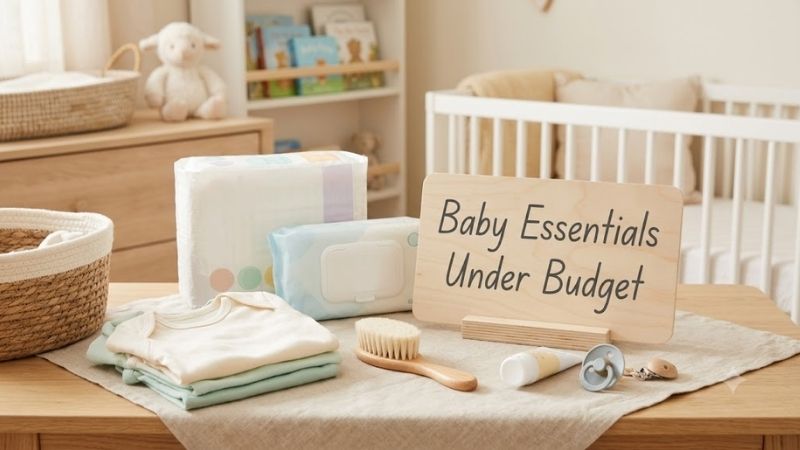
Cut through retail clutter by allocating your budget across three primary lifelines: safe sleep, secure travel, and sanitary care. Everything outside these categories—such as wipe warmers, designer nursery bedding, and dedicated shoe collections—is optional luxury. Focusing your funds strictly on a certified crib, an approved car seat, and basic clothing prevents budget leakage during early nesting phases.
Step 2: Prioritize Multi-Stage and Convertible Equipment
Avoid buying items engineered for a single development window lasting only two to three months. Instead, choose convertible gear that transitions alongside your child:
- Choose a 4-in-1 or 5-in-1 convertible crib that transitions into a toddler bed and daybed.
- Opt for a convertible car seat suitable from $5\text{ lbs}$ up to $40\text{ lbs}$ ($2.3\text{ kg}$ to $18\text{ kg}$) or more, bypassing short-lived infant carrier buckets.
- Select a portable playard equipped with an infant bassinet insert to serve as a bedside sleeper, changing surface, and daytime playpen in one footprint.
Step 3: Enforce Strict Secondhand Safety Boundaries
Purchasing pre-owned gear drastically lowers costs, but specific baby gear must always be purchased brand new for child safety:
- Always Buy New: Car seats (due to hidden structural stress, crash history, or expired materials) and crib mattresses (to ensure sanitary firmness and prevent suffocation hazards).
- Safe to Buy Used: Wooden dressers, strollers, baby carriers, clothing bundles, and hard plastic toys, provided they comply with current safety standards and have no active recalls.
Step 4: Streamline Wardrobes with the “Capsule” Method
Babies grow rapidly, often outgrowing newborn garments in less than four weeks. Resist buying elaborate multi-piece outfits. Instead, build a minimalist capsule wardrobe consisting of six to eight zip-up sleepers, six plain cotton bodysuits, three pairs of soft pants, and two swaddle blankets. Buying these bundles in neutral multipacks reduces laundry demands and cuts clothing costs by up to $60\%$.
Step 5: Stack Registry Completion Discounts and Bulk Deals
Create online baby registries across major platforms even if you do not plan to host a baby shower. Most major retailers offer a $15\%$ completion discount on remaining eligible items between $60$ days prior to and $180$ days after your baby’s due date. Combine these completion discounts with subscribe-and-save programs for diapers and wipes to lock in wholesale-level unit pricing.
Top 5 Baby Essentials Under Budget: Tested Practical Picks
Finding reliable nursery equipment on a modest budget requires looking for multi-stage utility and proven safety certifications. We evaluated budget-conscious baby essentials that offer long-term durability and functionality without inflated designer markups. Here are five standout essentials that maximize value for practical parents.
1. Multi-Functional Sleeper: Graco Pack ‘n Play On The Go Playard
- Best For: All-in-one bedside sleep, daytime naps, and travel containment.
- Key Features: Full-sized removable infant bassinet, folding feet and wheels, push-button compact fold, breathable perimeter mesh, included carry bag.
- Pros:
- Eliminates the need to buy a standalone bedside bassinet and separate travel crib.
- Sturdy steel frame sets up in seconds without tools.
- Meets all mandatory federal safety standards for infant sleep surfaces.
- Cons:
- The included mattress pad is thin and firm, requiring specially fitted playard sheets.
- Use Case: Serving as a primary newborn bedside sleeper for the first few months, then converting into a secure toddler travel crib.
- Who It’s For: Parents wanting an ultra-versatile, low-cost sleep and play station that saves hundreds compared to standalone wooden bassinets.
2. Convertible Car Seat: Cosco Scenera NEXT Convertible Car Seat
- Best For: Ultra-affordable, lightweight vehicle and airline safety.
- Key Features: Rear-facing capacity from $5\text{ lbs}$ to $40\text{ lbs}$, forward-facing capacity from $22\text{ lbs}$ to $40\text{ lbs}$, side-impact protection, removable machine-washable seat pad, FAA certified for aircraft travel.
- Pros:
- Sells for a fraction of the cost of premium convertible car seats while passing identical federal crash tests.
- Extremely lightweight (under $10\text{ lbs}$), making vehicle swaps and airport travel effortless.
- Compact footprint fits easily in three-across configurations in smaller backseats.
- Cons:
- Features basic manual rethread harness straps rather than a no-rethread glide system.
- Use Case: Providing long-lasting, certified vehicle restraint from hospital discharge through the toddler years.
- Who It’s For: Budget-conscious families seeking uncompromising crash-test safety without paying for heavy metal frames or luxury fabrics.
3. Ergonomic Baby Carrier: Infantino Flip Advanced 4-in-1 Carrier
- Best For: Hands-free infant soothing and mobility without costly wraps.
- Key Features: Four carrying positions (facing-in narrow seat, facing-in wide seat, facing-out, and back carry), adjustable head support, convertible ergonomic “M” seat, machine-washable Wonder Cover bib.
- Pros:
- Accommodates infants from $8\text{ lbs}$ to $32\text{ lbs}$ without requiring expensive newborn insert accessories.
- Structured lumbar belt and padded shoulder straps distribute baby weight evenly.
- Simple buckle system allows fast, solo adjustments compared to complex fabric wraps.
- Cons:
- Lacks storage pockets for parent essentials like keys or smartphones.
- Use Case: Keeping fussy newborns settled and upright against your chest while completing household tasks or navigating stores.
- Who It’s For: Parents seeking an ergonomic, multi-position baby carrier at a fraction of the price of boutique brand alternatives.
4. Space-Saving Feeding Seat: Fisher-Price Healthy Care Deluxe Booster Seat
- Best For: Compact feeding support that replaces bulky standalone high chairs.
- Key Features: Straps securely to standard dining chairs, three height adjustments, three-position tummy adjustments, snap-on dishwasher-safe feeding tray with cup holder.
- Pros:
- Replaces $100\text{+}$ freestanding high chairs while conserving precious dining room floor space.
- Smooth, crevice-free plastic wipes down instantly with zero fabric cushions to wash or stain.
- Folds compactly with a built-in shoulder carry strap for restaurant visits and travel.
- Cons:
- Requires an existing sturdy dining chair with a stable backrest.
- Use Case: Providing an upright, secure feeding platform from first solid purees at six months through toddler self-feeding.
- Who It’s For: Caregivers who prioritize effortless cleaning, small-space efficiency, and budget-friendly feeding gear.
5. Long-Term Sleep Solution: Graco Benton 5-in-1 Convertible Crib
- Best For: Durable, full-sized nursery sleeping that adapts into adulthood.
- Key Features: Greenguard Gold certified for low chemical emissions, solid pine construction, three-position adjustable mattress support base, converts to toddler bed, daybed, and full-size bed.
- Pros:
- Rigorously tested for non-toxic materials, ensuring clean nursery air quality.
- Timeless aesthetic matches any decor and provides a decade of furniture utility.
- Exceptional build quality and structural stability relative to its budget-friendly price point.
- Cons:
- Toddler guardrail and full-size conversion metal frame brackets must be purchased separately.
- Use Case: Anchoring the nursery as a safe, stationary newborn sleep space that expands as your child matures.
- Who It’s For: Families who want a safe, attractive, non-toxic crib designed to eliminate future bed purchases for years to come.
Buying Guide: How to Select Baby Essentials Under Budget
Stretching your baby gear budget requires understanding which design elements protect infant safety and which merely inflate retail pricing. High-end baby brands often market luxury features that add little functional value. Use this structured buying guide to evaluate budget baby essentials before spending your hard-earned household money.
1. Multi-Stage Adjustability & Lifespan
- What to look for: Products engineered with multiple configuration modes, such as convertible car seats, adjustable-height crib bases, and transitional high chairs.
- Why it matters: Equipment designed for a single developmental stage (like infant bouncers or static bassinets) must be replaced every two to four months, multiplying total household costs.
- Who needs this: Budget-conscious parents wanting to make single, decisive purchases that last across multiple developmental milestones.
- Trade-off: Convertible products can occasionally be bulkier than dedicated newborn items, but they provide drastically superior long-term financial return.
2. Mandatory Safety Certifications vs. Aesthetic Extras
- What to look for: Mandatory compliance labels such as JPMA (Juvenile Products Manufacturers Association), ASTM standards, and Greenguard Gold emissions ratings.
- Why it matters: In the United States, budget-priced car seats and cribs must pass the exact same federal safety and impact criteria as models costing ten times as much. Expensive models charge premiums for plush fabrics, magnetic buckles, and designer brand prestige rather than superior baseline safety.
- Who needs this: Every family shopping on a budget who refuses to compromise on verified infant protection.
- Trade-off: You miss out on faux-leather trims and ultra-sleek European styling, but your child receives identical physical safety protection.
3. Ease of Sanitization and Maintenance
- What to look for: Molded plastics, wipe-clean surfaces, and machine-washable fabrics devoid of intricate fabric creases.
- Why it matters: Newborns generate constant spills, diaper blowouts, and spit-up. Budget gear with complex, non-removable fabric covers degrades quickly and breeds bacteria, forcing early replacements.
- Who needs this: Practical caregivers managing daily chores without professional cleaning assistance.
- Trade-off: Smooth plastic furniture looks utilitarian compared to tufted, upholstered furniture, but it cleans in seconds and resists permanent staining.
Frequently Asked Questions About Budget Baby Gear
First-time parents often find budgeting for newborn supplies stressful because retail lists exaggerate what infants actually need. To help you allocate your finances effectively, we answered the most common questions regarding baby gear expenses, nursery trade-offs, and smart shopping habits backed by pediatric safety standards.
How much does a basic newborn setup cost on a tight budget?
A functional, safety-certified newborn setup can easily be achieved for between $\$300$ and $\$500$. By focusing on essentials—a multi-stage playard or convertible crib, a certified budget car seat, basic feeding gear, and wholesale multipacks of clothing and hygiene items—you cover all necessary pediatric care bases without excess debt.
What baby items should you never buy secondhand?
Never buy used infant car seats or crib mattresses. Pre-owned car seats may possess compromised structural integrity from unseen minor crashes, hidden plastic fatigue, or missing recall documentation. Used mattresses can harbor dust mites, allergens, or dangerous indentations that compromise the firm, flat sleep surface required to prevent Sudden Infant Death Syndrome (SIDS).
Is a dedicated diaper pail necessary on a budget?
No. A specialized diaper pail requiring expensive proprietary liner refills is not essential. A standard, lidded $13\text{-gallon}$ step-can lined with inexpensive household trash bags works effectively, especially if wet diapers are bagged in small grocery sacks and emptied daily.
Can a playard safely replace a traditional bassinet?
Yes. Pack ‘n Plays and playards that include a flat, certified infant bassinet attachment meet strict federal sleep surface requirements. They provide an equally safe, pediatrician-approved sleep environment from day one while offering superior long-term portability and travel utility compared to traditional wooden bassinets.
Securing baby essentials under budget is not about skimping on quality or safety; it is about making informed, practical decisions that prioritize functional value over commercial marketing hype. By investing in multi-stage equipment, observing strict safety standards, and bypassing short-lived accessories, you can build a nurturing, safe environment for your baby while keeping your household finances secure.


Write Your Review
No reviews yet. Be the first to share your experience!