
Key takeaways
- Bassinet or Convertible Crib: A bedside sleeper certified to Consumer Product Safety Commission (CPSC) standards. A bassinet offers easy nighttime nursing access, while a convertible crib lasts into toddlerhood.
- Firm Mattress and Fitted Sheets: Exactly 2 to 4 breathable, snug-fitting $100\%$ cotton crib sheets.
- Wearable Blankets and Swaddles: 3 to 4 adjustable velcro swaddles or two-way zip sleep sacks to prevent loose fabric hazards.
- White Noise Machine: Masks household noises, replicating the soothing continuous sounds of the womb.
- Dimmable Nursery Nightlight: Provides gentle, low-lumen amber illumination for midnight diaper changes without interrupting the infant’s melatonin production.
What's inside
Bringing your newborn home requires clarity, not clutter. Navigating endless baby registries often leaves expectant parents overwhelmed with unnecessary gadgets and conflicting advice. This complete newborn essentials checklist cuts through commercial noise to deliver an evidence-based, practical breakdown of what your infant genuinely needs for safe sleep, hygienic diapering, seamless feeding, and comfortable travel. By focusing on verified safety standards and versatile, durable gear, our guide helps you build a calm, functional nursery on any budget without frantic last-minute shopping.
Master Checklist: The Non-Negotiable Newborn Essentials by Category
Preparing your home for a baby can easily feel overwhelming amidst endless retail lists. To eliminate stress, we have organized your core newborn essentials into practical categories, distinguishing immediate necessities from optional luxuries so you invest solely in functional items that deliver everyday support and safety.
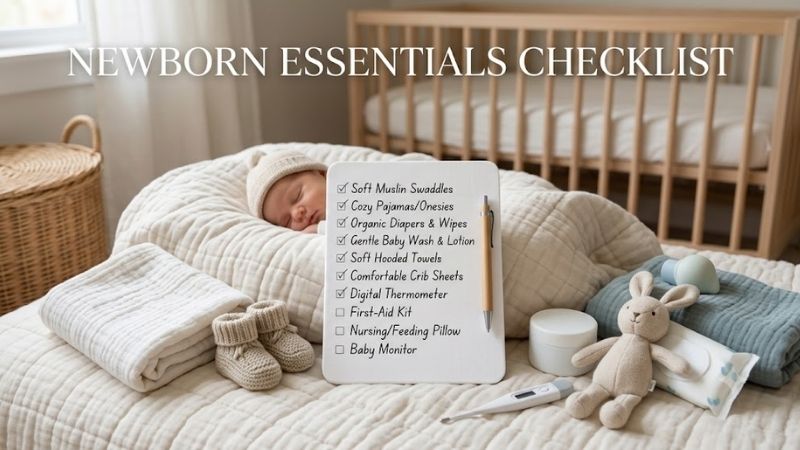
1. Nursery and Safe Sleep Station
According to the American Academy of Pediatrics (AAP), infants must sleep on a separate, flat, firm surface without soft bedding, pillows, bumpers, or loose blankets for their first six months.
- Bassinet or Convertible Crib: A bedside sleeper certified to Consumer Product Safety Commission (CPSC) standards. A bassinet offers easy nighttime nursing access, while a convertible crib lasts into toddlerhood.
- Firm Mattress and Fitted Sheets: Exactly 2 to 4 breathable, snug-fitting $100\%$ cotton crib sheets.
- Wearable Blankets and Swaddles: 3 to 4 adjustable velcro swaddles or two-way zip sleep sacks to prevent loose fabric hazards.
- White Noise Machine: Masks household noises, replicating the soothing continuous sounds of the womb.
- Dimmable Nursery Nightlight: Provides gentle, low-lumen amber illumination for midnight diaper changes without interrupting the infant’s melatonin production.
2. Diapering and Hygiene Gear
A typical newborn goes through 8 to 12 diapers daily. Stocking adequate supplies in advance prevents frantic midnight pharmacy runs.
- Diapers: 1 small pack of Newborn size (for babies under $8\text{ lbs}$) and 2 large economy boxes of Size 1 diapers.
- Sensitive Water Wipes: Fragrance-free, hypoallergenic wipes containing $99\%$ water. Plan for 6 to 8 packs.
- Barrier Diaper Rash Ointment: Petroleum or zinc oxide cream to protect delicate skin against friction and moisture.
- Waterproof Changing Pad and Covers: Wipe-clean polyurethane changing pad with raised safety edges and safety harness straps.
- Odor-Sealing Diaper Pail: A dedicated trash receptacle with airtight rubber gaskets to isolate dirty diaper odors inside living areas.
3. Feeding and Nursing Supplies
Whether you choose breastfeeding, formula feeding, or a hybrid combination, having the right ergonomic tools makes cluster-feeding manageable.
- Anti-Colic Baby Bottles: 4 to 6 small (4-ounce) bottles equipped with slow-flow (Stage 1) nipples to minimize trapped air bubbles.
- Burp Cloths: 8 to 12 ultra-absorbent multi-layer muslin cloths for spit-ups and dribbles.
- Bottle Cleaning Brush: Specialized brush with flexible silicone bristles and an integrated nipple-tip cleaner.
- Breast Pump and Milk Storage Bags: A hospital-grade double electric pump (frequently covered via insurance) and pre-sterilized storage bags.
- Ergonomic Nursing Pillow: Firm wraparound cushion supporting infant latch posture while relieving parental neck and back tension.
- Infant Formula (Emergency Backup): Even breastfeeding parents benefit from keeping one sealed container of gentle, stage-1 infant formula on standby.
4. Bathing and Grooming Essentials
Newborns require sponge baths until their umbilical cord stump falls off (typically 1 to 3 weeks postpartum). Thereafter, two to three baths per week suffice.
- Infant Bathtub with Mesh Sling: An ergonomic tub with an inclined newborn support mesh to keep slippery infants safely elevated above water.
- Gentle Tear-Free Wash: Fragrance-free, dermatologist-tested 2-in-1 hair and body cleanser.
- Hooded Baby Towels & Washcloths: 2 soft hooded towels and 4 to 6 bamboo or cotton washcloths.
- Electric Safety Nail Trimmer: Gentle rotating abrasive buffer pads that trim baby nails without the risk of clipping tiny fingertips.
- Soft Bristle Cradle Cap Brush: Silicone brush to loosen dry flakes gently during and after bath time.
5. Newborn Wardrobe Basics
Avoid complicated outfits with back buttons. Prioritize breathable fabrics and two-way zippers for rapid diaper changes.
- Short and Long-Sleeve Bodysuits (Onesies): 5 to 7 envelope-neck cotton suits that slide down over shoulders instead of over the head.
- Two-Way Zipper Sleepers (Footies): 5 to 7 breathable sleepers. The double zipper enables bottom-half opening while keeping chest and arms warm.
- Soft Elastic Pants: 3 to 4 pairs of stretchy cotton bottoms to layer over bodysuits in cooler weather.
- Cotton Socks or Booties: 4 to 6 pairs with snug ankle cuffs that stay on wriggling feet.
- Scratch Mittens: 2 to 3 pairs to protect delicate facial skin from sharp newborn fingernails.
6. On-the-Go Travel and Safety Gear
Hospitals will not discharge your baby without a properly installed, crash-tested infant safety seat.
- Rear-Facing Infant Car Seat: Verified FMVSS 213 certified seat featuring a stay-in-car base and side-impact protection.
- Travel Stroller or Frame Carrier: Stroller that accepts infant car seats via click-in adapters or provides a certified flat bassinet recline.
- Ergonomic Baby Carrier or Wrap: Stretchy wrap or soft-structured buckle carrier that supports an ergonomic “M-position” hip posture.
- Diaper Bag Backpack: Ergonomic backpack featuring insulated bottle pockets, wipe dispensers, and water-resistant nylon lining.
7. Health, Safety, and First Aid
- Digital Rectal Thermometer: The medical gold standard for accurate infant core temperature readings.
- Nasal Aspirator and Saline Drops: Manual suction tool paired with sterile saline mist to clear congested nasal passages.
- Infant Acetaminophen: Age-appropriate fever reducer (consult your pediatrician before administering under 12 weeks).
- Cool Mist Humidifier: Ultrasonic humidifier to lubricate dry airways during viral seasons without heating hazards.
+-----------------------------------------------------------------------------------+
|                        NEWBORN ESSENTIALS AT A GLANCE                             |
|                                                                                   |
|  [Sleep]      ---> Bassinet + Firm Mattress + Snug Sheets + Sleep Sacks           |
|  [Diapering]  ---> Diapers (NB + Size 1) + Water Wipes + Zinc Cream + Pad        |
|  [Feeding]    ---> Anti-Colic Bottles + Burp Cloths + Nursing Pillow / Formula    |
|  [Bath/Body]  ---> Tub Sling + Gentle Wash + Electric Nail File + Nasal Bulb      |
|  [Clothing]   ---> Two-Way Zip Sleepers + Envelope Onesies + Cotton Socks         |
|  [Travel]     ---> Rear-Facing Car Seat + Stroller System + Wrap Carrier          |
+-----------------------------------------------------------------------------------+
Top Verified Newborn Gear: In-Depth Product Reviews
Selecting dependable baby products requires looking past flashy branding to assess daily ergonomics. We compared foundational newborn tools across real parenting routines, measuring hygiene, ease of use, and durability to recommend only the most reliable gear that simplifies infant care during those critical first months at home.
1. Halo SleepSack 100% Cotton Swaddle
- Best For: Safe, adaptable newborn swaddling and startle reflex reduction.
- Key Features: Adjustable three-way swaddle wings (arms-in, hands-to-face, or arms-out), inverted bottom zipper for midnight diaper changes, certified “Hip Healthy” by the International Hip Dysplasia Institute, $100\%$ breathable cotton fabric.
- Pros:
- Fast, foolproof velcro closure eliminates loose blanket unraveling.
- Inverted zipper allows diaper access without unwrapping the chest.
- Adjusts easily as baby transitions from full swaddling to arms-free sleep.
- Cons:
- Strong velcro requires careful alignment to avoid snagging cotton in the wash.
- Sizing runs somewhat long for petite newborns under $6.5\text{ lbs}$.
- Analysis (Feature → Meaning → Benefit → Limitation → Use Case):
- Feature: Structured 3-way adjustable wing fastening over an inverted bottom zip.
- Meaning: Stabilizes Moro (startle) reflexes securely while keeping the abdominal zip accessible.
- Benefit: Parents avoid dangerous re-wrapping in the dark while extending continuous infant sleep stretches.
- Limitation: The industrial-grade velcro makes a tearing noise that can awaken light sleepers during adjustment.
- Use Case: Nightly bedtime routines from day one up to the moment baby demonstrates signs of rolling over.
- Who It’s For: Parents seeking an AAP-compliant swaddling solution that prevents loose blanket risks without requiring complex origami folding skills.
2. Hatch Rest 2nd Gen Sound Machine & Night Light
- Best For: Customizable nursery sleep cues, audio masking, and feeding light.
- Key Features: Combined white noise generator and adjustable LED night light, smartphone Wi-Fi controls, customizable schedules, soothing sound profiles (white noise, rain, ocean, lullabies).
- Pros:
- Controllable from your smartphone without stepping into the nursery.
- Dimmable warm nightlight is soft enough for overnight feedings.
- Transitions into a toddler “time-to-rise” sleep trainer in later stages.
- Cons:
- Higher initial cost than basic analog sound boxes.
- Relies on stable $2.4\text{ GHz}$ Wi-Fi network for smart automation.
- Analysis (Feature → Meaning → Benefit → Limitation → Use Case):
- Feature: App-controlled multi-spectrum ambient nightlight paired with high-fidelity sound masking.
- Meaning: Eliminates harsh overhead lighting while dampening household disruptions simultaneously.
- Benefit: Enables calm, low-stimulation nursing sessions that help infants return to sleep rapidly.
- Limitation: Advanced app soundscapes require a subscription, though core white noise and color presets remain free.
- Use Case: Stationary bedroom sleep setups requiring consistent background noise and soft ambient visibility.
- Who It’s For: Tech-friendly parents who want an all-in-one nightlight and sound machine that evolves from infancy through preschool years.
3. Dr. Brown’s Natural Flow Anti-Colic Options+ Baby Bottles
- Best For: Gas prevention, spit-up reduction, and colic-prone digestive systems.
- Key Features: Patented internal green vent system, contoured slow-flow silicone nipples, BPA-free construction, convertible design (vent can be removed as baby matures).
- Pros:
- Clinically shown to reduce air swallowing, gas, and burping pain.
- Positive-pressure flow closely mimics natural maternal breastfeeding.
- Preserves nutrients and vitamins A, C, and E by minimizing bubble oxidation.
- Cons:
- Multiple internal pieces demand dedicated washing with small brushes.
- Can leak if overtightened or filled beyond the maximum fill line.
- Analysis (Feature → Meaning → Benefit → Limitation → Use Case):
- Feature: Internal vacuum-free green vent routing air to the bottle base.
- Meaning: Liquid bypasses air mixing entirely, eliminating bubble formation inside formula or breast milk.
- Benefit: Substantially minimizes infant gas distress, fussiness, and painful post-feed reflux episodes.
- Limitation: Cleaning 5 discrete components per bottle increases daily sink maintenance.
- Use Case: Daily feedings for bottle-fed and combination-fed newborns struggling with tummy sensitivities or reflux.
- Who It’s For: Families managing infant digestive sensitivity who are willing to clean extra parts in exchange for peaceful post-feeding digestion.
4. FridaBaby NoseFrida Nasal Aspirator (The SnotSucker)
- Best For: Fast, hygienic relief from upper respiratory congestion.
- Key Features: Doctor-invented nasal aspirator utilizing gentle parent-powered suction, disposable hygienic foam filters, clear collection chamber, top-rack dishwasher safe.
- Pros:
- Far more effective suction control than traditional squeeze bulbs.
- Non-invasive tip rests against the nostril rim rather than penetrating delicate nasal tissue.
- Completely transparent barrel allows monitoring mucus clearance in real time.
- Cons:
- Manual mouth suction design causes initial squeamishness for some parents.
- Requires purchasing replacement foam filters over time.
- Analysis (Feature → Meaning → Benefit → Limitation → Use Case):
- Feature: User-regulated oral suction mechanism protected by an internal medical-grade filter.
- Meaning: Delivers continuous, customizable vacuum force without poking intrusive tips into baby’s nose.
- Benefit: Clears stuffy nasal passages in seconds, allowing congested infants to nurse and sleep comfortably.
- Limitation: Requires regular filter replacements to maintain hygienic airflow barriers.
- Use Case: Cold recovery and everyday morning hygiene when dry air or mucus obstructs clear breathing.
- Who It’s For: Parents wanting immediate, pediatric-approved respiratory relief for congested infants who cannot yet blow their own noses.
Strategic Buying Guide: How to Evaluate Baby Gear
Smart parenting preparation relies on understanding the functional trade-offs behind each purchase. Before buying nursery equipment, use this strategic buying guide to balance long-term durability, chemical safety, cleaning effort, and room dimensions, ensuring every dollar spent brings genuine value and comfort to your household.
1. Safety Certifications & Material Purity
- What: Third-party chemical and structural verifications including JPMA (Juvenile Products Manufacturers Association), CPSC standards, GREENGUARD Gold emissions certifications, and OEKO-TEX Standard 100 textile testing.
- Why: Newborns possess thinner skin, developing respiratory systems, and immature immune defenses vulnerable to off-gassing volatile organic compounds (VOCs), formaldehyde, and synthetic dyes.
- Who: Essential for every family setting up cribs, mattresses, clothing, and feeding containers.
- Trade-off: Certified organic and zero-emission furnishings carry higher initial price points than mass-market unregulated furniture.
2. Ease of Cleaning and Sanitization
- What: Products engineered with dishwasher-safe components, wipeable fabrics, and fully removable machine-washable zip covers.
- Why: Newborns experience constant spit-up, diaper blowouts, and formula spills. Complicated spot-clean-only fabrics waste precious sleep hours on difficult maintenance.
- Who: Vital for busy parents, working households, and solo caregivers with limited daily cleanup time.
- Trade-off: Removable covers and durable water-resistant coatings may feel slightly less plush than non-removable luxury fabrics.
3. Multi-Stage Adaptability vs. Single-Purpose Gear
- What: Convertible gear engineered to adapt across developmental milestones, such as 4-in-1 convertible cribs, multi-stage high chairs, and car seats that transition from infant rear-facing to forward-facing booster modes.
- Why: Babies outgrow newborn-exclusive items within 3 to 6 months. Multi-stage gear delivers substantial long-term financial efficiency.
- Who: Cost-conscious families looking to maximize durability across multiple early childhood stages.
- Trade-off: Multi-stage gear often has a larger footprint and lacks the lightweight portability of dedicated newborn items (e.g., an all-in-one car seat does not click onto a lightweight stroller frame).
4. Nursery Footprint & Living Space Optimization
- What: Foldable, collapsible, or small-footprint furnishings designed for bedside positioning and apartment living.
- Why: AAP guidelines recommend keeping baby sleeping in the parents’ bedroom for the first six months. Oversized furniture creates clunky spatial bottlenecks.
- Who: Families living in urban apartments, compact homes, or shared master bedroom layouts.
- Trade-off: Ultra-compact furniture often sacrifices under-unit storage drawers and built-in changing table shelves.
Step-by-Step Preparation Guide: Nursery Setup Timeline
Timing your purchases avoids last-minute nursery panic and spreads out your nursery budget comfortably. Follow our structured preparation timeline from the second trimester onward to methodically test gear, sanitize bottles, wash textiles, and install essential safety equipment well before your official hospital due date arrives.
Weeks 24 to 28: Research and Order Big-Ticket Items
Finalize your registry and secure heavy furniture early. Supply chain shipping delays frequently impact cribs, gliders, and car seats.
- Finalize and publish your baby registry to family and friends.
- Order your rear-facing infant car seat, stroller frame, and crib or bedside bassinet.
- Verify your health insurance eligibility for a complimentary electric breast pump.
Weeks 29 to 33: Assemble Furniture and Establish Sleep Zones
Assemble larger mechanical items while parental mobility remains manageable. Avoid leaving unboxed furniture for the final month.
- Assemble the crib or bassinet in your primary bedroom.
- Place the mattress inside, verifying there are zero gaps larger than two fingers along perimeter edges.
- Set up the changing station and organize diapers, wipes, and rash balms within direct arm’s reach of the changing pad.
Weeks 34 to 36: Wash Textiles and Sanitize Feeding Gear
New fabrics harbor factory finishing residues, and feeding tools require baseline microbial sterilization before their first infant use.
- Wash all newborn bodysuits, sleepers, swaddles, and crib sheets using hypoallergenic, fragrance-free laundry detergent.
- Boil or steam-sterilize bottles, replacement nipples, pacifiers, and breast pump parts for 5 minutes.
- Assemble your bedside diaper caddy containing wipes, burp cloths, diapers, and a nightlight.
Weeks 37+: Pack Go-Bags and Complete Car Safety Checks
Full-term delivery can occur at any moment. Your transit and immediate postpartum equipment must be fully operational.
- Install the infant car seat base in your vehicle’s back seat. Visit a certified Child Passenger Safety Technician (CPST) or fire station to verify zero lateral movement ($<1\text{ inch}$ along the belt path).
- Pack hospital go-bags with your pediatrician’s contact info, coming-home outfits in two sizes (Newborn and 0-3 Months), and nursing supplies.
- Stock non-perishable recovery essentials and household groceries for the initial two weeks postpartum.
Frequently Asked Questions About Newborn Essentials
New parents frequently wrestle with questions regarding sizing, diaper inventories, and sleep safety. Here are direct, field-tested answers addressing the most common registry uncertainties, helping you avoid clutter, bypass unnecessary gadgets, and build a streamlined nursery setup tailored to your baby’s earliest weeks of life.
How many newborn clothes do I actually need before delivery?
Keep approximately 5 to 7 bodysuits, 5 to 7 two-way zip footed sleepers, and 4 pairs of socks on hand. Because newborns grow rapidly and some weigh over $8.5\text{ lbs}$ at birth, avoid over-buying newborn (NB) sizing. Keep tags on several items and purchase 0-3 month sizes as backups; if your infant is large, they will move directly into 0-3 month clothing within their first two weeks.
Is a dedicated wipe warmer or bottle warmer necessary?
Neither is medically or practically essential. Wipe warmers often dry out pre-moistened wipes and can harbor bacteria if not cleaned constantly. Bottle warmers are convenient for gently thawing frozen breast milk, but warming can also be accomplished safely by submerging sealed bottles in a bowl of warm tap water for 3 to 5 minutes. Skipping warmers also prevents your infant from refusing room-temperature bottles when traveling.
What is the difference between a bassinet and a crib?
A bassinet is a compact, portable sleeping cradle intended strictly for infants from birth up to 4 to 6 months (or until the infant can push up on hands and knees). Its small size facilitates bedside room-sharing. A crib has a larger, standardized footprint ($52 \times 28\text{ inches}$) with higher weight ratings, accommodating children from birth through age three or four.
How many diapers should I buy in advance?
Do not buy more than one or two packs of Newborn diapers before delivery, as babies outgrow this size rapidly (often within two to three weeks). Instead, stock up on 2 to 3 large boxes of Size 1 diapers (fitting $8\text{ to }14\text{ lbs}$), which accommodate infant weight during the majority of the first two to three months.
Building a complete nursery does not require purchasing every trendy gadget on the market. By anchoring your home with certified safe sleep spaces, gentle feeding essentials, and ergonomic travel gear, you create a calm, nurturing environment where your newborn can thrive. Focus your budget on items offering daily convenience and multi-stage longevity, pass on single-use clutter, and approach delivery day with total peace of mind.








Write Your Review
No reviews yet. Be the first to share your experience!