
Key takeaways
- Sleep: Firm mattress, fitted sheet only, no loose bedding, bumper pads, or plush toys.
- Car Seat: Rear-facing infant seat installed at the proper recline angle, anchored tightly with LATCH or seatbelt.
- Bathing: Water heater capped at $120^\circ\text{F}$ ($49^\circ\text{C}$), bath water tested between $98^\circ\text{F}\text{–}100^\circ\text{F}$, two-inch water maximum, never left unattended.
- Nursery: Furniture anchored to wall studs, window cords tied out of reach, crib placed far from blinds and electrical outlets.
- Health & Feeding: Burping after feeds, formula temperature checked on inner wrist, bulb syringe and digital rectal thermometer within reach.
What's inside
- Quick-Scan Newborn Safety Checklist
- 1. Safe Sleep Environment (The ABCs of Sleep)
- 2. Car Seat Setup and Travel Safety
- 3. Bathing and Water Safety
- 4. Nursery Babyproofing and Hardware Safety
- 5. Feeding, Health, and Emergency Readiness
- Top 5 Newborn Safety Essentials
- Buying Guide: How to Select Newborn Safety Gear
- Frequently Asked Questions
- Conclusion
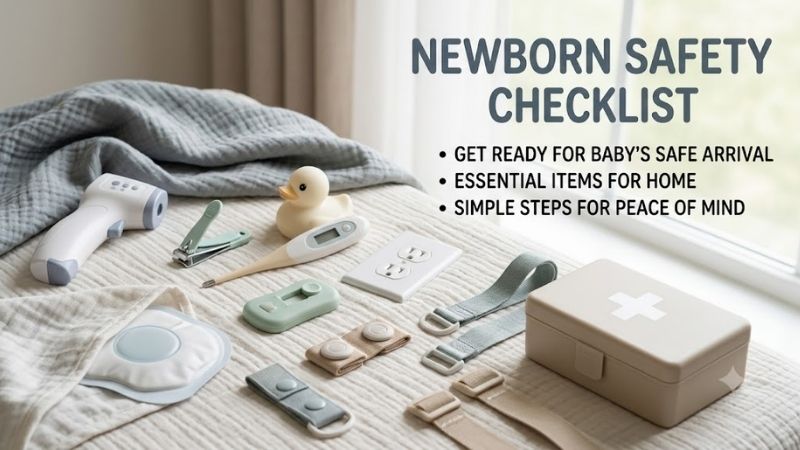
Welcoming an infant home is thrilling, yet navigating everyday home hazards can feel overwhelming without a clear plan. A comprehensive newborn safety checklist protects your baby across sleep environments, car travel, and daily baths. Follow this verified guide to babyproof your home and secure peace of mind from day one.
- Quick-Scan Newborn Safety Checklist
- 1. Safe Sleep Environment (The ABCs of Sleep)
- 2. Car Seat Setup and Travel Safety
- 3. Bathing and Water Safety
- 4. Nursery Babyproofing and Hardware Safety
- 5. Feeding, Health, and Emergency Readiness
- Top 5 Newborn Safety Essentials
- Buying Guide: How to Select Newborn Safety Gear
- Frequently Asked Questions
- Conclusion
Quick-Scan Newborn Safety Checklist
Use this high-priority overview to verify your home’s baseline security before bringing your baby through the front door:
- Sleep: Firm mattress, fitted sheet only, no loose bedding, bumper pads, or plush toys.
- Car Seat: Rear-facing infant seat installed at the proper recline angle, anchored tightly with LATCH or seatbelt.
- Bathing: Water heater capped at $120^\circ\text{F}$ ($49^\circ\text{C}$), bath water tested between $98^\circ\text{F}\text{–}100^\circ\text{F}$, two-inch water maximum, never left unattended.
- Nursery: Furniture anchored to wall studs, window cords tied out of reach, crib placed far from blinds and electrical outlets.
- Health & Feeding: Burping after feeds, formula temperature checked on inner wrist, bulb syringe and digital rectal thermometer within reach.
1. Safe Sleep Environment (The ABCs of Sleep)
Creating a protected sleep space remains the most urgent task for any new parent. Sudden Infant Death Syndrome (SIDS) and accidental suffocation risks plummet when you follow strict pediatric sleep rules. Review our actionable safe sleep checklist below to set up an empty, breathable crib that keeps your infant safe night and day.
According to the American Academy of Pediatrics (AAP), newborns must sleep following the ABC framework:
- A – Alone: The infant must sleep by themselves in a dedicated bassinet, crib, or playard. Never share a bed with an adult, sibling, or pet. Co-sleeping on sofas, armchairs, or adult mattresses poses severe entrapment and suffocation hazards.
- B – on their Back: Always place your infant on their back for every sleep period—both naps and nighttime. Rolling onto the stomach before 6 months significantly increases airway obstruction.
- C – in a Crib: Use a Consumer Product Safety Commission (CPSC)-approved crib or bassinet with a tight-fitting, firm mattress covered exclusively by a fitted sheet.
Crucial Safe Sleep Rules:
- Eliminate Soft Objects: Remove pillows, quilts, comforters, sheepskins, stuffed animals, and positioners.
- Say No to Crib Bumpers: Padded and breathable mesh bumpers both present strangulation and entrapment risks; avoid them entirely.
- Room-Share, Don’t Bed-Share: Keep the crib within arm’s reach of your bed for at least the first six months.
- Control Room Temperature: Maintain nursery ambient temperature between $68^\circ\text{F}$ and $72^\circ\text{F}$ ($20^\circ\text{C}\text{–}22.2^\circ\text{C}$). Dress the baby in layers or use an approved wearable blanket (sleep sack) rather than loose covers.
2. Car Seat Setup and Travel Safety
Before taking your infant home from the maternity ward, you must install an approved rear-facing infant car seat. Motor vehicle crashes represent a significant danger, but correctly fitted harness clips and tight vehicle base anchoring safeguard fragile spines. Check each vital step below before heading out on the road.
An infant’s head comprises roughly 25% of their total body mass, supported by fragile neck muscles and soft vertebrae. Rear-facing car seats cradle the head, neck, and torso during an impact, dispersing crash forces across the seat shell rather than the baby’s body.
| Inspection Item | Correct Setting | High-Risk Mistake |
|---|---|---|
| Seat Orientation | Rear-facing in the rear vehicle seat | Forward-facing or front passenger seat with active airbag |
| Base Movement | Under 1 inch of movement side-to-side at belt path | Loose base sliding freely on seat fabric |
| Harness Straps | At or just below shoulder level | Positioned above the shoulders |
| Chest Clip | Level with baby’s armpits | Placed low across the abdomen or stomach |
| Pinch Test | Fingers slide off webbing at the clavicle | Able to pinch excess strap fabric vertically |
| Clothing | Thin, fitted layers | Heavy winter coats or thick bunting bags |
Pro-Tip: Bulky winter jackets compress instantly during a collision, leaving loose harness webbing that can cause ejection. Dress your baby in thin clothing, buckle them securely, and drape a blanket over the outside of the harness once buckled.
3. Bathing and Water Safety
Bath time offers joyful bonding moments, but water presents critical scald and drowning dangers within seconds. Newborn skin burns significantly faster than adult tissue, demanding precise thermal control and constant physical contact. Use this targeted routine checklist to bathe your baby with absolute security every evening.
Infants can drown silently in as little as one inch of water in less than 30 seconds. Their delicate epidermis is also prone to severe second- and third-degree thermal burns if plumbing delivers unregulated hot water.
Essential Bathing Protocols:
- Lower the Thermostat: Adjust your home’s primary water heater down to $120^\circ\text{F}$ ($49^\circ\text{C}$) to eliminate sudden tap scalds.
- Test Water Before Entry: Target a bath water temperature between $98^\circ\text{F}$ and $100^\circ\text{F}$ ($36.6^\circ\text{C}\text{–}37.7^\circ\text{C}$). Use a floating digital bath thermometer rather than relying on elbow touch alone.
- Practice Touch Supervision: Keep one hand physically on your newborn at all times. Never step away to grab a washcloth, answer a doorbell, or check a phone.
- Sponge Baths First: Limit cleaning to sponge baths until the umbilical cord stump detaches completely and heals (typically 1 to 3 weeks).
- Slip-Resistant Basins: Use an infant bath basin equipped with an internal contoured support sling to keep their head permanently elevated above the shallow basin bottom.
4. Nursery Babyproofing and Hardware Safety
Newborns lack mobility at first, yet setting up an accident-proof nursery today prevents emergency room visits tomorrow. Hidden hazards like unsecured heavy dressers, dangling blind cords, and unshielded electrical outlets require early remediation. Inspect every corner of the nursery with these essential preventive measures.
While your infant cannot crawl during their first weeks, setting up these foundational barriers avoids rushed babyproofing later when your baby suddenly starts rolling and grabbing.
Room-by-Room Nursery Safeguards:
- Anchor Heavy Furniture: Fasten changing tables, dressers, and bookshelves into wall studs using steel anti-tip brackets and straps.
- Eliminate Cord Strangulation Hazards: Switch window coverings to cordless designs. If corded blinds exist, install cord cleats at least 5 feet off the floor. Keep the crib at least 3 feet away from any window or wall hanging.
- Cover Electrical Outlets: Install sliding safety plate covers or childproof outlet caps on all low electrical sockets.
- Monitor Power Cord Routing: Run baby monitor cables through wall-mounted channels or hard plastic conduits. Never let monitor cords hang within 3 feet of the crib perimeter.
- Secure Changing Stations: Always fasten the integrated safety buckle on the contoured changing pad, and maintain one hand on the baby even when reaching for a wipe.
5. Feeding, Health, and Emergency Readiness
Feeding routines and sudden infant illnesses require rapid, composed reactions supported by the right tools. From checking formula temperatures to clearing blocked airways, preparation minimizes panic during stressful situations. Review the practical health actions below to maintain an airtight emergency response at home.
Newborn immune systems and digestive tracts are sensitive. Maintaining clean equipment and mastering basic airway intervention prevents avoidable pediatric emergencies.
Feeding Safety:
- Sterilization: Sterilize all bottles, nipples, and pump parts before first use; wash in hot soapy water or run a sanitized dishwasher cycle after every feeding.
- Formula & Milk Heating: Warm bottles in a bowl of warm water or an electric bottle warmer. Never microwave breastmilk or formula; microwaves generate uneven hot spots that severely burn infant oral tissues.
- Pacing & Upright Hold: Hold the baby semi-upright during feeds to reduce choking and reflux risks. Burp every 2–3 ounces (or when switching breasts).
First-Aid & Emergency Preparations:
- Assemble a Newborn First-Aid Kit: Stock medical-grade infant acetaminophen (do not administer without pediatrician weight guidance), saline nasal mist, a silicone bulb aspirator, sterile gauze, and alcohol prep pads.
- Post Critical Phone Numbers: Place a laminated emergency card on your refrigerator with:
- Pediatrician’s direct office and after-hours line
- Poison Control Center: 1-800-222-1222 (US)
- Local Pediatric Urgent Care and Emergency Room addresses
- Your full home address (for emergency services navigation)
- Learn Infant CPR: Enroll in an infant-specific CPR and choking relief course through the American Heart Association (AHA) or Red Cross before baby arrives.
Top 5 Newborn Safety Essentials
Selecting vetted gear removes guesswork from newborn protection. We evaluated top-tier safety essentials to identify dependable models that meet stringent safety certifications without unnecessary complications. Discover five rigorously tested products that provide genuine utility, long-term durability, and parental reassurance.
+-----------------------------------------------------------------------------------+
|                           TOP PRODUCT PICKS AT A GLANCE                           |
+------------------------------------------+----------------------------------------+
| PRODUCT                                  | BEST FOR                               |
+------------------------------------------+----------------------------------------+
| Chicco KeyFit 30 Infant Car Seat         | Travel Safety & Easy Car Installation  |
| Newton Baby Waterproof Crib Mattress     | Breathable Crib Safety & Hygiene       |
| HALO SleepSack 100% Cotton Swaddle       | Safe Sleep without Loose Blankets      |
| FridaBaby Quick-Read Rectal Thermometer  | Accurate Newborn Fever Monitoring      |
| Safety 1st Deluxe Healthcare Grooming Kit| Everyday Health, Grooming & Care       |
+------------------------------------------+----------------------------------------+
1. Chicco KeyFit 30 Infant Car Seat
- Best For: Overall Infant Travel Safety & Foolproof Installation
- Key Features: ReclineSure leveling foot, RideRight bubble level-indicators, SuperCinch one-pull LATCH tightener, removable infant head and body support insert.
- Pros:
- One of the easiest, most reliable installations in the infant car seat segment.
- Clear visual bubble levels eliminate seat angle uncertainty.
- Sturdy 5-point harness with simple front-pull tensioning.
- Cons:
- Heavier carrier shell compared to ultralight competitive alternatives.
- Canopy coverage could be deeper for bright sunlight protection.
- Analysis:
- Feature: SuperCinch one-pull LATCH tightener.
- Meaning: Leverages force-multiplying gearing inside the base strap.
- Benefit: Parents achieve an immovable base attachment with minimal physical strain.
- Limitation: The combined weight of carrier and growing infant becomes heavy around 9 months.
- Use Case: Daily vehicle transportation and seamless click-in stroller travel systems.
- Who It’s For: New parents who want an intuitive, error-free base installation that guarantees strict travel compliance.
2. Newton Baby Waterproof Crib Mattress
- Best For: 100% Breathable Crib Sleeping
- Key Features: Wovon polymer core (90% air, 10% food-grade polymer), zero polyurethane foam, unquilted breathable spacer cover, fully washable core.
- Pros:
- Air flows freely through the core even if an infant presses their nose against it.
- Contains no off-gassing foams, toxic chemical adhesives, or chemical flame retardants.
- Entire mattress core rinses clean in a standard bathtub.
- Cons:
- Substantially higher investment than standard foam mattresses.
- Feels slightly firmer than traditional dual-sided coil options.
- Analysis:
- Feature: Wovon polymer construction without foam cores.
- Meaning: Air circulates completely through an open lattice pattern.
- Benefit: Minimizes suffocation anxiety if your baby rolls onto their stomach before you notice.
- Limitation: Requires thorough air-drying after washing the inner core.
- Use Case: Primary standard-size crib setup for overnight sleep and unmonitored naps.
- Who It’s For: Caregivers seeking maximum breathability to mitigate suffocation fears during sleep milestones.
3. HALO SleepSack 100% Cotton Swaddle
- Best For: Safe Swaddling & Transitioning without Loose Blankets
- Key Features: 3-way adjustable swaddle wings, inverted bottom zipper for simple diaper changes, hip-healthy roomy sack design, certified “Hip Healthy” by the International Hip Dysplasia Institute.
- Pros:
- Eliminates dangerous loose swaddle blankets from unraveling in the crib.
- Allows arms-in, hands-to-face, or one/two arms-out configurations as baby develops.
- Inverted zipper avoids unswaddling the baby’s chest during midnight diaper changes.
- Cons:
- Hook-and-loop fasteners produce loud tearing sounds during nighttime adjustments.
- Fabric can bunch near the neck if improperly sized.
- Analysis:
- Feature: 3-way adjustable swaddle wrap.
- Meaning: Secure wing panels fasten tightly over an enclosed wearable sack.
- Benefit: Keeps newborn startle reflexes contained without placing fabric over the airway.
- Limitation: Must stop wrapping wings across the torso the moment the baby shows signs of rolling.
- Use Case: Bedtime routine containment for restless newborns up to 3 months.
- Who It’s For: Parents who want the settling benefits of a swaddle without the safety risks of traditional swaddle blankets.
4. FridaBaby Quick-Read Digital Rectal Thermometer
- Best For: Fast, Accurate Newborn Fever Assessment
- Key Features: 10-second rapid measurement display, insertion stopper ring, flexible probe tip, backlit digital display, memory recall.
- Pros:
- Rectal measurement remains the medical gold standard for infants under 3 months.
- Built-in depth stopper prevents over-insertion injuries.
- 10-second read time reduces baby distress during temperature checks.
- Cons:
- Rectal assessment requires extra cleaning care and lubrication.
- Dedicated strictly to rectal use; cannot convert to oral or axillary.
- Analysis:
- Feature: Integrated mechanical insertion guard.
- Meaning: A wide flange blocks the probe from passing beyond safe rectal depth.
- Benefit: Eliminates parent hesitation and accidental rectal wall perforation during testing.
- Limitation: Requires petroleum jelly application for smooth, painless insertion.
- Use Case: Diagnosing true core body temperature when evaluating newborn fevers ($100.4^\circ\text{F}$ / $38^\circ\text{C}$ or higher).
- Who It’s For: Caregivers who require clinically accurate, fail-safe temperature readings for prompt pediatric consultations.
5. Safety 1st Deluxe Healthcare and Grooming Kit
- Best For: Comprehensive Newborn Care & Grooming
- Key Features: Ergonomic infant nail clippers, emery boards, silicone finger toothbrush, soft-bristle brush, fine-tooth comb, clear storage clutch.
- Pros:
- Curved clipper cutting blades engineered specifically for paper-thin infant nails.
- Prevents facial scratching without relying on restrictive mittens.
- Compact, zippered carrying case keeps hygiene accessories organized.
- Cons:
- Included bulb syringe has lower suction strength than hospital-grade models.
- Plastic cases can feel basic, though tools perform reliably.
- Analysis:
- Feature: Curved nail clippers with rounded trimming edges.
- Meaning: Sized to contour precisely against micro-sized fingernails.
- Benefit: Trims sharp newborn claws cleanly without pinching surrounding fingertip skin.
- Limitation: Requires trimming while the baby is sleeping or nursing to avoid accidental nicks.
- Use Case: Routine post-bath grooming and infant skin scratch prevention.
- Who It’s For: First-time parents who need a complete, medical-grade grooming kit covering all daily hygiene needs.
Buying Guide: How to Select Newborn Safety Gear
Investing in baby gear requires balancing certified protection against daily convenience, realistic budget limits, and nursery space. Not all flashy gadgets improve infant security, making targeted evaluation essential before purchasing. Apply this structured buying framework to choose equipment that delivers dependable real-world value.
+-------------------------------------------------------------------------------------+
|                             GEAR EVALUATION MATRIX                                  |
+---------------+---------------------+------------------------+----------------------+
| WHAT TO BUY   | WHY IT MATTERS      | WHO NEEDS IT           | KEY TRADE-OFF        |
+---------------+---------------------+------------------------+----------------------+
| Car Seat      | Spinal crash impact | All vehicle owners     | Bulk vs. ease of base|
|               | protection          | bringing baby home     | installation         |
+---------------+---------------------+------------------------+----------------------+
| Safe Mattress | Prevents suffocation| Every family with a    | Premium price vs.    |
|               | and re-breathing    | standalone crib setup  | simple foam utility  |
+---------------+---------------------+------------------------+----------------------+
| Wearable Sack | Safe warmth without | Parents replacing      | Hook-and-loop noise  |
|               | loose crib fabrics  | loose swaddle blankets | vs. wrap convenience |
+---------------+---------------------+------------------------+----------------------+
| Thermometer   | Precise medical fever| All homes; vital for  | Invasive method vs.  |
|               | triage under 90 days| rapid ER decisions     | unverified forehead  |
+---------------+---------------------+------------------------+----------------------+
1. Safety Certifications (Non-Negotiable)
- What: Verify seals from JPMA (Juvenile Products Manufacturers Association), CPSC, and ASTM International.
- Why: Independent laboratory testing proves the product withstands structural stress, uses non-toxic dyes, and poses no choking hazards.
- Who: Critical for every family purchasing bassinets, car seats, strollers, and sleepwear.
- Trade-off: Certified gear carries premium testing costs, but second-hand or uncertified discount models risk recalls and material failure.
2. Operational Simplicity vs. High-Tech Features
- What: Prioritize mechanical reliability (secure buckles, firm cores, bubble indicators) over complex app-tethered devices.
- Why: Smart socks and Wi-Fi sensor mats can suffer from connection drops, false alarms, and false reassurance, which can lead to lapses in basic safe-sleep routines.
- Who: Families wanting low-stress, fail-safe nursery functionality.
- Trade-off: High-tech devices track heart rate data, but mechanical safety fundamentals save lives reliably without battery recharges.
3. Ease of Sanitization and Maintenance
- What: Select gear with machine-washable fabrics, removable waterproof covers, and non-porous surfaces.
- Why: Newborn spit-up, diaper blowouts, and moisture breed mold and bacterial growth if materials cannot be quickly disinfected.
- Who: Busy households handling frequent daily laundering.
- Trade-off: Waterproof membranes can occasionally feel stiffer, requiring breathable top layers for comfort.
Frequently Asked Questions
Caring for a newborn frequently prompts urgent safety questions, especially during middle-of-the-night routines. Clear answers grounded in established pediatric health standards help you resolve dilemmas swiftly and confidently. Explore responses to the most common infant safety questions every modern caregiver encounters.
When should I transition my baby out of a swaddle?
Cease swaddling the moment your baby demonstrates any initial signs of attempting to roll over, often as early as 8 to 12 weeks. Rolling over while swaddled traps the infant’s face against the mattress without arm support, causing rapid suffocation. Transition immediately to a sleeveless wearable blanket (sleep sack) with both arms completely free.
Can I use a second-hand car seat from friends or family?
Never use a used car seat unless you know its complete history from someone you trust implicitly. Car seats must be retired immediately if they have been involved in a moderate-to-severe crash, if labels showing the model number and expiration date (typically 6 to 10 years from manufacture) are missing, or if the internal plastic shell exhibits micro-fractures.
How warm should I dress my newborn for sleep?
Dress your newborn in only one more light layer than an adult would comfortably wear in the same room. Check the back of their neck or chest for warmth and moisture; damp skin or sweaty hair indicates overheating, which is a recognized risk factor for SIDS. Keep their hands bare, as cool infant hands are normal due to developing circulatory systems.
Are sleep positioners or wedge pillows safe for infant acid reflux?
No. Pediatric organizations, including the AAP and FDA, strongly advise against all sleep positioners, wedges, inclined sleepers, and anti-roll pillows. These items cause positional asphyxiation by tilting the baby’s heavy head forward onto the chest, collapsing their narrow airway. Keep the crib mattress completely flat.
What is the safe temperature threshold for an infant fever?
A rectal temperature of $100.4^\circ\text{F}$ ($38.0^\circ\text{C}$) or higher in an infant under 12 weeks of age is a pediatric medical emergency. Do not administer over-the-counter fever reducers without medical instructions; contact your pediatrician or proceed directly to an emergency department for evaluation.
Conclusion
Bringing a baby home demands vigilance, but a structured newborn safety checklist transforms anxiety into calm confidence. Focus on the core pillars: flat back sleeping, rear-facing car seats, tested water temperatures, and anchored nursery furniture. Tackle each task methodically to build a secure haven where your little one thrives.








Write Your Review
No reviews yet. Be the first to share your experience!