
Key takeaways
- Feature: Carrier fabric extending perfectly from the back of one knee across to the back of the other knee.
- Meaning: The infant’s knees are elevated higher than their buttocks, creating a deep, secure squat position.
- Benefit: Actively prevents hip dysplasia by ensuring the thigh bone rests securely inside the hip socket during crucial early development phases.
- Limitation: Narrow-based carriers completely fail to provide this support, causing legs to dangle dangerously and strain the hip joints.
- Use Case: Visually checking your infant’s leg angle in a mirror before heading out for a long afternoon neighborhood walk.
What's inside
Understanding babywearing ergonomics is the most critical step to ensuring your infant’s safety and your physical comfort. Proper positioning protects fragile hip joints from dysplasia, supports natural spinal curves, and evenly distributes weight to prevent caregiver back pain. Discover how to master optimal carrying techniques confidently today.
Core Principles of Infant Positioning
Achieving proper alignment fundamentally dictates the overall safety of your babywearing journey. This precise biomechanical support prevents long-term joint damage while guaranteeing clear airways for respiration. By actively mastering these foundational posture rules, you seamlessly blend daily convenience with optimal orthopedic development.
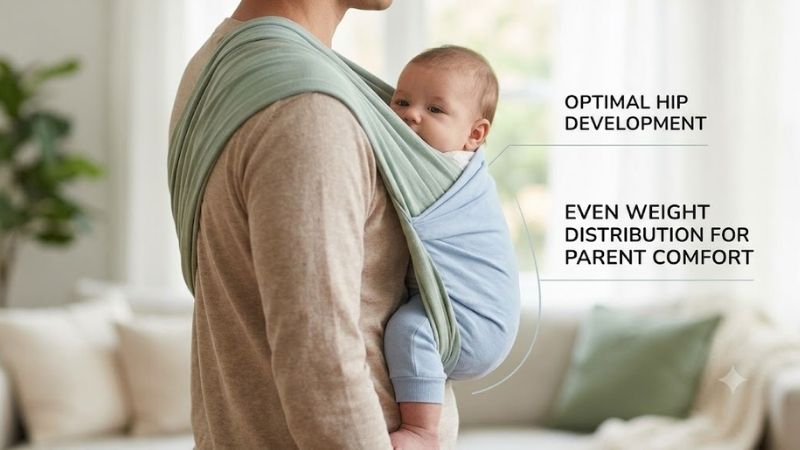
Ergonomic M-Shape Hip Positioning
- Feature: Carrier fabric extending perfectly from the back of one knee across to the back of the other knee.
- Meaning: The infant’s knees are elevated higher than their buttocks, creating a deep, secure squat position.
- Benefit: Actively prevents hip dysplasia by ensuring the thigh bone rests securely inside the hip socket during crucial early development phases.
- Limitation: Narrow-based carriers completely fail to provide this support, causing legs to dangle dangerously and strain the hip joints.
- Use Case: Visually checking your infant’s leg angle in a mirror before heading out for a long afternoon neighborhood walk.
Natural C-Curve Spinal Support
- Feature: Soft, yielding fabric panels that gently mold across the entirety of the infant’s back without applying rigid pressure.
- Meaning: The spine maintains its natural, convex kyphotic curve, which is the biological default for all newborns.
- Benefit: Protects unossified vertebrae from premature compression and prevents the infant from slumping downward, which can instantly block their airway.
- Limitation: Over-tightening the carrier straps forces the infant’s back straight, causing immediate physical distress and dangerous respiratory restriction.
- Use Case: Securing a sleeping newborn against your chest while ensuring their back remains softly rounded, not flattened against your torso.
Caregiver Lumbar Weight Distribution
- Feature: A wide, densely padded waistband that wraps firmly around the wearer’s natural waist or hips.
- Meaning: The physical weight of the growing child is transferred away from the shoulders and directly onto the stronger pelvic bones.
- Benefit: Eliminates severe upper back and neck pain, allowing for drastically extended, comfortable babywearing sessions throughout the day.
- Limitation: Velcro-only waistbands or overly thin straps degrade under heavier weights, rendering the carrier completely useless for robust toddlers.
- Use Case: Enduring a three-hour zoo trip with a thirty-pound toddler without experiencing debilitating lower back spasms the following morning.
How to Achieve Ergonomic Excellence
Implementing correct structural alignments requires deliberate adjustments every time you secure your infant. Consistently executing these systematic checks guarantees their delicate physiology remains fully protected against gravitational stress. Follow these precise operational steps to confidently create a secure, developmentally sound environment.
Step 1: Execute the Pelvic Tuck
Once the baby is placed inside the carrier, physically reach your hands inside the panel. Gently scoop your baby’s thighs upward and tilt their pelvis slightly toward your own body. This manual adjustment guarantees their weight rests entirely on their bottom, naturally forcing the knees into the required M-shape stance.
Step 2: Secure the Head and Neck
For infants lacking complete head control, ensure the carrier’s upper panel reaches the middle of their ear, but never covers their face. You must always maintain a minimum of two fingers of clearance between your baby’s chin and their chest to guarantee a fully open, unobstructed airway during movement.
Step 3: Calibrate Strap Tension
Tighten the shoulder straps until the baby’s body is held snugly against your chest. If you lean forward slightly and the baby pulls away from your body by more than an inch, the carrier is too loose. However, ensure you do not tighten so aggressively that you flatten the essential C-curve of their spine.
Top Ergonomic Baby Carriers Reviewed
Selecting equipment engineered specifically for physiological support is paramount for maintaining healthy joint development. The following carefully evaluated models feature specialized adjustable components designed to sustain orthopedic integrity. Explore these top-tier options to find the perfect mechanical match for your daily wearing requirements.
Ergobaby Omni 360 All-Position Baby Carrier
- Best For: Comprehensive, all-in-one ergonomic support spanning from the fragile newborn phase straight through to heavy toddler carrying.
- Key Features: Highly adjustable bucket seat, dedicated lumbar support waistbelt, heavily padded crossable shoulder straps, and a UPF 50+ privacy hood.
- Pros: Officially certified “hip-healthy” by the International Hip Dysplasia Institute; requires absolutely no infant insert; exceptional lower back support.
- Cons: The multi-layered structural fabric feels noticeably bulky and warm in high-humidity climates; managing numerous adjustment buckles requires practice.
- Use Case: Embarking on rugged weekend family hikes where superior, long-lasting lumbar support is required to prevent severe caregiver back fatigue.
- Who It’s For: Parents seeking a single, highly durable piece of equipment that seamlessly adapts to every stage of their child’s physical growth.
Tula Explore Baby Carrier
- Best For: Caregivers who heavily prioritize intuitive adjustments, streamlined aesthetics, and effortless transitions between front inward and outward positioning.
- Key Features: Innovative body panel with hidden snaps for seat width adjustment, padded neck support pillow, and breathable, lightweight cotton construction.
- Pros: Exceptionally user-friendly with a minimal learning curve; features stunning fabric designs; provides excellent knee-to-knee M-shape support inherently.
- Cons: Lacks the rigid, dedicated lumbar pad found on heavier competitors, which some users miss when carrying toddlers exceeding twenty-five pounds.
- Use Case: Rapidly securing your infant for quick grocery store runs where straightforward, fuss-free buckling systems drastically reduce transition times.
- Who It’s For: Fashion-conscious parents demanding a highly functional, visually appealing carrier that guarantees orthopedic safety without overwhelming mechanical complexity.
LÍLLÉbaby Complete 6-in-1 Baby Carrier
- Best For: Caregivers with a history of back pain demanding maximum structural reinforcement and highly versatile carrying configurations.
- Key Features: Massive, removable lumbar support pad, extendable zip-down torso panel, 3D mesh ventilation options, and completely customizable seat width.
- Pros: Unmatched upper and lower back pressure relief; six distinct carrying positions accommodate every developmental stage perfectly.
- Cons: The sheer number of zippers, snaps, and straps feels incredibly intimidating initially; the overall footprint is quite large for petite wearers.
- Use Case: Enduring deeply prolonged carrying sessions at theme parks where heavy-duty weight distribution is absolutely vital for physical endurance.
- Who It’s For: Wearers actively combating lower back issues who require heavy-duty, highly engineered orthopedic support to maintain daily babywearing habits.
Ergonomic Carrier Buying Guide
Evaluating structural components before purchasing guarantees you secure an item capable of nurturing proper infant physiology. Recognizing which specific hardware elements directly influence weight distribution prevents costly mistakes. Utilize these technical criteria to confidently navigate the complex marketplace of soft structured carriers.
Factor 1: Dynamic Seat Adjustability
- What: A heavily reinforced lower panel that can be physically widened or narrowed using hidden tracks, industrial Velcro, or sturdy snaps.
- Why: The base must perfectly match the exact length of the baby’s thigh bone. A dynamic seat guarantees the carrier actively grows with your child, sustaining the M-shape.
- Who: Economical parents aiming to purchase just one robust carrier to span from the newborn phase through the end of the toddler years.
- Trade-off: Carriers boasting highly adjustable seats inherently require extra layers of overlapping fabric, adding noticeable weight compared to fixed-panel designs.
Factor 2: Dedicated Lumbar Reinforcement
- What: A wide, rigid, heavily cushioned structural pad incorporated directly into the rear center of the carrier’s main waistbelt.
- Why: It actively forces the caregiver to maintain proper posture by preventing the waistbelt from buckling, sagging, or digging sharply into the lower spine.
- Who: Caregivers planning to wear children exceeding twenty pounds for multiple hours daily, or individuals with pre-existing lower back injuries.
- Trade-off: The rigid nature of the lumbar pad makes the carrier significantly bulkier to fold up and pack into a standard diaper bag.
Frequently Asked Questions
Addressing common orthopedic concerns empowers parents to troubleshoot complicated positioning challenges with absolute confidence. These thoroughly vetted answers provide clear, actionable guidance on maintaining safe mechanical alignments. Review these expert solutions to consistently uphold structural integrity during everyday carrying scenarios.
Does outward facing violate babywearing ergonomics?
Outward-facing positioning does not inherently violate safety rules if executed correctly, but it presents strict ergonomic challenges. The baby’s spine naturally straightens, making it impossible to maintain the optimal C-curve. You must utilize a carrier specifically engineered with a wide bucket seat to support the M-shape while outward facing, and severely limit these sessions to twenty minutes to prevent hip joint fatigue.
How do I know if the carrier is properly tightened?
Perform the “lean test.” With your baby securely buckled inside the carrier, place one hand gently behind their back for safety and lean forward slightly at the hips. If the baby’s body visibly pulls away from your chest by more than one inch, your shoulder straps are too loose. They should remain snugly against your torso without flattening their natural spinal curve.
Can newborns be worn ergonomically without an insert?
Yes, but exclusively if you are using a carrier explicitly designed with a micro-adjustable seat width that narrows significantly enough to accommodate a newborn’s tiny leg span. If you are using a traditional standard-sized soft structured carrier, you absolutely must use the manufacturer’s corresponding infant insert to elevate them to a safe breathing height and support their unossified hips.
Conclusion
Prioritizing babywearing ergonomics transforms routine carrying into an orthopedically secure, deeply bonding experience. By consistently enforcing the M-shape pelvic tuck, maintaining spinal C-curves, and selecting structurally sound equipment, you actively safeguard your child’s physical development while enjoying unparalleled daily convenience.









Write Your Review
No reviews yet. Be the first to share your experience!