
Key takeaways
- A listing emphasizes a high maximum weight but gives no minimum weight, developmental guidance, or instructions for safe positioning.
- The waist belt is narrow, lightly stitched, or lacks a clear buckle-locking system.
- The child sits far away from your body, slides forward, or causes the seat to tip downward.
- The product claims newborn suitability but offers no meaningful head, neck, or airway-support guidance.
- The stated waist range is missing, vague, or too short for your measured waist over clothing.
- There are no care instructions, return terms, or manufacturer contact details.
- You experience sharp back pain, shoulder pain, tingling, or numbness while using it. Stop and adjust or choose a different design.
Choosing a hip carrier by the biggest number on the box is one of the most common buying mistakes. A stated maximum of 35, 40, or 45 pounds does not automatically mean the carrier will be comfortable, stable, or appropriate for every child up to that point. The child’s sitting ability, height, body proportions, the caregiver’s waist size, and the carrier’s construction all matter just as much.
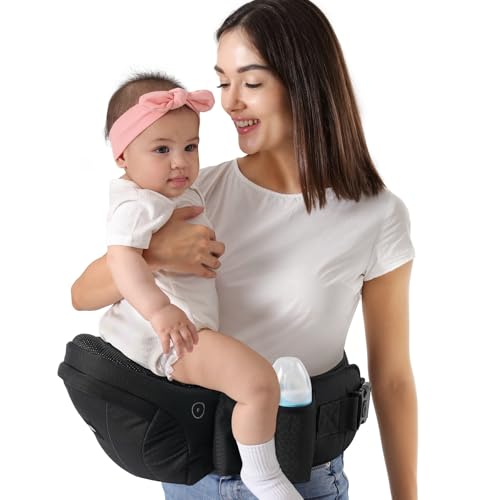
Another mistake is confusing a hip seat with a hands-free structured carrier. A basic hip seat supports a child on one side of your body and usually requires one arm around the child. A carrier with shoulder straps and a back panel can distribute weight more evenly and may offer more hands-free support. Before buying in 2026, match the product’s stated weight range to the way you actually plan to use it: quick errands, frequent up-and-down toddler carrying, travel, feeding support, or longer walks.
Our top picks


As an Amazon Associate we earn from qualifying purchases at no extra cost to you. Ratings are shown as listed on Amazon.
Decide These 3 Things First
- Start with your child’s current stage, not only their weight. Most hip seats are best for babies who have reliable head and neck control and can sit with support, often around 4 to 6 months. For newborn use, only choose a model that explicitly includes newborn support and states a minimum weight, commonly 7 to 12 pounds. Do not assume every “newborn to toddler” listing provides the same level of support.
- Choose your realistic upper limit. If your child weighs 26 pounds now and you expect to use the carrier for another year, a 35-pound maximum may leave little room. For many families, a listed limit of 40 to 45 pounds offers a more useful toddler window. However, caregiver comfort may become the practical limit well before the product’s maximum.
- Decide whether you need one-arm support or hands-free carrying. A compact hip seat is ideal for short carries and children who want frequent pickups. For walks longer than 15 to 30 minutes, airport days, or children above roughly 25 pounds, a structured model with shoulder straps and a supportive waist belt is usually the more comfortable choice.
Child Size, Weight Range, and Developmental Fit
The right hip carrier weight limit begins with the manufacturer’s stated minimum and maximum. Common ranges include 8 to 35 pounds for lightweight sling-style carriers, 12 to 40 pounds for many hip-seat carriers, and 7 to 45 pounds for more substantial structured systems. Treat these numbers as an approved use range, not a promise that every carry position works equally well across that span.
Check both the lower limit and the developmental language in the instructions. A 10-pound baby may technically meet a listed minimum, but a hip-seat position still may not be suitable without adequate head control. For a young baby, the carrier should provide a secure, visible position with the face unobstructed and the chin off the chest. A baby should never be positioned so deeply in fabric or so low on the caregiver that breathing and face visibility are compromised.
For toddlers, height matters. A tall 32-pound child can feel more top-heavy than a shorter child at the same weight. Look for a seat that is wide enough to support the child’s bottom without forcing them to perch on a narrow edge. Hip seats commonly measure about 7 to 9 inches wide and 5 to 7 inches deep. A seat in that range gives a toddler a more stable platform than a small, shallow pad.
Finally, use the lower of two limits: the carrier’s published maximum or your own comfortable carrying limit. If you feel pressure in your lower back, numbness at the hip, or constant pulling at the shoulder, shorten the carrying session and reassess fit. More capacity is useful only if the carrier distributes that load well.
Materials and Heat Management
Material choice affects comfort more than it affects the printed weight limit, but it can determine whether you actually use the carrier. Breathable mesh panels are helpful in warm weather and during active errands, while cotton-blend or polyester fabrics may feel more substantial and easier to wipe clean. A carrier does not need to be all mesh to be practical; strategically placed mesh across the back panel or side panels can improve airflow without making the structure feel flimsy.
Look closely at the seat surface. A non-slip covering, often textured polyester or silicone-style grip material, helps prevent a child from sliding forward when they shift their weight. The seat should have firm internal support rather than soft padding alone. Soft foam may feel pleasant initially but can compress over time, especially when regularly carrying children above 25 pounds.
For everyday cleanup, choose fabrics that can be spot-cleaned easily. Dark colors hide scuffs, while lighter gray or beige fabrics can show sunscreen, snack residue, and denim transfer more readily. If machine washing is important, verify that the entire carrier—not just removable fabric sections—is approved for washing. Many structured seats contain inserts or boards that require hand cleaning.
Construction, Buckles, and Waistband Support
A hip carrier’s safe working limit depends heavily on its waist belt and attachment points. Look for wide webbing, reinforced stitching at the seat-to-belt connection, and buckles that close with a clear, secure click. A safety elastic or secondary retention loop is a worthwhile feature because it helps keep the loose end from slipping through if the buckle is bumped.
For a child above 25 pounds, a waist belt at least 4 inches wide usually spreads pressure better than a narrow 2- to 3-inch strap. Padded belts are often around 4 to 6 inches tall at the back. The belt should sit snugly at your natural waist or slightly above it, rather than loosely around the hips. A loose belt allows the seat to tilt outward, increasing strain on your back and making the child feel less stable.
Check the published waist adjustment range before ordering. Many hip carriers fit approximately 25- to 45-inch waists, while more inclusive versions may extend to 50 or 52 inches with an extender. Measure where you plan to wear the belt, over the clothing you normally use. A 34-inch jeans size does not necessarily equal a 34-inch carrier-waist measurement.
If buying a carrier with shoulder straps, inspect how the straps connect to the belt and back panel. Adjustable straps should be easy to tighten without leaving long, dangling ends. For heavier toddlers, a back panel and dual shoulder straps can shift part of the load away from one hip and reduce the tendency to twist your torso.
Comfort and Real-World Performance
Hip carriers are designed for convenience, but their comfort ceiling varies. A simple hip seat can be excellent for five-minute pickups, grocery-store transitions, or soothing a child while standing. It is less ideal for a 2-mile walk because the caregiver usually supports part of the child’s upper body with one arm and carries the load asymmetrically.
For children in the 20- to 30-pound range, prioritize a firm, angled seat with a wide belt. The seat should angle slightly upward toward your body, helping the child settle inward instead of sliding away from you. If the seat feels flat or slopes down, the child’s weight may pull forward and increase lower-back pressure.
For children over 30 pounds, look for shoulder support if you expect carries longer than 10 to 15 minutes at a time. A structured hip carrier can still be faster than a full wrap, but it should have enough adjustability to keep the child high and close. Your child’s head should be near your upper chest, not down at your abdomen.
Storage can improve real-world usefulness. Small carriers may include a zippered compartment large enough for keys, a phone, and 1 or 2 diapers. Larger models may add insulated bottle pockets or a waist pouch. Avoid overloading these pockets: adding several pounds of bottles, wipes, and accessories changes the balance and can make a 30-pound child feel considerably heavier.
Price Tiers and What You Get
Budget: $15 to $35. At this level, expect lightweight sling-style carriers or basic hip seats with fewer storage features and simpler padding. Some list ranges around 8 to 35 pounds. These can work well for occasional use, but inspect the waistband width, buckle quality, return policy, and instructions carefully.
Mid-range: $35 to $70. This is the practical sweet spot for many families. You can often find a firmer hip seat, breathable panels, better waist padding, non-slip seating, and published ranges up to about 40 pounds. This tier suits frequent short carries and daily toddler transitions.
Premium: $70 to $120 or more. Premium carriers commonly add more substantial structure, safety-oriented buckle details, better-organized storage, and more refined fit adjustments. Some support children up to 45 pounds. The extra cost is most justified if you will use the carrier several times a week, need a broader waist range, or want a system that remains comfortable as your child grows.
Warranty, Returns, and Delivery Considerations
A hip carrier should arrive ready to use, but do not discard packaging until you have tested the fit indoors. Most require no assembly beyond adjusting the waist belt, attaching any shoulder straps, and reading the safety instructions. Plan on 5 to 10 minutes for initial setup and adjustment.
Look for at least a 30-day return window, especially if you are between sizes or buying before your child reaches the intended stage. A one-year limited warranty is common on better-made carriers, though coverage often excludes normal wear, staining, and damage caused by improper washing. Keep the receipt and product documentation in case a buckle, seam, or strap needs to be evaluated.
Before the first outing, practice over a bed or soft surface with another adult nearby. Adjust the belt, seat angle, and any shoulder straps until the child feels close and centered. Recheck all buckles every time you put the carrier on.
Spec Checklist
| Spec | Budget | Mid | Premium |
|---|---|---|---|
| Typical price | $15-$35 | $35-$70 | $70-$120+ |
| Common stated child range | 8-35 lb | 12-40 lb | 7-45 lb |
| Waist belt width | 2-4 in. | 4-5 in. | 4-6 in. |
| Typical waist adjustment | 25-40 in. | 25-45 in. | 25-50+ in. |
| Seat features | Basic padded platform | Firm seat with non-slip surface | Structured, angled seat with enhanced grip |
| Best use | Occasional short carries | Daily errands and toddler pickups | Frequent use and longer carrying sessions |
| Storage | Minimal or none | Small zip pocket | Multiple pockets and accessory storage |
Red Flags
- A listing emphasizes a high maximum weight but gives no minimum weight, developmental guidance, or instructions for safe positioning.
- The waist belt is narrow, lightly stitched, or lacks a clear buckle-locking system.
- The child sits far away from your body, slides forward, or causes the seat to tip downward.
- The product claims newborn suitability but offers no meaningful head, neck, or airway-support guidance.
- The stated waist range is missing, vague, or too short for your measured waist over clothing.
- There are no care instructions, return terms, or manufacturer contact details.
- You experience sharp back pain, shoulder pain, tingling, or numbness while using it. Stop and adjust or choose a different design.
FAQ
What is the best hip carrier weight limit to look for?
For a carrier intended to last through much of toddlerhood, a stated maximum of 40 to 45 pounds is a useful target. For occasional short carries, 35 pounds may be enough. Always follow the manufacturer’s stated range and stop earlier if fit or comfort becomes poor.
Can I use a hip seat for a newborn?
Only if the specific carrier explicitly permits newborn use and provides appropriate support and instructions. Many hip seats are better suited to babies with reliable head control, commonly around 4 to 6 months. Weight alone does not determine readiness.
Is a higher weight limit always better?
No. A higher limit is valuable only when the seat, waistband, buckles, and shoulder support are built to manage the load comfortably. A well-fitted 35-pound carrier may be a better purchase than a poorly designed model claiming 45 pounds.
When should I choose a structured carrier instead of a hip seat?
Choose a structured carrier with shoulder straps if you want hands-free use, walk for more than 15 to 30 minutes, travel often, or regularly carry a child above about 25 pounds. Choose a simple hip seat when fast pickups and short, frequent carries are your priority.


Write Your Review
No reviews yet. Be the first to share your experience!