
Key takeaways
- Tight: The carrier must be snug enough to hug your baby close. Any slack allows them to slump down, which can compromise breathing and pull on your back.
- In view at all times: You should always be able to see your baby’s face by simply glancing down. The fabric of a sling or carrier should not close around them.
- Close enough to kiss: Your baby’s head should be as close to your chin as is comfortable. By tipping your head forward, you should easily be able to kiss their forehead or top of their head.
- Keep chin off the chest: A baby should never be curled so their chin is forced onto their chest, as this restricts breathing. Ensure there is always a space of at least two fingers under your baby’s chin.
- Supported back: In an upright carry, a baby should be held comfortably close to the wearer so their back is supported in its natural curvature, with their tummy and chest against you.
What's inside
Mastering safe carrier positioning is essential for keeping your baby secure, comfortable, and developmentally supported while keeping your hands free. Understanding the correct postural alignments ensures your infant’s airway remains clear and their developing hips are protected during every adventure.
The Foundations of Safe Babywearing
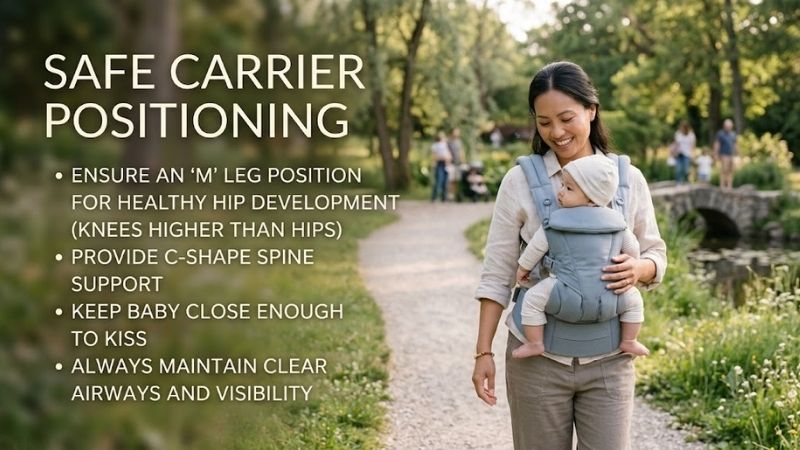
When positioning your baby in any wrap, ring sling, or soft-structured carrier, safety relies on two critical concepts: protecting the airway and supporting natural hip development. Newborns lack head control and their hip joints are still pliable cartilage, making correct structural support non-negotiable.
The T.I.C.K.S. Rule for Airway Protection
The UK Sling Consortium developed the T.I.C.K.S. rule as the gold standard for babywearing safety. Checking these five elements prevents positional asphyxiation and dangerous slumping.
- Tight: The carrier must be snug enough to hug your baby close. Any slack allows them to slump down, which can compromise breathing and pull on your back.
- In view at all times: You should always be able to see your baby’s face by simply glancing down. The fabric of a sling or carrier should not close around them.
- Close enough to kiss: Your baby’s head should be as close to your chin as is comfortable. By tipping your head forward, you should easily be able to kiss their forehead or top of their head.
- Keep chin off the chest: A baby should never be curled so their chin is forced onto their chest, as this restricts breathing. Ensure there is always a space of at least two fingers under your baby’s chin.
- Supported back: In an upright carry, a baby should be held comfortably close to the wearer so their back is supported in its natural curvature, with their tummy and chest against you.
The Ergonomic “M” Shape for Hip Health
The International Hip Dysplasia Institute (IHDI) emphasizes the “M-position” (or spread-squat position) to promote healthy hip joint development.
- What it is: The baby’s knees should be positioned slightly higher than their bottom, with their thighs spread around your torso and fully supported from knee-to-knee.
- Why it matters: This mimics the natural fetal tuck. If a baby’s legs dangle straight down, it places undue stress on the hip joints, which can contribute to hip dysplasia.
- How to achieve it: After buckling or tying the carrier, perform a “pelvic tuck.” Reach inside the carrier, gently tilt the baby’s pelvis forward, and guide their knees upward.
Essential Carrier Positioning by Age
As your baby grows and gains strength, their positioning needs evolve. Choosing the right carrying style at the correct stage prevents physical strain for both of you.
Front-Inward Facing (0+ Months)
This is the only safe position for newborns and young infants who cannot independently hold their heads up.
- The Setup: Baby faces your chest, high and tight, adhering strictly to the T.I.C.K.S. rule. Ensure the carrier’s back panel provides rigid support to the nape of their neck.
- The Benefit: It allows constant monitoring of their airway, facilitates the M-position perfectly, and provides soothing skin-to-skin contact.
Front-Outward Facing (6+ Months)
This position is for curious, older babies who have robust head and neck control, typically starting around six months.
- The Setup: Baby faces away from you. Ensure your specific carrier supports the M-shape in this position (not all do).
- The Limitation: It can easily cause overstimulation and is generally less ergonomic for the parent’s lower back. Limit outward-facing carries to 20-30 minutes at a time.
Back Carrying (6+ Months)
Ideal for older, heavier babies and toddlers who can sit unassisted.
- The Setup: Baby is carried on your back, similar to a hiking backpack. They must still be supported knee-to-knee in a deep seat.
- The Benefit: Distributes heavy weight much more efficiently across the wearer’s hips and shoulders, making it the safest option for long walks, chores, or hiking.
Top Carriers for Optimal Positioning
Not all carriers are created equal when it comes to supporting the T.I.C.K.S. rule and the M-position. The following carriers are recognized by the International Hip Dysplasia Institute and excel at keeping your baby safe.
1. Ergobaby Omni Breeze
- Best For: All-around ergonomic support and maximum breathability.
- Key Features: SoftFlex Mesh material, padded lumbar support, adjustable seat width, and accommodates 7 to 45 pounds.
- Pros: The highly adjustable seat ensures a perfect knee-to-knee M-position from newborn to toddler without needing an extra infant insert. The structured panel prevents any unsafe slumping.
- Cons: The thick, heavily padded waistband and shoulder straps can feel bulky on petite frames.
- Use Case: Ideal for long walks, hiking, or parents who need serious lower back support while ensuring their baby remains in a strict, structured upright position.
- Who It’s For: Parents wanting a single, durable, highly structured “one-and-done” carrier that easily transitions through all safe carrying positions (inward, outward, hip, and back).
2. Solly Baby Wrap
- Best For: Newborn airway protection and custom, snug tension.
- Key Features: Made from ultra-soft TENCEL Modal fabric, one-size-fits-all, designed specifically for the first year (up to 25 lbs).
- Pros: The stretchy fabric allows you to tie it tightly to your body first, then pop the baby in. This provides a custom, rigid-free fit that naturally supports the baby’s C-curve spine and keeps them high on your chest.
- Cons: There is a learning curve to mastering the tying process to ensure the tension is tight enough to prevent the baby from sagging down over time.
- Use Case: Perfect for the “fourth trimester” at home when a newborn needs constant, secure, womb-like contact while keeping the parent’s hands free.
- Who It’s For: Caregivers of infants under 15 pounds who prioritize soft, customizable fabric to ensure the baby stays “close enough to kiss” without rigid buckles.
3. WildBird Ring Sling
- Best For: Quick hip carries and easy pelvic tuck adjustments.
- Key Features: Made from 100% European linen, seamless aluminum rings, accommodates newborns to toddlers (up to 35 lbs).
- Pros: The single layer of fabric threaded through rings allows for micro-adjustments. You can easily pull the fabric deep under the baby’s bottom to quickly create a profound, ergonomic M-position seat.
- Cons: The asymmetric design puts all the weight on one shoulder of the wearer, which can lead to rapid fatigue with heavier babies.
- Use Case: Excellent for quick errands, rapid up-and-downs with a toddler, or situations where you need to easily adjust the baby into a safe hip carry.
- Who It’s For: Parents looking for a stylish, highly adjustable option that makes achieving a deep, safe seat incredibly fast once you master the ring threading technique.
Buying Guide: Choosing for Safety
When shopping for a carrier, prioritize structural features that actively promote safe positioning over aesthetic designs.
Adjustable Seat Width
- What: The fabric panel where the baby sits can be widened or narrowed using snaps, velcro, or cinching cords.
- Why: A newborn needs a narrow seat to prevent their legs from being forced too far apart. A toddler needs a wide seat to support their long legs knee-to-knee. An adjustable seat guarantees the M-position at every age.
- Who: Anyone planning to use a single soft-structured carrier from birth through the toddler years.
- Trade-off: Carriers with highly adjustable seats often have more complex moving parts and stiff velcro tracks compared to simpler models.
Firm Neck and Head Support
- What: A structured panel, padded roll, or adjustable fabric at the top of the carrier that sits behind the baby’s neck.
- Why: Until a baby develops neck strength (around 4 months), their head can loll backward or sideways, which can obstruct their airway. Firm support keeps their head stabilized and their chin off their chest.
- Who: Crucial for parents carrying newborns or infants who frequently fall asleep in the carrier.
- Trade-off: High, stiff neck panels can sometimes block a curious older baby’s view, requiring you to fold the panel down when they are awake.
Frequently Asked Questions
How do I know if my carrier is too loose? If you have to support your baby’s back with your hands when you lean forward, the carrier is too loose. A properly tightened carrier will hold the baby securely against your body without any gap, preventing them from slumping downward and compromising their airway.
Is it safe for my baby’s legs to dangle straight down? No. Dangling legs put unhealthy stress on a baby’s developing hip joints and can increase the risk of hip dysplasia. Always ensure the carrier fabric supports their thighs fully from knee to knee, keeping their knees slightly higher than their bottom in an M-shape.
Conclusion
Prioritizing safe carrier positioning transforms babywearing into a secure, developmentally beneficial experience for your child. By diligently applying the T.I.C.K.S. rule and ensuring a proper ergonomic M-shape, you can confidently keep your baby close while protecting their airway and supporting their growing body.










Write Your Review
No reviews yet. Be the first to share your experience!