
Key takeaways
- Choosing by maximum length alone: A long strap is not useful if it cannot tighten enough for your torso.
- Measuring over bare clothing: Winter coats and thick sweaters can add several inches to the required belt range.
- Leaving the carrier too loose: The baby should remain high, close, and supported without a deep gap between the baby and your body.
- Over-tightening: Straps that cause numbness, neck pressure, or restricted breathing need to be repositioned and adjusted.
- Ignoring the panel width: The carrier should support the baby from knee to knee without forcing the legs straight or allowing them to dangle.
- Assuming one setting fits every position: Front inward-facing, hip, back, and forward-facing positions may require different adjustments. Use only positions approved for your baby’s age and development.
- Allowing unsecured tails to hang: Use the carrier’s elastic loops or webbing keepers to secure excess strap material.
The Short Answer
Baby carrier straps should be long enough to adjust the carrier snugly around your body without leaving excess webbing dangling near the baby’s face, feet, or hands. For most soft-structured carriers, a practical starting range is 35 to 55 inches (89 to 140 cm) per shoulder strap and 25 to 55 inches (64 to 140 cm) for the waist belt. Wraps and ring slings use much longer fabric panels, commonly เรีย 180 to 220 inches (457 to 559 cm), because the fabric circles the wearer and creates the support.
There is no single correct strap length. The right size depends on your chest, waist, clothing layers, carrying position, and the carrier’s adjustment system. When fitted correctly, the baby should sit high enough to kiss, with the carrier supporting the baby in an ergonomic “M” position: knees higher than the bottom and thighs supported. The straps should feel secure but should not dig into your neck, restrict breathing, or pull the baby’s back flat.
Our top picks
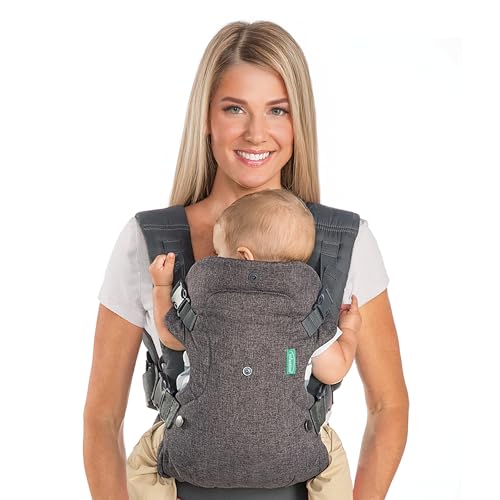 Infantino Flip 4-in-1 Baby Carrier Convertible Ergonomic
- From coffee runs and grocery trips to neighborhood…
- The adjustable convertible seat supports babies from 8-32…
- Choose facing-in with a narrow seat, facing-in with…
| Product | Key specs | Amazon rating | |
|---|---|---|---|
 Biabyio Baby Sling Carrier Biabyio Baby Sling Carrier | – | Check price | |
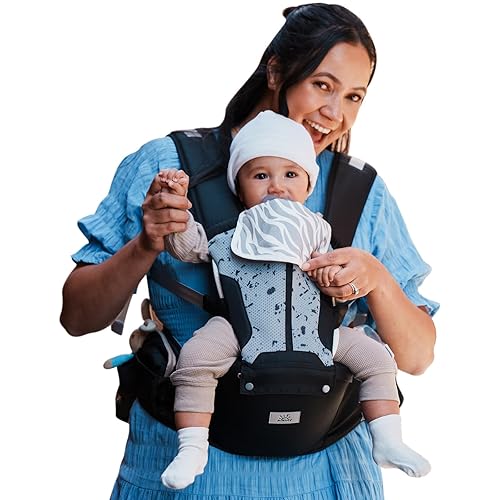 MOMTORY Safety-Certified 6-in-1 Baby Carrier Newborn to MOMTORY Safety-Certified 6-in-1 Baby Carrier Newborn to | 4.6★ | Check price | |
| Infantino Flip 4-in-1 Baby Carrier Convertible Ergonomic | From coffee runs and grocery trips to neighborhood… The adjustable convertible seat supports babies from 8-32… Choose facing-in with a narrow seat, facing-in with… | 4.9★ | Check price |
 Momcozy Baby Carrier with Hip Seat Momcozy Baby Carrier with Hip Seat | – | Check price |
As an Amazon Associate we earn from qualifying purchases at no extra cost to you. Ratings are shown as listed on Amazon.
For 2026 shopping, focus less on the maximum advertised strap length and more on the carrier’s minimum adjustment range. A strap that adjusts down too far may leave excess webbing; one that does not adjust enough can create pressure points or an unsafe, loose fit.
Standard Sizes
The measurements below are useful buying guidelines, not universal industry standards. Manufacturers measure straps differently: some list the webbing only, while others include padded sections, buckles, and adjustment tails. Always compare the published range with your own body measurements and the brand’s fitting instructions.
| Carrier part | Common length range | Approximate metric range | What it should fit |
|---|---|---|---|
| Shoulder strap, compact carrier | 30–45 in | 76–114 cm | Small to average adult torsos |
| Shoulder strap, adjustable carrier | 35–55 in | 89–140 cm | Most adults, including layered clothing |
| Extended shoulder strap | 45–65 in | 114–165 cm | Tall, broad, or plus-size wearers |
| Waist belt, standard | 25–50 in | 64–127 cm | Waists and hips up to roughly 45 in |
| Waist belt, extended | 30–60 in | 76–152 cm | Larger waists, hips, or winter layers |
| Ring sling shoulder-to-tail fabric | 72–90 in | 183–229 cm | Adjustable one-shoulder carries |
| Woven wrap | 180–220 in | 457–559 cm | Multiple wrap carries and body sizes |
As a general fit check, a fastened waist belt should have at least 2 to 4 inches (5 to 10 cm) of adjustment left after tightening. That gives you room for a shirt, coat, or small body changes. Do not rely on the tail length alone: a long tail does not compensate for a belt that is too loose or a carrier panel that does not support the baby’s body.
Budget and midrange carriers illustrate why measurements vary. A small sling may cost about $15 to $25, while a buckle carrier such as an Infantino Flip-style model or a basic MOMTORY carrier often falls around $30 to $50. A carrier with a hip seat or more adjustment features may cost approximately $60 to $90. Price does not determine fit, and a lower-priced carrier is not automatically less suitable if it adjusts correctly and is used within its stated weight range.
How to Measure Your Space
- Measure your waist or torso where the belt will sit. Use a soft tape measure over the clothing you expect to wear. Measure around your natural waist, hips, or the position recommended by the carrier manual. Keep the tape level and comfortably snug, not tight.
- Record your smallest and largest seasonal measurements. If your waist is 36 inches (91 cm) in light clothing and 40 inches (102 cm) over a coat, choose a belt with an adjustment range that comfortably covers both numbers.
- Measure your torso length. Measure from the top of your shoulder, near where a backpack strap rests, down to the top of your hip. This helps identify whether shoulder straps and the carrier panel will sit in the correct position.
- Check the shoulder strap path. Estimate the route from the carrier’s upper attachment point, over your shoulder, across or around your back, to the lower adjustment point. Add about 4 to 8 inches (10 to 20 cm) for tightening and seasonal clothing. The strap should not end at your neck or sit directly on the baby’s head.
- Measure the usable adjustment range. If a listing says a strap is 55 inches long, ask whether that includes padding, buckles, and the loose tail. The useful measurement is the distance between the attachment points at the shortest and longest settings.
- Allow modest excess, not a dangling loop. After fitting, leave enough tail for the buckle or safety elastic to secure it. Roll or tuck extra webbing into the carrier’s keeper bands. Loose straps should never hang where the baby can pull them toward the face or mouth.
- Test with a weighted object before the first use. Practice tightening and releasing the carrier with a weighted stuffed toy or similar object, then follow the manufacturer’s instructions with your baby. A practice test does not replace a real fit check or professional instruction.
By Room or Use Case
Quick errands and indoor use
For short grocery trips, chores, or moving around the house, a carrier with shoulder straps around 30 to 45 inches (76 to 114 cm) may be sufficient for a smaller or average-size wearer. Prioritize simple one-handed adjustments and a short excess tail. A compact sling can work well for brief carries, but it must still support the baby’s head and keep the airway visible.
Long walks and travel
For extended walks, look for padded, adjustable shoulder straps of approximately 35 to 60 inches (89 to 152 cm) and a waist belt that accommodates your clothing layers. A broader belt can transfer some weight to the hips, reducing shoulder fatigue. Hip-seat designs may feel convenient for toddlers, but confirm the model’s minimum and maximum child weight and use the safety strap when instructed.
Newborn carrying
Newborn carriers need more than long straps. They require a properly sized panel, head and neck support, and a fit that keeps the baby’s face uncovered and close enough to monitor. A strap can be 55 inches long and still be unsuitable if the carrier cannot narrow at the seat or adjust to a small infant. Follow the manufacturer’s minimum age, weight, and positioning requirements.
Plus-size or shared use
For a larger wearer or two caregivers sharing one carrier, seek a waist belt with at least a 45- to 60-inch (114- to 152-cm) range and shoulder straps that extend to about 60 or 65 inches (152 or 165 cm), depending on the adjustment design. Shared use is easiest when both shoulder straps and the belt have clearly marked, independent adjustments rather than fixed-length loops.
Common Sizing Mistakes
- Choosing by maximum length alone: A long strap is not useful if it cannot tighten enough for your torso.
- Measuring over bare clothing: Winter coats and thick sweaters can add several inches to the required belt range.
- Leaving the carrier too loose: The baby should remain high, close, and supported without a deep gap between the baby and your body.
- Over-tightening: Straps that cause numbness, neck pressure, or restricted breathing need to be repositioned and adjusted.
- Ignoring the panel width: The carrier should support the baby from knee to knee without forcing the legs straight or allowing them to dangle.
- Assuming one setting fits every position: Front inward-facing, hip, back, and forward-facing positions may require different adjustments. Use only positions approved for your baby’s age and development.
- Allowing unsecured tails to hang: Use the carrier’s elastic loops or webbing keepers to secure excess strap material.
FAQ
How much strap should be left after tightening?
Leave enough webbing to pass through the safety elastic or keeper—often about 2 to 6 inches (5 to 15 cm)—but avoid long dangling loops. The exact amount depends on the buckle design. If the strap tail reaches the baby’s face or hands, secure it or choose a carrier with a better adjustment range.
Are longer baby carrier straps safer?
Not by themselves. Safety depends on a secure buckle, correct positioning, an appropriate carrier size, and a snug fit that keeps the baby’s airway clear. Excessively long straps can create loose sections or snagging hazards. Select the shortest carrier range that fits comfortably while allowing normal clothing layers.
What strap length is best for a plus-size wearer?
Many plus-size wearers need shoulder straps extending to about 55 to 65 inches (140 to 165 cm) and a waist belt reaching at least 50 to 60 inches (127 to 152 cm). Measure your actual belt position and compare it with the carrier’s usable range rather than its total webbing length.
Can I add an extension to baby carrier straps?
Only if the carrier manufacturer specifically approves a compatible extension. Homemade additions, sewn alterations, and third-party clips can change how weight is distributed or cause a buckle to fail. If the carrier cannot adjust to your body with its original parts, choose a model with an extended-size option instead.


Write Your Review
No reviews yet. Be the first to share your experience!