
Our Top Picks
Best overall for most PS5 owners this Black Friday: the Sony PlayStation 5 DualSense Wireless Controller – Midnight Black, the official pad at mid-range pricing that delivers adaptive triggers, haptic feedback, a built-in mic array and full console-level compatibility without the premium markup of the Edge. If you play competitively and want back paddles, swappable stick modules and adjustable trigger stops, the PlayStation DualSense Edge is the premium pick. If you want the cheapest sensible second controller or spare, the BETMI Wireless Controller with Hall Joysticks is the budget pick, and its Hall-effect sticks are the single most useful upgrade a cheap pad can carry, because they sidestep the mechanical wear that produces stick drift. The remaining four sit between those poles: the PlayStation-branded DualSense bundle with a PC USB cable, the Sony DualSense Midnight Black at mid-range, the macro-and-turbo NBCP pad, and the LED-styled Gamrombo. This roundup compares all seven by wireless features, battery life, comfort, compatibility and what actually comes in the box, so you can match a deal to how you play rather than to a discount percentage.
Top 3 Picks
Best overall: Sony PlayStation 5 DualSense Wireless Controller – Midnight Black
For the largest number of buyers, the standard official DualSense is the right answer: it is the only controller on this list guaranteed to expose every console-level feature, including adaptive trigger resistance in supported titles, haptic feedback, the built-in speaker and mic array, and the Create button. It sits at mid-range pricing, which means Black Friday discounts typically land it in budget-adjacent territory for a genuine first-party pad. It suits a first-time PS5 owner, a household adding a second controller, and anyone who wants zero compatibility guesswork.
Best budget: BETMI Wireless Controller with Hall Joysticks
The BETMI pad is the pick when the goal is spending as little as possible without buying a pad that will develop drift in a year. Its listing name explicitly claims Hall-effect joysticks, which use magnetic sensing instead of a physical wiper inside a potentiometer, and that is the one budget feature worth paying a little extra for. It covers PS5, PS5 Pro, PS5 Slim and PC, and it is the sensible choice for a spare pad, a second player, or a console that sees heavy local multiplayer use.
Best premium: PlayStation DualSense Edge Wireless Controller – Midnight Black
The Edge is the premium pick and the only controller here built around competitive customisation: swappable stick modules, two pairs of back inputs, adjustable trigger stops, on-controller profile switching, and a carrying case with a braided cable and extra stick caps. It costs a large premium over the standard DualSense and has a shorter battery life, so it only makes sense if you genuinely use back buttons and trigger stops in ranked play. Everyone else should save the money.
Quick Comparison
| Product | Best for | Key specs | Price tier |
|---|---|---|---|
| PlayStation DualSense Wireless Controller + USB Cable for PC | Official features plus a wired PC option straight out of the box | Adaptive triggers, haptics, built-in mic array and speaker, 3.5 mm jack, USB-C, Bluetooth; ~1,560 mAh battery class, roughly 6–9 hours mixed use; ~280 g class; includes controller + USB cable | Premium |
| PlayStation DualSense Edge Wireless Controller | Competitive players who use back inputs and trigger stops | Swappable stick modules, two pairs of back inputs, adjustable trigger stops, on-controller profiles, carrying case, braided USB-C cable, extra stick caps; shorter runtime than the standard DualSense; heavier body | Premium |
| BETMI Wireless Controller (Hall Joysticks) | Budget buyers who want drift-resistant sticks | Hall-effect joysticks, wireless, compatible with PS5 / PS5 Pro / PS5 Slim / PC; black shell; remaining features unstated in the listing name | Budget |
| NBCP Wireless Controller for PS5 | Players who map macros and turbo inputs | Dual vibration, macro and turbo functions, 3.5 mm audio jack, compatible with PS5 / PS5 Pro / PS5 Slim / PC | Mid-range |
| Sony PlayStation 5 DualSense Wireless Controller – Midnight Black | The default official buy for most PS5 owners | Adaptive triggers, haptics, built-in mic array and speaker, 3.5 mm jack, USB-C, Bluetooth; ~1,560 mAh battery class; ~280 g class; controller only | Mid-range |
| Akalyptra Wireless Controller for PS5 | People switching between PS5, PC and Steam Deck | Wireless, compatible with PS5 / PS5 Pro / PS5 Slim / PC / Steam Deck; black shell | Budget |
| Gamrombo LED Wireless Controller for PS5 | Budget buyers who want visible LED styling | LED lighting, dual vibration, macro and turbo functions, compatible with PS5 / PS5 Pro / PS5 Slim / PC | Budget |
How We Chose
This list is built from published specifications, manufacturer feature lists and the information each product listing states about itself, not from laboratory measurement. Every pick had to clear four filters. First, category fit: official PlayStation pads and third-party pads solve different problems, so both are represented rather than pretending a budget pad replaces an Edge. Second, feature-to-use-case fit: a controller earns a place here only if a specific type of player benefits from what it offers, whether that is Hall-effect sticks, back inputs, macro keys or simply the guaranteed feature set of a first-party pad.
Third, compatibility honesty: each entry names exactly which consoles and platforms its listing claims, and we flag where a listing is silent rather than filling the gap with an invented spec. Fourth, upgrade path and ownership cost: what wears first, whether consumable parts can be replaced, and whether the next tier up is worth the premium. We do not claim to have tested, benchmarked or owned any of these controllers; the numbers below are the published ones, and where a figure is a class rather than an exact value, we say so. Prices are described only as tiers, because promotional pricing moves daily.
1. PlayStation DualSense Wireless Controller + USB Cable for PC – Best for Official Features With a Wired PC Option

PlayStation DualSense® Wireless Controller – Midnight Black + USB Cable for PC
Chosen because it specifies Midnight Black + USB Cable for PC.
View on AmazonThis is the bundle to pick if you want the official PlayStation pad and you also play on a desktop or laptop. Functionally it is the standard DualSense with a USB cable included for PC use, which sounds minor until you realise how many PC players end up buying a cable separately because the console never shipped with one in the box. It suits a PS5 owner whose setup spans a console and a computer, and who would rather pay a little more once than hunt for a compatible cable later.
Wireless behaviour is the standard DualSense behaviour: Bluetooth to the console, USB-C wired to a PC, with the full feature set available on PS5 and partial feature support in PC titles that implement it. Adaptive trigger resistance, haptic feedback, the built-in speaker, the mic array and the 3.5 mm headset jack all come from the official platform rather than a third-party approximation, which is the main argument for paying the premium tier price. In supported single-player titles this is the difference between rumble that buzzes and rumble that communicates surface texture.
Key specs
- Connection: Bluetooth wireless to PS5, PS5 Pro and PS5 Slim; USB-C wired to PC and console
- Battery: roughly 1,560 mAh class cell; manufacturer runtime claim sits in the 12-hour class; realistic mixed play with haptics and adaptive triggers active is closer to 6–9 hours
- Weight: approximately 280 g class, the standard DualSense body
- Inputs and output: adaptive triggers, haptic feedback, dual-mic array, built-in speaker, 3.5 mm headset jack, touchpad, Create button, USB-C port
- In the box: controller plus a USB cable intended for PC connection
The strengths are reliability and completeness. Because it is the reference design, no game has to be patched to support it, no mapping utility is required, and firmware updates arrive through the console as normal. Midnight Black is a matte finish that hides fingerprints better than the lighter colourways, which matters more than people expect after a year of use. The included cable also removes the most common wired-PC frustration, which is discovering that the cable you own is charge-only and carries no data.
The trade-offs are the same ones every standard DualSense carries. There are no back buttons, no trigger stops and no swappable stick modules, so a player who wants competitive inputs has to move up to the Edge. The potentiometer-based sticks are the part most likely to develop drift over years of use, and the battery is not designed for casual user replacement. Finally, this bundle costs more than the standalone DualSense for the same controller plus a cable, so the premium only pays off if you actually need the cable.
Pros
- Guaranteed full console feature support, including adaptive triggers and haptics
- USB cable included, so PC play works immediately without a separate purchase
- Standard 280 g class body that fits the same grips and cases as any DualSense
- Midnight Black matte shell resists visible smudging
- Firmware updates and repairs follow the normal first-party path
Cons
- Premium tier pricing for what is, mechanically, a standard DualSense
- No back inputs, trigger stops or replaceable stick modules
- Battery life drops sharply with haptics and adaptive triggers at full strength
- Sticks remain the long-term wear point, with no user-replaceable modules
Compared with the standalone Sony DualSense Midnight Black further down this list, the two controllers are the same hardware; the bundle simply adds a cable and moves up a price tier. If you already own a data-capable USB-C cable, the standalone is the better value and the bundle is redundant. Compared with the DualSense Edge, this pad gives up back inputs, trigger stops and stick module replacement but keeps a longer battery life, a lighter body and a much lower price. In short: choose the bundle for official features plus convenience, choose the standalone to save, choose the Edge only if you will use its extra hardware.
2. PlayStation DualSense Edge Wireless Controller – Best for Competitive Customisation

PlayStation DualSense Edge Wireless Controller - Midnight Black
Chosen because it specifies Midnight Black.
View on AmazonThe DualSense Edge is for the player who has already decided that inputs win rounds. It keeps everything the standard DualSense does — adaptive triggers, haptics, the speaker and mic array — and layers on hardware customisation that no third-party pad here matches: two pairs of back inputs, adjustable trigger stops, swappable stick modules, and the ability to store and switch between custom profiles without opening a menu. It suits ranked shooter players, fighting game players who want extra face-button access without moving their thumbs, and anyone who has already replaced a controller because of drift.
Key specs
- Connection: Bluetooth wireless to PS5, PS5 Pro and PS5 Slim; USB-C wired
- Battery: a smaller cell than the standard DualSense, which is the most consistent criticism of this model; expect noticeably shorter sessions per charge, especially with haptics and adaptive triggers running
- Weight: heavier than the standard DualSense body once back inputs are fitted
- Customisation: swappable stick modules, two pairs of back inputs, adjustable trigger stops, on-controller profile switching, button remapping through the console settings
- In the box: carrying case, braided USB-C cable, extra stick caps, connector housing; replacement stick modules are generally sold separately
The strengths are all about control. Back inputs let you keep both thumbs on the sticks while jumping, crouching or reloading, which is the single biggest mechanical advantage a controller can give in a shooter. Trigger stops shorten the travel on the shoulder triggers so a semi-automatic weapon fires sooner, and because the stops are mechanical rather than software-based, nothing needs to be configured per game. Swappable stick modules attack drift directly: when a module wears out, you replace the module rather than the controller. The carrying case and braided cable make it a genuinely portable kit for players who take a pad to a friend’s house or a tournament.
The costs are real. It is the most expensive controller on this list by a wide margin, it is heavier in the hand, and its battery life is the weakest of the official options — the exact opposite of what you would expect at a premium price. The stick modules are consumables that must be bought again when they wear, so the ownership cost does not stop at purchase. Back inputs also take deliberate practice to use well; players who map them and then forget them have paid for hardware they never exploit. Finally, macro and rapid-fire style functions are not part of this pad, so players who specifically want turbo or macro keys should look at the NBCP or Gamrombo entries instead.
Pros
- Two pairs of back inputs, configurable for different grip styles
- Adjustable trigger stops shorten shoulder-button travel mechanically
- Swappable stick modules turn the most common failure point into a replaceable part
- On-controller profile switching without opening a settings menu
- Retains the full official feature set: adaptive triggers, haptics, speaker, mic array
Cons
- Premium pricing, the highest tier in this roundup
- Shorter battery life than the standard DualSense, despite costing far more
- Heavier body, which some players notice over three-hour sessions
- Replacement stick modules are an ongoing cost rather than a one-off
Compared with the standard DualSense and the PlayStation bundle, the Edge is a different product category: same core features, plus competitive hardware. If you do not use back buttons, the extra money buys you weight, shorter battery life and a case. Compared with the budget pads here, the Edge is the opposite philosophy — they minimise cost, it maximises control. The honest test is simple: if you cannot name the two inputs you would move to the back of the controller, this is not the pad for you.
3. BETMI Wireless Controller for PS5 / Pro / Slim / PC with Hall Joysticks – Best for Budget Drift Resistance
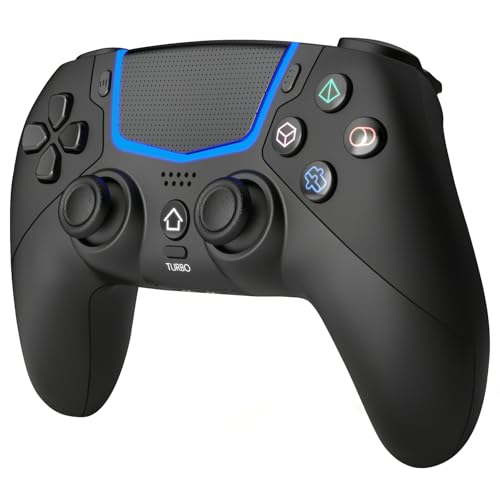
BETMI Wireless Controller for PS-5/Pro/Slim/PC with Hall Joysticks (Black)
Picked as a relevant option in this category.
View on AmazonThe BETMI controller is the budget pick for a specific reason: its listing name advertises Hall-effect joysticks, and that is the one specification worth chasing at the cheap end of the market. Hall-effect sticks sense position magnetically instead of through a physical contact wiper, so the wear mechanism that produces classic stick drift is largely removed. It suits the buyer who needs a second pad for local multiplayer, a spare for a child, or a controller for a console that gets a lot of hours from different hands.
Compatibility as stated is broad: PS5, PS5 Pro, PS5 Slim and PC, in a black shell. The listing name does not detail the full feature list beyond the joystick type and the platform coverage, and that silence matters. Where a listing does not mention adaptive trigger support, haptic feedback quality, audio jack, back buttons or battery capacity, treat those features as unconfirmed and check the product description before ordering. What you can reasonably assume at this price tier is a wireless pad with the standard DualShock-style layout, dual vibration feedback of some kind, and a USB-C or similar charging path — but confirm each one.
Key specs
- Joysticks: Hall-effect, which avoids the contact-wiper wear that causes drift
- Compatibility (as listed): PS5, PS5 Pro, PS5 Slim, PC
- Connection: wireless, with a wired charging path
- Colour: black
- Not stated in the listing name: battery capacity, audio jack, back buttons, macro or turbo functions, adaptive trigger support
The strength is straightforward value. Hall-effect sticks at a budget price is the combination that makes most sense for a spare controller, because the spare is exactly the pad that gets handed around, dropped on a couch and left to charge overnight. If the sticks resist drift, the pad stays usable for years instead of becoming the annoying one that pulls your aim to the left. Broad platform coverage also means one purchase can serve a console in the living room and a desktop PC.
The compromises follow the price tier. You should not expect the adaptive trigger resistance or haptic depth of an official DualSense, because that hardware and the firmware behind it are first-party territory. Battery capacity is unstated, so runtime is a genuine unknown; a budget pad with a small cell may need charging every couple of sessions. Build materials will be lighter and more plasticky than the official shell, and the finish will show wear sooner. There is also no back-button or profile system at this tier.
Pros
- Hall-effect joysticks address the most common long-term failure at the lowest price point
- Covers PS5, PS5 Pro, PS5 Slim and PC in one purchase
- Budget tier, which makes a second or third controller affordable
- Plain black shell that suits any setup
Cons
- Battery capacity and runtime are not stated in the listing name
- No adaptive trigger or first-party haptic support
- Lighter materials and finish than the official controller
- Audio jack, macro keys and back buttons cannot be assumed
Compared with the Akalyptra pad, the BETMI trades Steam Deck coverage for the more valuable stick technology: Hall-effect sticks are a durability feature, while Steam Deck compatibility is a convenience feature. Compared with the Gamrombo LED pad, BETMI offers no lighting but a better long-term bet on the part that actually breaks. If you want one cheap controller that will still feel fine in three years, this is the safer of the three budget entries; if you split your time between a console and a Steam Deck, look at the Akalyptra instead.
4. NBCP Wireless Controller for PS5 – Best for Macro and Turbo Users

NBCP Wireless Controller for PS5, Compatible with PS5 Pro/Slim/PC, Dual Vibration, Macro/Turbo Function, 3.5mm Audio Jack, 6-Axis Motion Control Gamepad with LED Light
Chosen because it specifies Compatible with PS5 Pro/Slim/PC and Dual Vibration.
View on AmazonThe NBCP pad is the mid-range entry for players whose priority is programmable inputs rather than first-party fidelity. Its listing states dual vibration, macro and turbo functions, a 3.5 mm audio jack, and compatibility with PS5, PS5 Pro, PS5 Slim and PC. It suits someone who plays games where repeating an input sequence is tedious — crafting loops, racing throttle control, farming routes — or who wants a turbo function for single-player shooting galleries.
Key specs
- Compatibility: PS5, PS5 Pro, PS5 Slim, PC
- Feedback: dual vibration motors
- Programmable inputs: macro recording and turbo (rapid repeat) functions
- Audio: 3.5 mm jack for a wired headset
- Connection: wireless, with wired charging
- Not stated in the listing name: battery capacity, stick technology, back button count
The macro function is the reason to buy it. Where the official controllers expect you to press a sequence every time, a macro pad lets you record it once and replay it with a single press, which is genuinely useful in single-player and simulation genres. Turbo is the simpler cousin: hold a button and it repeats at an interval rather than requiring repeated presses, which reduces thumb fatigue in games that involve sustained fire or repeated menu navigation. Dual vibration and a 3.5 mm jack round it out as a normal, comfortable pad rather than a novelty.
The mid-range positioning buys better build and a fuller feature set than the budget trio, but not official-grade trigger or haptic hardware. There is a real caveat with programmable inputs: many online multiplayer games treat macro and turbo use as cheating, and enforcement can include account penalties. Treat these functions as single-player and offline conveniences, and check the rules of any game you play competitively. Battery capacity is unstated, so plan on charging habits rather than a published runtime, and stick technology is not specified, which means drift resistance should not be assumed the way it can be with the BETMI pad.
Pros
- Macro recording and turbo functions are unusual at this price tier
- 3.5 mm headset jack included for wired audio
- Broad console and PC compatibility, including PS5 Pro and Slim
- Dual vibration motors for standard feedback
- Mid-range build quality rather than the lightest budget shell
Cons
- Macro and turbo use can breach online game rules and risk penalties
- Battery capacity is not published, so runtime is unpredictable
- No Hall-effect sticks mentioned, so drift resistance is unconfirmed
- No adaptive trigger or first-party haptic support
Compared with the Gamrombo LED pad, the NBCP is the better-built version of a similar idea: both offer macro and turbo functions, but NBCP sits a tier higher and adds a headset jack, while Gamrombo spends its budget on lighting. Compared with the BETMI pad, the choice comes down to priorities — NBCP for programmable inputs and a fuller feature list, BETMI for stick durability. Players who care about neither macros nor drift-proof sticks should be looking at the official Sony pad instead.
5. Sony PlayStation 5 DualSense Wireless Controller – Midnight Black – Best for the Default Official Buy

Sony PlayStation 5 DualSense Wireless Controller - Midnight Black
Chosen because it specifies Midnight Black.
View on AmazonThis is the controller most PS5 owners should buy, and it is the reason the mid-range tier exists on this list. It is the official DualSense in Midnight Black with no bundle, no case and no extras, which means it is the lowest-cost route to guaranteed full console feature support. It suits a first-time PS5 owner, a household adding a second pad for split-screen and couch co-op, and anyone who wants the simplest possible purchase decision.
Key specs
- Connection: Bluetooth wireless to PS5, PS5 Pro and PS5 Slim; USB-C wired for charging and PC use
- Battery: approximately 1,560 mAh class cell; manufacturer runtime claim in the 12-hour class, with realistic mixed play closer to 6–9 hours
- Weight: roughly 280 g class
- Features: adaptive triggers, haptic feedback, built-in speaker, dual-mic array, 3.5 mm headset jack, touchpad, Create button
- In the box: controller only
The advantage of buying the official pad is that nothing needs to be verified. Adaptive trigger resistance works in every title that implements it, haptics are tuned by the developers themselves, the mic array and speaker work in games that use them, and system-level updates arrive automatically. Ergonomically it is the reference point against which every third-party shell is judged, and the 280 g class weight is a reasonable middle ground: heavy enough to feel substantial, light enough for a long session.
The weaknesses are well known and worth stating plainly. Battery life is the most common complaint — 6–9 hours in real mixed use means a charge every few evenings if you play daily, and haptics drain it faster. The potentiometer-based sticks are the component most likely to develop drift over several years, and unlike the Edge, there is no module to replace. There are no back buttons and no trigger stops. And because it is a first-party product, it rarely drops as steeply as third-party pads during sale events, even in the mid-range tier.
Pros
- Full, guaranteed first-party feature support with no compatibility guesswork
- Mid-range pricing, the cheapest route to genuine DualSense features
- Reference ergonomics and a comfortable 280 g class weight
- Automatic firmware updates through the console
- Midnight Black matte finish that hides fingerprints
Cons
- Battery life of roughly 6–9 hours in mixed use, less with heavy haptics
- No back buttons, trigger stops or swappable stick modules
- Sticks are the long-term wear point and are not user-replaceable
- No cable in the box, so PC players may need to buy one
Compared with the PlayStation bundle at the top of this list, this is the same controller without the cable, one tier cheaper — if you own a data-capable USB-C cable already, this is the smarter buy. Compared with the DualSense Edge, it gives up customisation and gains battery life, lower weight and a much lower price. Compared with every third-party pad here, it gives up price and programmable extras in exchange for guaranteed feature fidelity. For most people, that trade is the right one.
6. Akalyptra Wireless Controller for PS5 / Pro / Slim / PC / Steam Deck – Best for Steam Deck and PC Crossover

Akalyptra Wireless Controller for PS-5, Pro/Slim/PC/Steam Deck (Black)
Chosen because it specifies Pro/Slim/PC/Steam Deck (Black).
View on AmazonThe Akalyptra pad is the budget entry for players whose setup is not purely a PlayStation console. Its listing claims compatibility with PS5, PS5 Pro, PS5 Slim, PC and Steam Deck, which is the broadest platform spread on this list. It suits someone who docks a Steam Deck to a television, plays the same games on a desktop, and wants one controller that travels between all of them instead of pairing a different pad to each device.
Steam Deck support is the distinguishing feature. Handheld players frequently want a full-size controller for docked play because the built-in controls become uncomfortable over long sessions, and buying a separate pad for that one scenario is hard to justify. A budget pad that covers the console, the desktop and the handheld solves three problems with one purchase. The black shell keeps it visually neutral next to a dock and a console.
Key specs
- Compatibility (as listed): PS5, PS5 Pro, PS5 Slim, PC, Steam Deck
- Connection: wireless, with wired charging
- Colour: black
- Not stated in the listing name: battery capacity, stick technology, audio jack, macro or turbo functions, back buttons, vibration type
The strength is flexibility at a low price. Very few budget pads state Steam Deck compatibility explicitly, and for a docked Deck user that single line is worth more than any lighting effect or programmable key. Because it is a budget-tier pad, buying one to leave permanently attached to a dock is a reasonable decision rather than an extravagance.
The compromises are the standard budget ones. Nothing in the listing name confirms Hall-effect sticks, so drift resistance cannot be assumed, and on a budget pad the sticks are the first thing to wear. Battery capacity is unpublished, audio jack support is unconfirmed, and vibration is not described. Build materials will be lighter than the official controller. Expect to check the product description for the charging connector type and any wired-mode requirements before ordering, because a pad that only works wirelessly with a Deck dock can be frustrating if pairing is fussy.
Pros
- Broadest compatibility here, including Steam Deck alongside PS5, PS5 Pro, PS5 Slim and PC
- Budget tier, cheap enough to dedicate to a docked setup
- Neutral black shell that fits any desk or media unit
- Wireless operation with a wired charging path
Cons
- No Hall-effect sticks mentioned, so long-term drift is a real risk
- Battery capacity, audio jack and vibration type are unstated
- No adaptive trigger or first-party haptic support
- Budget materials and finish that will show wear sooner
Compared with the BETMI pad, the Akalyptra wins on platform coverage and loses on stick durability; if your Steam Deck never leaves the house, BETMI is the better buy, and if it does, Akalyptra earns its place. Compared with the Gamrombo LED pad, Akalyptra trades macro and turbo functions and lighting for Steam Deck compatibility. Neither is a substitute for the official DualSense on a PS5 that you play seriously, but both are sensible second pads.
7. Gamrombo LED Wireless Controller for PS5 – Best for Budget LED Styling
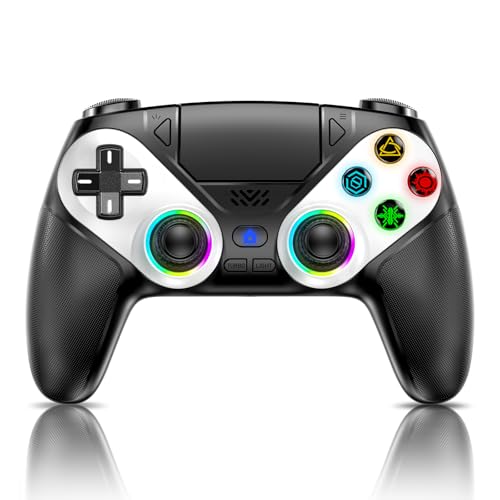
Gamrombo LED Wireless Controller for PS5, Compatible with PS5 Pro/Slim/PC, Dual Vibration, Macro/Turbo Function, 3.5mm Audio Jack, 6-Axis Motion Control Gamepad with Speaker
Chosen because it specifies Compatible with PS5 Pro/Slim/PC and Dual Vibration.
View on AmazonThe Gamrombo pad targets a different buyer: someone who wants a controller that looks like an upgrade without paying upgrade money. Its listing states LED lighting, dual vibration, macro and turbo functions, and compatibility with PS5, PS5 Pro, PS5 Slim and PC. It suits a younger player, a themed setup, or anyone who wants a visible second controller that is easy to identify when four people are passing pads around a couch.
Key specs
- Compatibility: PS5, PS5 Pro, PS5 Slim, PC
- Lighting: LED lighting built into the shell
- Feedback: dual vibration motors
- Programmable inputs: macro and turbo functions
- Connection: wireless, with wired charging
- Not stated in the listing name: battery capacity, stick technology, audio jack, back button count
The appeal is obvious: LED lighting and a macro system at the cheapest tier on this list is a lot of visible feature per unit of spend. Turbo and macro functions give it practical value beyond the aesthetics, particularly in single-player games with repetitive inputs. Dual vibration keeps it feeling like a normal controller rather than a decorative one, and the platform coverage matches the mid-range NBCP pad.
The trade-offs matter more here than anywhere else in this roundup, because LED lighting is a battery cost with no gameplay benefit. An unspecified battery capacity combined with powered lighting is the least predictable runtime combination on this list, and buyers should plan on more frequent charging than with an official pad. Stick technology is not specified, so drift resistance is unconfirmed. Audio jack support is not mentioned, which matters if you use a wired headset. And as with the NBCP pad, macro and turbo use in online multiplayer can breach game rules and lead to penalties — keep those functions for offline play.
Pros
- LED lighting at the budget tier, which is rare
- Macro and turbo functions included despite the low price
- Compatible with PS5, PS5 Pro, PS5 Slim and PC
- Dual vibration motors for standard feedback
- Easy to identify in a pile of controllers during local multiplayer
Cons
- Lighting drains a battery whose capacity is not published
- No Hall-effect sticks listed, so drift is a risk
- Audio jack support is unconfirmed
- Macro and turbo carry the same online-rules risk as any programmable pad
Compared with the NBCP pad, Gamrombo is the cheaper, flashier version of the same concept: both offer dual vibration, macro and turbo, but NBCP sits a tier higher and confirms a 3.5 mm jack, while Gamrombo confirms only lighting. Compared with the BETMI pad, this is the aesthetics-versus-durability choice — BETMI protects the sticks, Gamrombo protects the look of your setup. If the LED effect is what makes the pad get picked up, it has done its job; if you want a pad that survives five years of use, spend the same money on Hall-effect sticks instead.
How to Choose
The right controller is a function of four things: how much you play, what you play, what hardware you play on, and how much you care about first-party features. Work through those in order and the seven products above collapse into a single obvious answer for your situation.
Wireless features: what actually changes your play
Three wireless features matter, and they are not equally valuable. Haptic feedback and adaptive trigger resistance are first-party features — they require the game to implement them and the controller to be an official DualSense or Edge. If you play single-player titles that use them, that capability alone justifies an official pad, because no third-party controller on this list replicates it. Low-latency wireless is the second factor: Bluetooth is fine for most genres, but for competitive shooters, wired USB-C reduces input delay and removes battery anxiety entirely. Range is the third, and it is the least important — a typical Bluetooth controller holds a stable connection at roughly 10 metres in open space, which is more than any normal living room requires, though walls and crowded 2.4 GHz Wi-Fi bands can cut that noticeably.
Battery life maths: runtime, charge cycles and cost per hour
Battery life is where marketing and reality diverge most. The standard DualSense carries roughly a 1,560 mAh class cell, and the manufacturer claim sits in the 12-hour class. Real mixed play with haptics and adaptive triggers active is closer to 6–9 hours, and heavy haptics in a game like a racing title can push it lower. Here is the practical arithmetic. If you play three hours a night, a 7-hour runtime means recharging every second or third session. Over a year of five nights a week, that is around 780 hours of play and somewhere near 110 charge cycles. A lithium-ion cell in this class typically holds most of its capacity for several hundred full cycles, so the battery is not the component that will end this controller’s life — the sticks are.
Cost per hour is the other useful calculation. A mid-range controller used two hours a day, five days a week, is about 520 hours a year. Spread over two years that is over 1,000 hours of use. A premium controller at roughly two to three times the price needs to deliver a real competitive advantage, not just a nicer case, to justify itself on that basis — which is exactly why the Edge only makes sense if you will actually use back inputs and trigger stops every session.
| Play pattern | Hours per week | Hours per year | Charges per year (7-hour runtime) |
|---|---|---|---|
| Casual, weekends only | 4 | ~210 | ~30 |
| Regular, most evenings | 10 | ~520 | ~75 |
| Heavy, daily sessions | 20 | ~1,040 | ~150 |
| Competitive, daily plus weekends | 30 | ~1,560 | ~225 |
Read that table against the Edge’s shorter runtime and the case for buying two controllers instead of one expensive one becomes clearer for heavy players: a pair of mid-range pads gives you continuous wireless play with no cable, while a single premium pad with a small battery will spend part of every long session tethered.
Comfort and ergonomics: weight, grip and hand size
Comfort is the most underrated specification because it is the only one you feel every minute. The standard DualSense is a roughly 280 g class body with a wide, rounded grip that suits medium to large hands and remains usable for smaller hands because the shoulder buttons sit close to the shell. The Edge is heavier once back inputs are fitted, and that extra mass is most noticeable in the first hour. Budget pads vary more than official ones: lighter shells can feel hollow, and slightly narrower grips suit smaller hands better but cramp larger ones over long sessions. Thumbstick cap height also matters — high-dome caps shorten the distance your thumb travels and can reduce strain during long aiming sessions, which is why the Edge ships with a second set.
Take breaks. Controller ergonomics are not a medical matter, but sustained play with a tense grip is a common cause of wrist and thumb discomfort, and adjusting grip, switching to a lighter pad or simply pausing every hour helps. If pain persists or recurs, see a qualified professional rather than working around it with a different controller.
Compatibility: consoles, PC and handhelds
Every controller here covers PS5, PS5 Pro and PS5 Slim, and most cover PC. Two entries go further: the Akalyptra pad states Steam Deck compatibility, and the BETMI pad covers PC but not Steam Deck. If your library spans a console, a desktop and a handheld, that single line in a listing can decide the purchase. On PC, also check whether the pad is recognised as a standard gamepad without extra software; official DualSense pads benefit from platform-level support, while third-party pads generally present themselves as generic controllers, which is fine for most games but can complicate button-prompt accuracy in titles that assume a DualSense.
Sticks and triggers: the parts that decide longevity
There are two stick technologies in play. Potentiometer sticks, used in the standard DualSense, rely on a physical contact wiper inside the module; that contact surface wears, and the result is drift — a stick that reports movement when untouched. Hall-effect sticks, advertised by the BETMI pad, sense position magnetically with no contact wear, so the drift mechanism is largely removed. Trigger technology splits similarly: standard analogue triggers have long travel, while the Edge’s adjustable stops shorten it mechanically. If you play shooters, trigger stops are a genuine advantage. If you play racing games, long analogue travel is better, and trigger stops can actually hurt.
What is in the box, and why it matters
Accessories change the real price of a controller. The Edge includes a case, a braided cable and extra stick caps; the PlayStation bundle includes a USB cable intended for PC use; the Sony standalone and all four third-party pads ship with the controller alone. If you plan to play wired on PC, a cable you already own is only useful if it carries data — many charging cables do not. If you travel with a pad, a case is a genuine expense you would otherwise buy separately.
Durability and ownership: what wears first
Across every controller in this list, the wear order is consistent. Sticks go first, usually through drift or a loosened spring. Thumbstick caps go second, as the rubber surface smooths or tears. The USB-C port goes third, especially if you habitually yank the cable rather than pulling the connector straight. Triggers and shoulder buttons follow, and the battery is usually last, degrading gradually rather than failing. The ownership implications are simple: if you want a pad that lasts, prioritise stick technology over lighting and extra buttons; charge with a gentle, straight connector insertion; and keep the shell clean, because dust and skin oils work into stick housings and accelerate wear. Cleaning with a slightly damp microfibre cloth and a soft brush around the stick wells, rather than solvents, is the safe routine. The most common mistakes are buying a flashy pad with unspecified sticks, buying an expensive pad without a plan to use its extra inputs, and assuming a premium controller automatically has the best battery life — the Edge proves otherwise.
Decision matrix by situation
| Your situation | Priority | Pick |
|---|---|---|
| First controller for a new PS5 | Guaranteed features, sensible price | Sony DualSense Wireless Controller – Midnight Black |
| Console plus desktop PC, no spare cable | Official features with wired PC option | PlayStation DualSense + USB Cable for PC |
| Ranked shooters, uses back inputs | Customisation and replaceable parts | DualSense Edge |
| Second or third pad for local multiplayer | Lowest cost with drift resistance | BETMI Wireless Controller with Hall Joysticks |
| Single-player games with repetitive inputs | Macro and turbo functions | NBCP Wireless Controller |
| Docked Steam Deck plus console | Widest platform coverage | Akalyptra Wireless Controller |
| Themed setup or a younger player | LED styling at low cost | Gamrombo LED Wireless Controller |
Frequently Asked Questions
Is a third-party PS5 controller as good as the official DualSense?
For core input, often yes: buttons, sticks and vibration work, and games respond normally. For platform features, no: adaptive trigger resistance and detailed haptic feedback are first-party capabilities that third-party pads on this list do not claim. If you play titles that lean on those features, the official pad is the only real answer. If you mainly play competitive multiplayer where those features are usually disabled anyway, a good third-party pad loses very little.
Do Hall-effect sticks really prevent drift?
They remove the most common mechanical cause of drift, which is wear on the contact wiper inside a traditional potentiometer stick. That is a meaningful durability improvement rather than a marketing claim. They are not indestructible — the spring and the housing can still wear, and firmware calibration issues can still occur — but at a budget price, Hall-effect sticks are the single most valuable spec you can look for.
Can I use a DualSense or a third-party pad on PC and Steam Deck?
Yes. The official DualSense works on PC over USB-C or Bluetooth, and third-party pads generally present themselves as standard gamepads. Steam Deck compatibility is stated explicitly by only one pad in this list, the Akalyptra, so check that line if a handheld is part of your setup. On PC, expect first-party feature support to be partial even with an official pad, because it depends on the individual game.
How long does a DualSense battery actually last?
The manufacturer claim is in the 12-hour class, but realistic mixed play with haptics and adaptive triggers active lands closer to 6–9 hours, and haptic-heavy games can shorten that further. Practically, most players charge every two or three sessions. The battery is rarely the component that ends a controller’s useful life; the sticks usually get there first.
Is the DualSense Edge worth the premium over a standard DualSense?
Only if you will use back inputs and trigger stops in most sessions. The Edge adds swappable stick modules, two pairs of back inputs, adjustable trigger stops and on-controller profiles, but it costs a large premium and has shorter battery life than the standard pad. Players who would not remap anything are paying for weight, a case and a smaller battery.
Will third-party controllers work with PS5 exclusive games?
They work as input devices, so you can play. What they generally do not provide is the first-party feature layer: adaptive trigger resistance, detailed haptics and the built-in speaker and mic array. A few games also assume a DualSense for specific mechanics. If a title’s presentation leans on those features, an official controller gives the intended experience.
Related Guides





Write Your Review
No reviews yet. Be the first to share your experience!