
Key takeaways
- Best For: Newborns prone to colic, reflux, or uncomfortable feeding gas.
- Key Features: Patented internal green vent system; breast-like silicone nipple; vacuum-free paced feeding rate; BPA-free polypropylene construction.
- Pros:
- Clinically shown to preserve bottle milk nutrients by minimizing oxidation.
- Internal vent prevents nipple collapse during vigorous suction.
- Operates with or without the green vent insert as the baby matures.
What's inside
Assembling the right baby feeding essentials turns daily mealtime stress into calm bonding. From anti-colic bottles to ergonomic high chairs, choosing safe, easy-to-clean gear protects infant digestion and saves hours. Our verified guide reviews top pediatrician-approved tools to help you nourish your growing baby with absolute confidence.
Top 7 Baby Feeding Essentials for Infants and Toddlers
Selecting reliable baby feeding essentials eliminates daily chaos from nursing through solid transitions. We tested top-rated tools for safety, ergonomics, and ease of cleaning to bring you seven proven solutions. Each choice supports your child’s milestones while keeping parents sane. Here are our verified picks for modern homes.
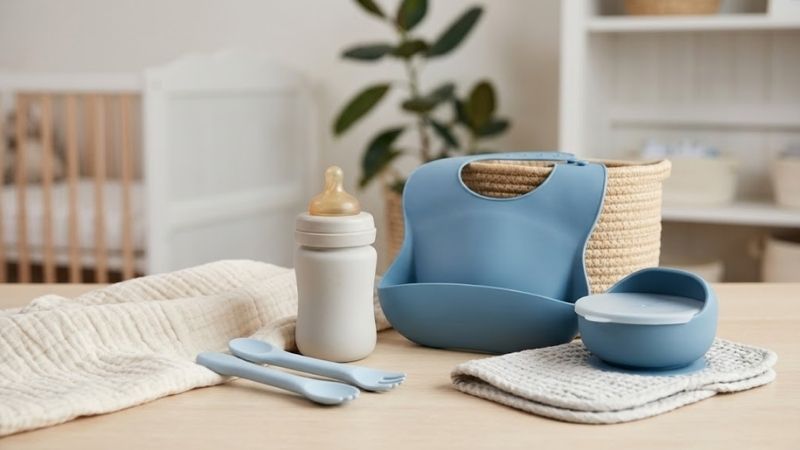
1. Dr. Brown’s Natural Flow Options+ Anti-Colic Baby Bottles
Dr. Brown’s Options+ bottles feature an internal vent system designed to eliminate vacuum pressure and air bubbles, reducing gas, spit-up, and colic symptoms.
- Best For: Newborns prone to colic, reflux, or uncomfortable feeding gas.
- Key Features: Patented internal green vent system; breast-like silicone nipple; vacuum-free paced feeding rate; BPA-free polypropylene construction.
- Pros:
- Clinically shown to preserve bottle milk nutrients by minimizing oxidation.
- Internal vent prevents nipple collapse during vigorous suction.
- Operates with or without the green vent insert as the baby matures.
- Cons:
- Multi-part assembly requires meticulous hand-cleaning with specialized wire brushes.
- Occasional leakage occurs if liquid exceeds the fill line or collar threads misalign.
- Use Case: Daily bottle feedings with pumped breastmilk or infant formula from birth through the first year.
- Who It’s For: Parents of newborns struggling with severe post-feed discomfort, painful burps, or frequent spit-ups.
2. Spectra S1 Plus Premier Rechargeable Breast Pump
The Spectra S1 Plus delivers hospital-strength suction combined with an integrated rechargeable battery, allowing nursing mothers to express milk efficiently without staying tethered to a wall outlet.
- Best For: Exclusively pumping mothers and working parents needing quiet, efficient expression.
- Key Features: Closed hygienic system with backflow protectors; built-in rechargeable battery; dual vacuum adjustments up to $270\text{ mmHg}$; integrated two-phase massage mode.
- Pros:
- Closed-system design guarantees milk never enters the pump tubing or motor.
- Ultra-quiet motor operation enables discreet nighttime pumping sessions.
- Independent cycle and vacuum controls closely replicate infant nursing patterns.
- Cons:
- Substantial pump footprint makes it bulkier to pack inside compact work bags.
- Flange sizing requires separate purchases if default sizes do not fit your anatomy.
- Use Case: Frequent milk expression at home, at the office, or during car travel.
- Who It’s For: Mothers prioritizing adjustable suction strength, hygiene protection, and cord-free pumping mobility.
3. Stokke Tripp Trapp High Chair
Crafted from solid European beech wood, the Stokke Tripp Trapp brings infants directly to the family dining table with fully adjustable seat and footrest panels that support proper spinal alignment.
- Best For: Long-term ergonomic posture from infant solids through childhood.
- Key Features: Fully adjustable seat and footplate depths and heights; five-point harness; water-based, non-toxic finish; $300\text{ lb}$ weight capacity.
- Pros:
- Dedicated 90-degree foot support facilitates safe swallowing and stabilizes the core during eating.
- Pulls up flush against standard dining tables to promote family socialization.
- Converts seamlessly from an infant high chair into a sturdy adult chair.
- Cons:
- High upfront investment compared to conventional plastic feeding chairs.
- Infant seat accessories, harness sets, and trays must often be purchased separately.
- Use Case: Starting infant-led weaning and puree feeding at $6\text{ months}$, continuing through school-age homework sessions.
- Who It’s For: Caregivers seeking durable, sustainably made furniture that encourages upright swallowing posture without disposable plastic parts.
4. ezpz First Tiny Cup and Spoon Set
Constructed from $100\%$ food-grade silicone, the ezpz First Feeding set helps infants master open-cup drinking and independent utensil dipping without irritating delicate gums.
- Best For: Developing fine motor skills and oral dexterity during early self-feeding.
- Key Features: Weighted cup base with sensory tactile bumps; narrow open-cup rim; short, wide, silicone-handled spoon; heat-resistant up to $350^\circ\text{F}$.
- Pros:
- Weighted cup bottom provides stability, reducing mealtime liquid tipping.
- Soft silicone protects emerging primary teeth and sensitive oral tissue.
- Compact spoon bowl perfectly matches an infant’s oral capacity.
- Cons:
- Small cup capacity ($2\text{ oz}$) requires constant refilling during meals.
- Pure silicone can absorb residual scents from perfumed dishwasher detergents.
- Use Case: Introducing water, breastmilk, purees, and soft mash at $6\text{ months}$ alongside solid food exploration.
- Who It’s For: Parents practicing baby-led weaning who want pediatric-recommended open cup training tools.
5. BEABA Babycook Solo 4-in-1 Baby Food Maker
The BEABA Babycook Solo combines steam cooking, blending, defrosting, and reheating into a single countertop vessel, allowing parents to prepare fresh, homemade baby food in under 15 minutes.
- Best For: Busy parents who want to prepare customized, preservative-free baby purees at home.
- Key Features: Patented steam cooking system; cyclone-effect stainless steel blending blade; single-hand dial control; automatic shut-off with audible cycle timer.
- Pros:
- Steam cooking preserves vital nutrients, vitamins, and natural meal flavors.
- Precision blade allows seamless progression from smooth purees to chunky toddler textures.
- Compact countertop footprint takes minimal kitchen workspace.
- Cons:
- Water reservoir requires periodic descaling with white vinegar to prevent mineral buildup.
- Cooking basket capacity ($4.7\text{ cups}$) limits large-scale bulk batch freezing.
- Use Case: Steaming and blending fruits, vegetables, poultry, and grains for fresh baby food batches.
- Who It’s For: Health-conscious families seeking to control ingredients and bypass store-bought jars and pouches.
6. Boon Grass Countertop Drying Rack
The Boon Grass countertop rack features a low-profile tray with flexible plastic blades that hold washed bottles, valves, pacifiers, and pump flanges upright to facilitate thorough air drying.
- Best For: Sanitary, organized air-drying of multi-piece baby bottles and pumping accessories.
- Key Features: Two-piece tray system; flexible vertical upright prongs; BPA-free, Phthalate-free, and PVC-free materials; compatible with vertical hanging accessories.
- Pros:
- Holds awkward pump parts, narrow straws, and wide collars firmly off wet surfaces.
- Excess water drains into the lower tray, away from clean silicone and plastic components.
- Sleek aesthetic keeps kitchen countertops looking modern and organized.
- Cons:
- Requires weekly disassembly and hand-washing to prevent water film in the bottom basin.
- Not rated safe for automated high-heat dishwasher cycles.
- Use Case: Post-wash air-drying of breast pump shields, bottle teats, medicine syringes, and toddler utensils.
- Who It’s For: Parents handling dozens of daily bottle and pump parts who need a clean, dedicated drying station.
7. OXO Tot Roll-Up Bib
The OXO Tot bib merges soft, comfortable fabric around the baby’s neck with a wide, food-safe silicone pocket that catches runaway solid food and rolls neatly into itself for storage.
- Best For: Catching heavy meal spills at home and dining out on the go.
- Key Features: Shaped silicone catch-all pocket; soft fabric upper collar; secure adjustable hook-and-loop closure; roll-up travel design.
- Pros:
- Flexible silicone scoop remains wide open beneath the chin to trap dropped food.
- Soft fabric collar prevents neck chafing commonly caused by stiff plastic bibs.
- Rolls completely into the bottom silicone pocket for clean, compact diaper bag transport.
- Cons:
- Fabric section requires periodic spot treatment or line drying after greasy liquid spills.
- Strong toddlers can occasionally pull off the hook-and-loop fastener.
- Use Case: Daily high-chair meals, baby-led weaning exploration, restaurant dining, and travel snacking.
- Who It’s For: Parents who want high-capacity food mess containment without causing uncomfortable friction around their baby’s neck.
Baby Feeding Essentials Buying Guide: What to Look For
Choosing the right nursery equipment requires evaluating safety certifications, materials, and daily practicality. To avoid cluttered countertops and buyer regret, assess every feeding purchase against core developmental criteria. This framework clarifies your choices so you invest only in durable, practical items.
1. Anti-Colic Venting and Flow Dynamics
- What: Engineering mechanisms in bottle nipples and internal chambers that regulate milk flow and equalize air pressure.
- Why: Unvented bottles force infants to swallow air bubbles, leading to stomach distension, painful gas spasms, and sleep disruptions.
- Who: Newborns, premature infants, and babies switching between maternal nursing and paced bottle feeds.
- Trade-off: Complex vent tubes and anti-vacuum inserts dramatically lower colic symptoms but require extra daily cleaning components.
2. Material Safety and Thermal Stability
- What: Baby equipment fabricated exclusively from platinum silicone, food-grade polypropylene, borosilicate glass, or untreated hardwoods.
- Why: Infants absorb synthetic chemicals easily; feeding gear must remain free of BPA, BPS, lead, and phthalates under high-heat steam.
- Who: Any infant ingesting heated milk, purees, or teething on high chair trays and utensils.
- Trade-off: Non-toxic glass and hardwood products offer maximum chemical safety and durability but add physical weight and retail cost.
3. Ergonomic Posture and Developmental Support
- What: High chairs and seating tools that offer 90-degree hip, knee, and foot support during solid food intake.
- Why: Dangling legs compromise core stability, reducing an infant’s chewing strength and increasing the physical risk of choking.
- Who: Infants starting complementary purees or finger foods from $6\text{ months}$ of age and beyond.
- Trade-off: Fully adjustable, developmental chairs carry a higher price tag than molded plastic models, but adapt as your child grows.
4. Daily Maintenance and Sanitization
- What: The ease with which gear can be disassembled, scrubbed, air-dried, or run through residential dishwashers and steam sterilizers.
- Why: Milk fat and formula residues breed bacterial film if trapped in hidden gaskets, tight straw crevices, or textured valves.
- Who: Busy households washing multiple bottle sets and pump collections multiple times each day.
- Trade-off: Intricately designed developmental accessories often necessitate hand washing and dedicated brush kits rather than fast dishwashing.
Frequently Asked Questions
First-time parents often face confusing choices when preparing for infant nutrition and milestone transitions. Below are concise, expert-backed answers to the most common questions regarding feeding schedules, equipment sanitization, and essential gear. Use these tips to feed your newborn safely and confidently.
How many baby bottles do I actually need to buy at first?
If formula feeding or exclusively pumping, keep 6 to 8 bottles on hand so you can navigate a full 24-hour cycle without washing parts after every feed. For primarily breastfed infants receiving occasional expressed milk, 3 to 4 bottles provide ample flexibility. Start by purchasing single-bottle test packs to confirm your baby accepts the nipple shape before investing in complete starter kits.
When should I transition my baby from bottles to an open cup?
The American Academy of Pediatrics recommends introducing small sips of water from an open training cup or straw cup around $6\text{ months}$ of age alongside solids. This practice builds facial muscle coordination, tongue posture, and oral dexterity. Aim to phase out infant bottles entirely between $12\text{ and }18\text{ months}$ to prevent tooth decay and bite misalignment.
Do I need to sterilize baby feeding equipment after every single use?
Healthy, full-term infants generally require rigorous steam or boiling water sterilization only prior to first use, followed by thorough hot, soapy washing or high-heat dishwasher cycles. However, if your baby was born prematurely, is under three months old, or has a compromised immune system, pediatricians recommend daily sanitization of all bottle nipples, valves, and breast pump parts.
What is the safest way to warm breastmilk or infant formula?
Never warm breastmilk or infant formula in a microwave oven, as uneven heating produces scalding hot spots that burn infant mouths and degrades critical protective antibodies in breastmilk. Instead, place the filled bottle in a warm water bath or use a dedicated electric bottle warmer that circulates gentle heat to approximately $98.6^\circ\text{F}$ ($37^\circ\text{C}$).
Master Mealtime with Confidence
Investing in dependable baby feeding essentials streamlines daily routines, minimizes colic symptoms, and creates positive mealtime memories. By choosing proven tools like Dr. Brown’s bottles and the Stokke Tripp Trapp chair, you support your child’s physical growth. Focus on safety and ease of cleaning for peace of mind.







Write Your Review
No reviews yet. Be the first to share your experience!