
Key takeaways
- Best Solution: Anti-tip steel cable furniture straps (such as Quakehold! or Skyla Homes Furniture Straps).
- Best For: Dressers, bookcases, display cabinets, and TV media consoles.
- Key Features: Aircraft-grade braided steel cables, metal brackets, triple-screw wall anchor points.
- Pros: Resists seismic shock and heavy climbing leverage; durable metal fittings do not crack like plastic.
- Cons: Requires drilling into solid wood studs and furniture backing.
- Use Case: Fastening tall or top-heavy storage units to prevent catastrophic crush injuries.
- Who It’s For: Every household with free-standing furniture taller than 24 inches.
What's inside
- Getting Started: When and How to Childproof
- Living Room: Anchoring Furniture and Managing Cords
- Kitchen and Bathroom: Chemical and Scald Protection
- Hallways and Stairs: Selecting Certified Safety Gates
- Electrical and Window Safety: Essential Safeguards
- Essential Baby Proofing Buying Criteria
- Frequently Asked Questions
Baby proofing transforms your living space into a safe exploration zone before your infant starts rolling, crawling, or pulling up on unstable surfaces. Navigating safety latches, safety gates, wall anchors, and outlet protectors often feels overwhelming, but prioritizing foundational hazards room by room eliminates guesswork. By securing heavy furniture, locking away hazardous household chemicals, and restricting stairway access early, you establish a resilient environment that protects your child from severe accidents while encouraging natural motor development.
- Getting Started: When and How to Childproof
- Living Room: Anchoring Furniture and Managing Cords
- Kitchen and Bathroom: Chemical and Scald Protection
- Hallways and Stairs: Selecting Certified Safety Gates
- Electrical and Window Safety: Essential Safeguards
- Essential Baby Proofing Buying Criteria
- Frequently Asked Questions
Getting Started: When and How to Childproof
The best moment to begin childproofing is around your infant’s fourth month, well before crawling and cruising begin around six to nine months. Gaining a child-centric perspective helps identify subtle household hazards that adults routinely overlook from standing height.
Getting down on your hands and knees reveals blind spots, dangling electrical wires, low unstable surfaces, and accessible small objects across your floors. Prioritize structural risks first—specifically tip-over hazards and stairway falls—before proceeding systematically room by room.
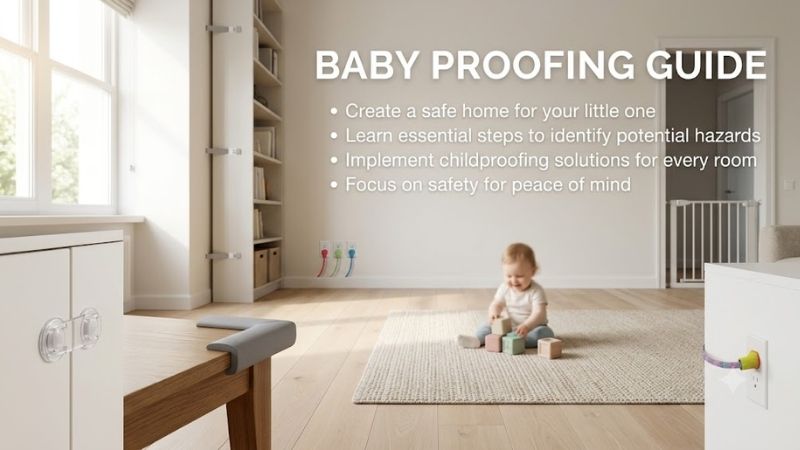
Living Room: Anchoring Furniture and Managing Cords
Living rooms present high-impact hazards due to heavy entertainment centers, unstable bookshelves, glass coffee tables, and tangled electronics cables. Toddlers rely on furniture edges to stand, making tip-over prevention your primary structural defense.
1. Secure Heavy Furniture to Wall Studs
Heavy items must be anchored directly into wall studs rather than dry wall alone.
- Best Solution: Anti-tip steel cable furniture straps (such as Quakehold! or Skyla Homes Furniture Straps).
- Best For: Dressers, bookcases, display cabinets, and TV media consoles.
- Key Features: Aircraft-grade braided steel cables, metal brackets, triple-screw wall anchor points.
- Pros: Resists seismic shock and heavy climbing leverage; durable metal fittings do not crack like plastic.
- Cons: Requires drilling into solid wood studs and furniture backing.
- Use Case: Fastening tall or top-heavy storage units to prevent catastrophic crush injuries.
- Who It’s For: Every household with free-standing furniture taller than 24 inches.
2. Protect Sharp Corners and Edges
Low coffee tables and hearth edges sit right at toddler head level, risking blunt-force facial lacerations during inevitable balance losses.
- Best Solution: Roving Cove Pre-Taped Edge and Corner Guards.
- Best For: Sharp glass tables, marble fireplace hearths, and square wooden coffee tables.
- Key Features: High-density closed-cell rubber foam, non-toxic flame retardants, pre-applied 3M adhesive tape.
- Pros: Absorbs heavy impacts effectively; neutral colorways blend into furniture; clean removal with heat.
- Cons: Curious toddlers may gradually pick at adhesive edges over prolonged periods.
- Use Case: Lining hard rectangular edges that sit lower than 30 inches from the floor.
- Who It’s For: Homes with low wooden, metallic, or masonry centerpieces.
Kitchen and Bathroom: Chemical and Scald Protection
Kitchens and bathrooms contain concentrated chemical, burn, and drowning hazards. Keeping toxic cleaners, sharp knives, hot appliances, and standing water inaccessible requires reliable mechanical latches and temperature controls.
1. Lock Lower Cabinets and Drawers
Under-sink areas house caustic dishwashing detergents, bleach, and drain cleaners that pose acute poisoning risks if breached.
- Best Solution: Eco-Baby Magnetic Cabinet Locks.
- Best For: Lower cabinets, deep cutlery drawers, and bathroom vanities.
- Key Features: Hidden interior latching mechanism operated exclusively by an exterior magnetic key.
- Pros: Completely invisible from the outside; leaves no visible drill holes when using adhesive mounts; includes disengage mode.
- Cons: If keys are misplaced, opening cabinets requires locating the spare magnetic key.
- Use Case: Securing cleaning supplies, medications, garbage disposals, and sharp utensils.
- Who It’s For: Families seeking robust child resistance without compromising cabinet aesthetics.
2. Regulate Water Heater Output
Water heated above $120^\circ\text{F}$ ($49^\circ\text{C}$) can cause third-degree burns to an infant’s delicate skin in less than three seconds.
- Actionable Step: Lower your household water heater thermostat setting to exactly $120^\circ\text{F}$.
- Supplementary Hardware: Install anti-scald thermostatic mixing valves or spout covers with integrated temperature sensors (such as the Munchkin White Hot Duck Spout Cover) to buffer sudden temperature spikes.
Hallways and Stairs: Selecting Certified Safety Gates
Staircases represent the most critical fall hazard in multi-level houses. Selecting the right safety gate mechanism depends heavily on mounting location, structural framing, and strict compliance with ASTM standards.
Hardware-mounted gates screw directly into wall framing or newel posts, providing structural rigidity against high push forces. Pressure-mounted models rely on tension between surfaces, making them unsuitable for top-of-stair placement.
+-------------------+--------------------------------+--------------------------------+
| Feature           | Hardware-Mounted Gates         | Pressure-Mounted Gates         |
+-------------------+--------------------------------+--------------------------------+
| Primary Location  | Top of stairs, structural gaps | Bottom of stairs, room dividers|
| Installation      | Screws directly into wall studs| Tension pads pressed on drywall|
| Threshold Bar     | None (flat walk-through floor) | Raised bar (creates trip risk) |
| Impact Resistance | Maximum (certified for drops)  | Moderate (can slip if pushed)  |
| Wall Damage       | Requires small screw holes     | Zero wall holes (adhesion only)|
+-------------------+--------------------------------+--------------------------------+
Top Pick: Regalo Easy Step Walk-Through Safety Gate
- Best For: High-traffic bottom-of-stairways and standard hallway openings (29 to 34 inches wide).
- Key Features: All-steel construction, dual-action safety locking handle, pressure-mount system with included wall-cup mounts.
- Pros: Easy one-handed adult lever latch; durable steel frame; includes extension kits.
- Cons: Contains a lower threshold bar, making it hazardous for top-of-stairs use unless wall-screwed with zero-threshold kits.
- Use Case: Blocking kitchen entryways, bottom stairs, and pet access corridors.
- Who It’s For: Budget-conscious parents needing a dependable, wide walk-through divider.
Electrical and Window Safety: Essential Safeguards
Exposed electrical outlets and dangling window blind cords present severe shock and strangulation threats. Remediating these vulnerabilities involves replacing loose plastic caps with sliding plate covers and securing window blind mechanisms.
Traditional plastic outlet plugs can be removed by persistent toddlers and quickly become choking hazards. Self-closing outlet wall plates automatically snap shut when cords are pulled out, providing continuous, fail-safe protection.
- Best Solution: Safety 1st Deluxe Press and Push Outlet Covers or Box Outlet Covers.
- Cord Safety Action: Eliminate looped pull cords by transitioning to cordless blinds or installing cord cleats mounted at least five feet above floor level.
- Window Stops: Install window wedges or stops limiting window openings to less than 4 inches ($10\text{ cm}$) to eliminate falls.
Essential Baby Proofing Buying Criteria
Choosing reliable safety products requires balancing durability, mechanical complexity, and installation demands. Evaluating purchases through a four-part framework ensures practical, lasting protection across your entire home.
- What: Certified hardware tested to ASTM International or EN safety benchmarks.
- Why: Cheap adhesives and fragile plastics crack under repeated lateral forces when toddlers shake them.
- Who: Multi-child households need one-handed operation latches so caregivers can open doors while carrying an infant.
- Trade-Off: Hardware-mounted installations take more setup time and leave screw holes, but they eliminate the catastrophic displacement risks inherent to tension-only designs.
Frequently Asked Questions
When should I start baby proofing my home?
Begin baby proofing around your baby’s fourth month. Initiating preparations before crawling starts ensures heavy items are securely anchored, chemical cabinets are locked, and stair gates are operational without last-minute rushing.
Are magnetic cabinet locks better than spring latches?
Yes. Magnetic locks remain hidden inside cabinets, eliminating visual clutter and preventing kids from using pry tools. Spring latches allow cabinets to open an inch, leaving pinch points for curious fingers.
Can I install a pressure-mounted gate at the top of stairs?
No, never use pressure-mounted gates at the top of stairs. Without permanent screw anchors into studs, a leaning or falling toddler can dislodge the tension pads, causing the child and the gate to fall down the staircase.
Executing a methodical, room-by-room baby proofing plan establishes a secure space that protects your curious toddler from major household hazards while granting your entire family invaluable peace of mind.









Write Your Review
No reviews yet. Be the first to share your experience!