
Key takeaways
- The Strategy: Use a circular nipple ruler or digital caliper to measure the diameter of your nipple base immediately before a session, then select a flange tunnel $2$–$3\text{ mm}$ wider than your measurement.
- Why It Matters: Standard $24\text{ mm}$ and $28\text{ mm}$ flanges packaged with most pumps are too large for over $60\%$ of women, pulling sensitive areolar tissue into the tunnel and causing friction blisters, vasospasms, and reduced milk yields.
- Pro Tip: If your nipple base measures $17\text{ mm}$, install an aftermarket $19\text{ mm}$ or $20\text{ mm}$ silicone flange insert into your standard shield rather than purchasing an entirely new shield assembly.
What's inside
Mastering pumping essentials transforms breastfeeding into an organized, sustainable routine. Whether returning to the workplace or exclusively pumping for your newborn, having vetted gear and a streamlined daily workflow prevents nipple trauma, maximizes milk output, and preserves sanity during demanding nighttime sessions.
How to Build an Efficient Pumping Routine: Step-by-Step
Establishing a seamless expression schedule requires the right physiological preparation, proper hygiene protocols, and responsive mechanical settings. Following these proven sequential steps helps parents protect their breast tissue, stimulate multiple letdowns, and collect clean breast milk with minimal daily disruption.
Step 1: Measure Your Nipple Base for Correct Flange Sizing
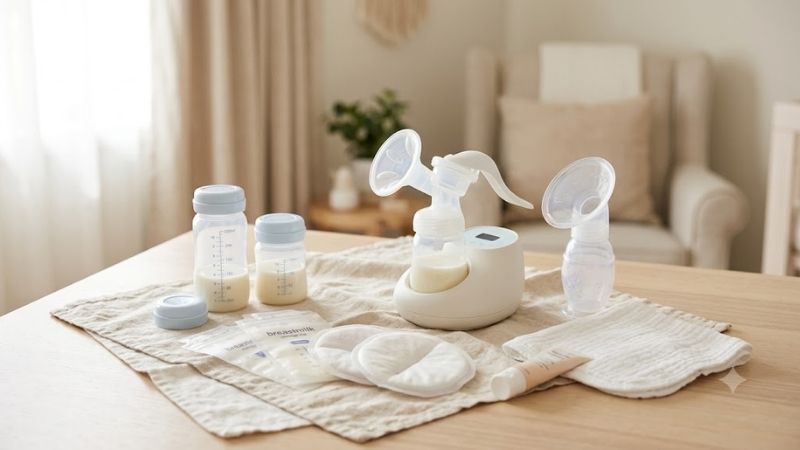
- The Strategy: Use a circular nipple ruler or digital caliper to measure the diameter of your nipple base immediately before a session, then select a flange tunnel $2$–$3\text{ mm}$ wider than your measurement.
- Why It Matters: Standard $24\text{ mm}$ and $28\text{ mm}$ flanges packaged with most pumps are too large for over $60\%$ of women, pulling sensitive areolar tissue into the tunnel and causing friction blisters, vasospasms, and reduced milk yields.
- Pro Tip: If your nipple base measures $17\text{ mm}$, install an aftermarket $19\text{ mm}$ or $20\text{ mm}$ silicone flange insert into your standard shield rather than purchasing an entirely new shield assembly.
Step 2: Establish a Dedicated and Sanitized Pumping Station
- The Strategy: Designate a permanent rolling utility cart or bedside table stocked with your pump, charging cords, spare duckbill valves, water bottle, silicone collection cups, and non-perishable snacks.
- Why It Matters: Searching for misplaced valve membranes or extension cords during engorged morning letdowns spikes cortisol levels, which physiologically inhibits oxytocin release and delays the milk-ejection reflex.
- Pro Tip: Keep an insulated lunch tote containing two reusable ice packs directly at your workstation to safely store fresh milk bottles for up to $24$ hours without walking to the kitchen refrigerator at night.
Step 3: Apply Flange Lubricant Prior to Expression
- The Strategy: Coat the inner tunnel of each plastic breast shield with three drops of food-grade organic coconut oil, olive oil, or lanolin-free nipple butter before initiating motor suction.
- Why It Matters: Dry plastic creates repetitive shear forces against delicate epidermal skin during $15$–$20$ minute suction cycles, leading to micro-tears, cracked skin, and bleeding.
- Pro Tip: Apply lubricant directly to the outer edges of your areola and nipple shaft with clean fingers rather than swabbing the inside of the funnel to ensure uniform, friction-free glide.
Step 4: Master the Two-Phase Cycle and Vacuum Adjustments
- The Strategy: Begin every session in “Massage” or “Stimulation” mode ($70$ cycles per minute at low suction) for $2$–$3$ minutes until milk flows, then toggle to “Expression” mode ($38$–$54$ cycles per minute) at your maximum comfortable vacuum.
- Why It Matters: Cranking vacuum levels to the highest setting does not extract more milk; excessive vacuum causes pain that triggers adrenaline, abruptly constricting milk ducts and halting milk flow entirely.
- Pro Tip: Once milk flow drops to slow intermittent drips around the $12$-minute mark, switch back to stimulation mode for $2$ minutes to trigger a secondary letdown before ending the session.
Step 5: Follow CDC-Compliant Sanitation and Storage Protocols
- The Strategy: Disassemble all milk-contact parts immediately after use, rinse in cold water to strip milk proteins, and wash in dedicated washbasins using warm soapy water before air-drying on an elevated drying rack.
- Why It Matters: Never place pump parts directly into shared kitchen sinks, which harbor pathogenic bacterial biofilms like Cronobacter sakazakii that thrive in warm, nutrient-dense breast milk residues.
- Pro Tip: If pumping multiple times during work hours without access to clean running water, store disassembled flange kits in a sealed, food-grade silicone bag inside your insulated cooler between sessions.
Top 5 Pumping Essentials for Output, Comfort, and Speed
Curating the right collection of gear transforms pumping from an exhausting chore into a manageable lifestyle. Each vetted essential below addresses a distinct friction point during daily lactation sessions, helping mothers express comfortable letdowns, protect sore skin, and store precious liquid gold with total confidence.
1. Spectra S1 Plus Electric Breast Pump – Best Overall Double Electric Pump
- Best For: Mothers needing hospital-strength suction combined with cordless battery portability for everyday home and office use.
- Key Features: Built-in rechargeable lithium-ion battery delivering over $3$ hours of cordless runtime; hygienic closed-system design with physical backflow membranes; fully customizable two-phase cycling with $12$ vacuum levels and $5$ cycle speeds; integrated nightlight with two brightness levels; whisper-quiet motor operating at under $45\text{ dB}$.
- Pros:
- Closed-system design guarantees zero moisture enters tubing or motor housing, preventing mold accumulation.
- Cordless internal battery allows total freedom from wall outlets during morning routines.
- Independent speed and suction controls allow exact replication of infant nursing cadences.
- Cons:
- Rounded chassis footprint is bulkier to transport in compact tote bags compared to wearable models.
- Packaged standard flanges ($24\text{ mm}$ and $28\text{ mm}$) require separate purchasing of smaller sizes.
- Use Case: Daily primary double-pumping for home, office desks, night feeding, and establishing baseline milk production.
- Who It’s For: Exclusively pumping mothers and working parents demanding reliable motor power, quiet pumping, and cordless flexibility.
2. Simple Wishes Signature Hands-Free Pumping Bra – Best Hands-Free Pumping Bra
- Best For: Pumping parents who need both hands free to work at a laptop, hold their infant, or massage breasts for increased milk drainage.
- Key Features: Fully adjustable four-way overlapping layer system designed to tightly lock all major flange necks in place; $10$-inch hook-and-loop back panel expanding or contracting up to $10$ inches for postpartum physical shifts; convertible front zipper configuration; breathable $83\%$ cotton blend with reinforced stitching.
- Pros:
- Firm cross-layer design maintains airtight flange suction without sagging or bottle slippage.
- Massive back panel adjustability accommodates natural breast size fluctuations before and after letdowns.
- Front zipper allows instant wear over standard nursing bras without fully undressing.
- Cons:
- Layered cotton construction around flange openings creates a visible profile under fitted work attire.
- Must be removed or unzipped for direct infant nursing sessions.
- Use Case: Securing double-electric collection bottles during computer work, driving, reading, or hands-on breast compressions.
- Who It’s For: Any parent using traditional flange-and-bottle electric pumps who wants true dual-hand freedom during pumping sessions.
3. Lansinoh Breastmilk Storage Bags – Best Milk Storage Bags for Space-Saving Freezing
- Best For: Creating a compact, organized breast milk freezer stash with reliable protection against punctures and accidental freezer burn.
- Key Features: Patented double Click ‘n’ Secure zipper seal preventing spills; reinforced double-sealed side seams engineered to withstand expansion during deep-freezing; pre-sterilized medical-grade polyethylene material free from BPA and BPS; write-on labeling tab positioned above fill line to prevent puncture risks; flat-freezing structural design.
- Pros:
- Lays completely flat when frozen, allowing space-saving vertical “brick” organization in small freezer drawers.
- Distinct audible click confirms the double zip closure is sealed before inversion or freezing.
- Large exterior label surface stays clear of condensation for legible dates and ounce measurements.
- Cons:
- Volumetric ounce markers printed on plastic bags can be slightly inaccurate compared to rigid collection bottles.
- Requires careful two-handed pouring when transferring thawed milk into narrow-neck infant bottles.
- Use Case: Safe medium- to long-term storage of expressed breast milk in kitchen freezers and deep chest freezers.
- Who It’s For: Parents building a supplemental milk supply for daycare, return-to-work routines, or emergency reserves.
4. Medela Quick Clean Micro-Steam Bags – Best Sanitizing Essential for Busy Parents
- Best For: Fast, reliable sanitization of breast pump shields, valves, and bottles at workplace offices, travel destinations, or between shifts.
- Key Features: High-heat steam sanitization eliminating $99.9\%$ of common household bacteria and germs within $3$ minutes; $20$ individual check-box uses tracked on the front of each durable bag; integrated steam-vent spout for safe scalding-free hot water drainage; compact, flexible pouch design easily tucked into pump travel bags.
- Pros:
- Eliminates the need for bulky countertop electric sterilizers or boiling pots of water.
- Built-in cool-touch corner grip and water drainage pour spout prevent steam burns during handling.
- Five-pack box supplies $100$ total sanitation cycles, delivering exceptional financial value.
- Cons:
- Cannot sanitize metal components or certain non-heat-resistant silicone items without melting risk.
- Requires direct access to a functional microwave with sufficient internal turntable clearance.
- Use Case: Rapid daytime disinfection of pump accessories in office breakrooms, airport lactation suites, and hotels.
- Who It’s For: Working parents and traveling mothers needing clinical-grade disinfection without carrying heavy sanitizing machines.
5. Earth Mama Organic Nipple Butter – Best Soothing Lanolin-Free Pumping Lubricant
- Best For: Preventing flange friction, soothing sensitive areolar tissue, and maintaining healthy skin barriers without synthetic additives.
- Key Features: $100\%$ USDA Certified Organic formula containing organic herbs, beeswax, and botanical plant butters; completely cruelty-free and non-GMO Project Verified; cruelty-free formulation free from petroleum, parabens, artificial fragrances, and lanolin; safe for direct ingestion by newborns with zero need to wipe off before infant feeding.
- Pros:
- Plant-based formula glides smoothly across skin without the sticky, draggy texture common to thick lanolin.
- Zero synthetic chemicals or toxins make it safe to leave on flanges and skin during nursing or pumping.
- Melts smoothly at body temperature to quickly penetrate rough, chafed, or raw nipple tissues.
- Cons:
- Natural vegetable oil base can leave light grease spots on delicate silk or synthetic clothing fabrics.
- Tends to liquefy if left in hot vehicles during summer travel, requiring cooling to firm up.
- Use Case: Flange tunnel lubrication prior to pumping sessions and soothing skin recovery immediately following vacuum cycles.
- Who It’s For: Mothers with sensitive skin, lanolin allergies, or persistent friction soreness caused by regular pump flange abrasion.
Key Buying Considerations for Pumping Gear and Essentials
Navigating lactation equipment requires evaluating daily portability, motor endurance, and skin-safe materials before making costly investments. Analyzing your pumping gear through four structured dimensions ensures every purchase supports long-term lactation goals without introducing unnecessary nursery clutter.
1. Motor Strength and Suction Adjustability
- What: Commercial-grade micro-piston motors offering variable suction strength ($0$–$280\text{ mmHg}$) and independently variable cycle speeds.
- Why: Breasts respond dynamically to distinct hormonal triggers; rigid, single-speed motors fail to elicit secondary letdowns and can bruise delicate glandular tissue over time.
- Who: Exclusively pumping mothers and parents establishing milk supply in the initial six weeks postpartum.
- Trade-off: High-powered piston motors require larger chassis housings and heavier internal components, making them bulkier to carry than wearable battery cups.
2. Flange Fit and Cushion Compatibility
- What: The internal diameter, funnel angle, and material composition of the funnel connecting directly against breast skin.
- Why: A mismatch as small as $2\text{ mm}$ pinches lactiferous ducts, cutting expressed milk yields by up to $30\%$ while causing severe tissue inflammation.
- Who: Mothers experiencing nipple blanching, persistent post-pumping soreness, or unexplained sudden drops in milk extraction.
- Trade-off: Custom silicone sizing cushions require separate purchasing, adding recurring replacement expenses and extra tiny components to wash daily.
3. Hands-Free Mobility and Power Portability
- What: Rechargeable internal lithium batteries, portable belt clips, and compatible hands-free bra harnesses.
- Why: Pumping multiple times daily for $20$ minutes while tethered to a static wall outlet creates physical fatigue, resentment, and workflow interruptions.
- Who: Mothers caring for active older siblings, commuting professionals, and parents working extended desk shifts.
- Trade-off: Lightweight wearable pumps with integrated cup motors generally deliver lower overall vacuum adjustability and feature smaller collection capacities ($4$–$6\text{ oz}$).
4. Cleaning Convenience and Dishwasher Safety
- What: Minimalist component design featuring BPA-free, heat-resistant plastics and single-piece silicone valves rated for steam sanitation.
- Why: Washing and sterilizing eight distinct flange assemblies three to six times a day quickly induces mental exhaustion and risks bacterial contamination if parts are hard to clean.
- Who: Sleep-deprived parents and working caregivers with restricted daily clean-up windows.
- Trade-off: Minimalist parts like combined valve-and-membrane pieces cost significantly more to replace if the thin silicone membrane tears during daily scrubbing.
Frequently Asked Questions About Pumping Essentials
Navigating pumping schedules, hygienic flange sanitation, and breast milk storage guidelines can feel overwhelming for busy parents. Below, we address five critical queries to help you refine your daily pumping routine, avoid common latch pitfalls, and maintain pristine feeding supplies without exhausting guesswork.
How do I know if my pump flange is the wrong size?
Flange size is incorrect if your areola is pulled deeply into the suction tunnel, if your nipple rubs aggressively against the plastic walls, or if the skin turns white or bright red during pumping. An optimal fit allows your nipple to move freely centered in the tunnel without pulling excess areolar tissue or causing friction pain.
How often do duckbill valves and silicone membranes need replacement?
Duckbill valves and thin silicone membranes should be replaced every $4$–$8$ weeks for frequent or exclusive pumpers, and every $8$–$12$ weeks for occasional pumpers. Silicone loses its elastic tension over time, which causes an imperceptible drop in vacuum suction and leads to reduced milk output and longer session times.
Can I store different pumping sessions together in the same milk bag?
Yes, but only after cooling both milk collections to the same temperature. Never pour warm, freshly expressed milk directly into already chilled or frozen milk, as the temperature difference warms the existing batch, encouraging bacterial proliferation and potentially compromising the immunological biofactors of the stored milk.
What is the “fridge hack” for pump parts, and is it safe?
The “fridge hack” involves placing unwashed pump parts in a sealed ziplock bag inside the refrigerator between sessions to skip washing during the day. While common among parents, the CDC cautions against this practice because household refrigerators do not stop bacterial growth entirely, posing contamination risks for preterm or vulnerable infants.
How many bottles and flange sets should an exclusively pumping mother own?
Exclusively pumping mothers should ideally own at least three complete sets of flanges, bottles, and valves. Having three full setups ensures you always have one clean set ready for unexpected sessions, one in current rotation, and one drying on the rack, eliminating the stress of emergency dishwashing during newborn sleep windows.
Conclusion
Investing in certified pumping essentials elevates daily lactation from an overwhelming physical chore into an empowering parenting journey. By prioritizing properly fitted flanges, double electric motors, and hygienic storage, you protect milk production while reclaiming invaluable rest and personal peace of mind.








Write Your Review
No reviews yet. Be the first to share your experience!