
Our Top Picks
 PlanToys® Dancing Alligator Pull Toy for Toddlers22.47 cubic inches9.7 x 3.9 x 3.7 inches0.9 poundsCheck on Amazon


A pull-along toy is often the first companion a new walker chooses for herself: a puppy, an alligator or a little dog on a cord that follows wherever she toddles. Unlike a push walker, which a baby leans on for support, a pull-along trails behind the child and rewards steps already taken, so it suits toddlers who are walking with reasonable confidence. The best pull-along toys for toddlers share a few traits: a low, stable body that does not tip on every turn, smooth wheels that roll on both carpet and hard floors, a short cord sized for small hands, and some kind of motion or sound that makes a child want to keep going. This guide compares five well-made options, from quiet wooden classics to electronic puppies that sing the alphabet.
As an Amazon Associate, we earn from qualifying purchases.
Quick answer
The best pull-along toys for toddlers are low, stable and easy to roll, with a short cord and a playful motion that rewards walking. The Hape Walk-A-Long Puppy suits pretend-play fans, the PlanToys Dancing Alligator adds click-clack sound without batteries, the BRIO Dachshund is a durable wooden classic, and the VTech and LeapFrog puppies layer in songs, letters and numbers.
Hape Walk-A-Long Puppy

Hape’s Walk-A-Long Puppy, model E0347, is a wooden pull toy with a trick most pull toys cannot match: the puppy can be posed sitting or standing, then rolled along when the walk resumes. As it moves, its head turns and its ears wiggle, which gives toddlers the feeling of walking a real dog rather than dragging a block on wheels. The wheels carry rubber rims, so the puppy rolls quietly and is kinder to hard floors than bare wooden wheels. Hape rates it for ages twelve months and up, and the solid wood construction shrugs off the drops and doorway collisions that are part of life with a one-year-old. There are no batteries, no sounds and nothing electronic to fail. Families who want one calm, well-finished wooden toy that works for both early pretend play and daily laps of the living room will find this the most versatile pick in the group. It is also a good choice for younger toddlers, because the sitting pose lets a child who is not walking yet push it around from a seated position.
PlanToys Dancing Alligator
The PlanToys Dancing Alligator, model 5105, has been a favorite wooden pull toy for decades, and its appeal is the movement: the segmented body ripples as it rolls, the head and tail bob up and down, and the body pieces make a rhythmic click-clack sound with every step. PlanToys makes it in Thailand from chemical-free rubberwood taken from trees that have finished producing latex, finished with formaldehyde-free glue, organic pigments and water-based dyes, which suits parents who read materials lists closely. At about 9.65 by 3.74 by 3.94 inches it is a manageable size for toddlers aged twelve months and up, and it needs no batteries because the sound is purely mechanical. The trade-off is volume: the clacking is charming in short bursts and noticeable on tile or hardwood during a long hallway session. Nothing on the toy comes loose for small hands, and the finish holds up well to being wiped clean. Choose the alligator if you want an eco-minded, battery-free pull toy with real personality, and accept that it announces itself as it travels.
BRIO Pull Along Dachshund
BRIO has sold a version of this pull-along dachshund since 1958, and the current model 30332 keeps the original idea intact: a low wooden dog whose head bobs, ears flap and tail wags as a toddler pulls it across the floor. It is made from FSC-certified wood with the smooth, rounded finish BRIO is known for, and BRIO rates it for children from twelve months, with the listing giving an upper guide of thirty-six months. The listing dimensions are about eight by five by four inches, so it is compact enough for apartment hallways and small play spaces. One point of diligence for this brand: BRIO has recalled other pull toys in the past, including a pull-along snail in 2006 and a caterpillar pull toy in 2002, both over choking hazards on small parts. Those recalls covered different models, and the dachshund is not among them, but it is a reminder to check the wheels and tail on any wooden pull toy periodically and retire it if anything works loose. For a gift-grade classic that grandparents may remember from their own childhood, this is the pick.
VTech Pull and Sing Puppy
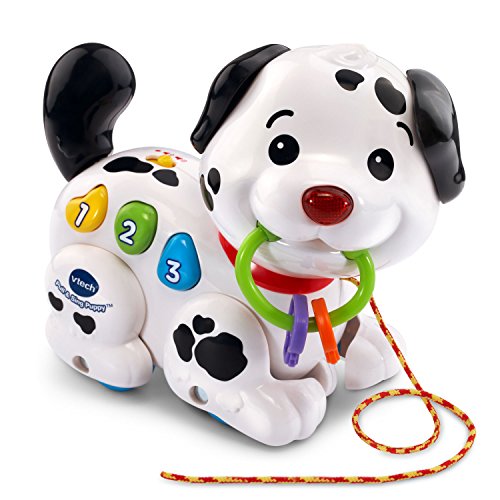
The VTech Pull and Sing Puppy, model 80-502800, is the electronic option for families who want a pull toy that also teaches. Three buttons on the puppy’s side introduce numbers, colors and music, and pulling the cord triggers songs, melodies and playful phrases as the puppy rolls and its tail spins. VTech rates it for ages six to thirty-six months, which makes it the one pick here a pre-walker can enjoy seated, pressing buttons long before the cord gets used for actual walks. The body is lightweight plastic rather than wood, so it is easy for small toddlers to pull and simple to wipe down, though it lacks the heirloom feel of the wooden toys in this guide. It runs on AAA batteries, and the sounds play at a level most parents describe as manageable rather than piercing. Pick the VTech if your toddler lights up for music and early words, and you want one toy that works from the sitting stage through confident walking. The cord stores against the body when it is not in use, which keeps it from trailing during seated play.
LeapFrog Wooden AlphaPup
The LeapFrog Wooden AlphaPup, model 80-615200, splits the difference between the wooden classics and the electronic VTech: a wooden pull-along puppy with electronic learning built in. As a toddler pulls it along, the AlphaPup wobbles, its tail lights up and wags, and it sings the alphabet song; buttons along its side let a seated child explore letters at her own pace. LeapFrog rates it for ages twelve months and up. The wooden body gives it more substance than an all-plastic toy, and the wobbling gait is deliberately a little silly, which toddlers tend to love. A note on this brand’s history: LeapFrog’s one pull-toy recall was a recall to repair for the much older Alphabet Pal caterpillar in 2000, a different product from a different era; the AlphaPup is not affected. Choose the AlphaPup if letters and songs are the draw but you still want the look and sturdiness of wood on the shelf. It needs batteries for the songs and lights, so keep spares if it becomes a daily favorite.
How to choose
Start with your child’s walking stage. A pull-along trails behind, so it works best once a toddler walks steadily and can glance backward without falling; a baby who still cruises furniture will get more from a push toy or from pushing a pull toy around while seated. Next, look at stability: a low center of gravity, a wide wheelbase and a body that rights itself or resists tipping will save frustration, because a toy that falls over at every turn quickly gets abandoned. Wheels matter more than they seem. Rubber-rimmed or rubber-edged wheels roll quietly and grip hard floors, while plain wood or plastic wheels are louder but often track better on carpet; if your home mixes both surfaces, rubber rims are the safer default. Check the cord: it should be short, fixed securely, and finished with a handle or loop a small hand can hold. Toy safety rules in the United States keep cords on toys for this age group short by design, and you should never lengthen one or tie on extra string. Then decide on sound. Mechanical sounds, like the alligator’s click-clack, need no batteries and cannot be switched off; electronic toys add letters, numbers and songs and usually offer volume settings, at the cost of batteries and a busier play style. Finally, check the age grading on the box, confirm there are no small detachable parts for your child’s stage, and wipe-down practicality: a toy that travels the whole house will meet the kitchen floor daily.
Who should skip
Skip pull-along toys for now if your baby is not yet walking independently; a trailing toy can pull a cruising baby off balance, and a supportive push walker is the better tool for that stage. Skip the electronic picks if your household is trying to keep the playroom quiet or battery-free, and skip the wooden click-clack alligator if your floors are hard and your patience for rhythmic noise is short. Pull-along toys are also the wrong purchase if you actually need a ride-on, a wagon for carrying cargo, or an outdoor toy; these five are indoor companions sized for hallways and living rooms. And if a toddler shows no interest in walking toys yet, wait a month or two rather than forcing it: interest in pulling something behind usually arrives soon after confident walking does.
FAQ
When can a baby start using a pull-along toy?
Most pull-along toys are graded for twelve months and up, and the right moment is when a toddler walks steadily across a room without holding on. Before that stage, many babies still enjoy a pull toy from a seated position, pushing it back and forth or pressing its buttons, so an early gift is rarely wasted.
Are pull cords on toddler toys safe?
Cords on toys for this age group are kept short under United States toy safety standards, and the five toys here use short fixed cords or leashes. Even so, a pull toy is a supervised toy: keep it out of cribs and beds, never let a child wrap the cord around her neck, and do not attach extra string to make the cord longer.
Is a wooden or an electronic pull toy better?
Neither is better for every family. Wooden pull toys are quiet or mechanically musical, durable and battery-free, and they lean toward pretend play. Electronic pull toys add letters, numbers, colors and songs, which some toddlers find motivating, but they need batteries and make more noise. Many families end up with one of each.
Do pull-along toys help toddlers learn to walk?
A pull-along toy does not teach walking and gives no support to lean on, so it is not a walking aid. What it does is reward walking that has already started: the motion, sound and company give a new walker a reason to cross the room again. For learning to walk itself, pediatric guidance favors barefoot time on the floor and sturdy furniture or push toys for support.
Final verdict
For most families, the Hape Walk-A-Long Puppy is the best single buy: it poses, rolls quietly on rubber-rimmed wheels and works from seated play through confident walking. The PlanToys Dancing Alligator is the pick for battery-free, eco-minded play with a little joyful noise, and the BRIO Dachshund is the classic gift choice. If songs and early learning matter most, choose between the VTech Pull and Sing Puppy for the youngest starters and the LeapFrog Wooden AlphaPup for letters in a wooden body.
Product and ASIN Reference
| Product | ASIN |
|---|---|
| Hape Walk-A-Long Puppy | B008E190RG |
| PlanToys Dancing Alligator | B000I8SMZE |
| BRIO Pull Along Dachshund | B0002HWQEE |
| VTech Pull and Sing Puppy | B01MQ3YP7Y |
| LeapFrog Wooden AlphaPup | B0C3VWHWCY |
FAQ
When can a baby start using a pull-along toy?
Are pull cords on toddler toys safe?
Is a wooden or an electronic pull toy better?
Do pull-along toys help toddlers learn to walk?
More from Amazon
Programs that pair well with the guide above. Offers and eligibility are set by Amazon and may change.
Build one list of everything you need for the new arrival and share it with family and friends.
Create a baby registrySet up recurring deliveries of everyday items on eligible products. Terms and savings are set by Amazon.
Explore Subscribe & SaveFree shipping on eligible items, Prime Video and more. Eligible new members can start with a free trial.
Start a Prime free trialAudiobooks and podcasts to listen to on the go. Eligible new members can start with a free trial.
Try Audible freeAs an Amazon Associate we earn from qualifying purchases.

Write Your Review
No reviews yet. Be the first to share your experience!