
Key takeaways
- Touring and regular overnight travel: Hard cases such as Givi Monokey or SW-Motech DUSC side cases make sense when your motorcycle has a compatible rack and you value locking storage, shape retention, and easy packing. Check whether the cases and rack are sold as a matched fitment for your exact model.
- Daily commuting: A single quick-release soft pannier or compact hard case is easier to manage than a wide touring pair. Choose a bag that comes off quickly if you carry a laptop or other valuables indoors; use a separate protective sleeve for electronics.
- Weekend rides on bikes without racks: Rackless soft luggage avoids buying a permanent frame. Look at purpose-built systems from brands such as Kriega, Mosko Moto, or Giant Loop, and confirm that the harness is compatible with your seat, bodywork, and passenger setup.
- Occasional use on a standard motorcycle: Throw-over textile saddlebags are often the lower-cost option. They can be convenient, but need careful securing, heat protection, and checks for movement during the ride.
The best motorcycle saddlebags depend on your bike and ride: choose a rigid, lockable hard case for frequent touring, a compact quick-release bag for commuting, or flexible roll-top luggage for occasional weekend trips. Before buying, compare usable capacity, mounting compatibility, exhaust and wheel clearance, weather protection, and how the material holds up to abrasion.
Best saddlebags by riding situation
- Touring and regular overnight travel: Hard cases such as Givi Monokey or SW-Motech DUSC side cases make sense when your motorcycle has a compatible rack and you value locking storage, shape retention, and easy packing. Check whether the cases and rack are sold as a matched fitment for your exact model.
- Daily commuting: A single quick-release soft pannier or compact hard case is easier to manage than a wide touring pair. Choose a bag that comes off quickly if you carry a laptop or other valuables indoors; use a separate protective sleeve for electronics.
- Weekend rides on bikes without racks: Rackless soft luggage avoids buying a permanent frame. Look at purpose-built systems from brands such as Kriega, Mosko Moto, or Giant Loop, and confirm that the harness is compatible with your seat, bodywork, and passenger setup.
- Occasional use on a standard motorcycle: Throw-over textile saddlebags are often the lower-cost option. They can be convenient, but need careful securing, heat protection, and checks for movement during the ride.
Capacity is not the same as usable space
Manufacturers usually state capacity in litres, but two bags with the same rating can pack very differently. A box-shaped case may use more of its stated volume for bulky clothing, while a tapered bag can be easier to fit around a motorcycle’s bodywork. Soft bags compress around a light load, but that flexibility can make packing and lashing less predictable.
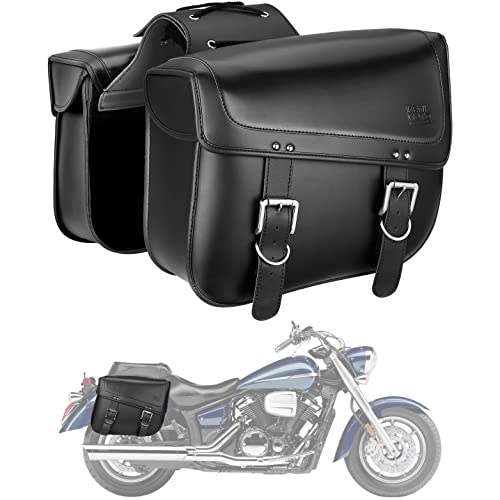
KEMIMOTO Motorcycle Saddlebags 30L Large Capacity Universal Saddle Bags
Included for 'Best Motorcycle Saddlebags for Different Rides' as a relevant option in this category; details come from the product listing.
View on Amazon
Milwaukee Leather Studded Throw-Over Motorcycle Saddlebags – Synthetic Leather – Universal Fit – Zip-Off - LG
Included for 'Best Motorcycle Saddlebags for Different Rides' because the listing specifies Synthetic Leather and Universal Fit, details this guide uses to compare options.
View on Amazon
Nomad Universal Motorcycle Saddlebags – 30L Large Capacity Quick-Easy Throw Over Bags for Cruiser, Chopper, Touring – Heavy Duty saddle bags,Waterproof,Secure Lock,Durable Storage Side Bags for Bikers
Included for 'Best Motorcycle Saddlebags for Different Rides' because the listing specifies 30L Large Capacity Quick-Easy Throw Over Bags for Cruiser and Chopper, details this guide uses to compare options.
View on Amazon
KEMIMOTO Motorcycle Saddlebags 40L(20Lx2) Large Capacity
Included for 'Best Motorcycle Saddlebags for Different Rides' as a relevant option in this category; details come from the product listing.
View on AmazonFor a sense of scale, a pair of 20-litre bags offers 40 litres of nominal capacity. That is often enough for a compact weekend kit, but not necessarily for two riders’ full-size helmets or bulky camping equipment. If you need to carry a specific item, compare its dimensions with the bag’s internal opening—not just the advertised litre figure. Also account for any space taken by internal liners, stiffeners, or mounting hardware.
| Bag type | Typical pair capacity | Mounting style | Weather protection | Best fit |
|---|---|---|---|---|
| Compact throw-over textile | 20–40 L | Straps over or beneath the seat | Varies; rain covers are common | Occasional weekend rides, limited budget |
| Rack-mounted soft panniers | 30–60 L | Straps, buckles, or brand-specific frames | Often a roll-top liner or separate dry bag | Mixed road and light off-road travel |
| Rack-mounted hard cases | 30–70 L | Dedicated side rack and locking mounts | Usually weather-resistant when correctly closed | Touring, commuting, frequent use |
| Rackless soft luggage | 25–50 L | Harness secured to the motorcycle | Depends on liner and closure design | Rack-free bikes and flexible trip packing |
These are broad product-category ranges, not guarantees for every model. A particular motorcycle may require smaller cases or a specific rack, and listed capacity may refer to a complete system rather than each side bag.
Compare the trade-offs that affect a real ride
Mounting and removal
Hard cases generally need a model-specific rack, which adds cost and can leave hardware on the bike when the cases are removed. Their quick-release mounts are convenient for carrying luggage indoors, but confirm that the case can actually be removed without tools and that the lock secures both the lid and attachment as intended.
Soft systems vary widely. Throw-over bags may fit several motorcycles, but loose straps can flap, loosen, or reach moving parts. Rackless harnesses can be secure when installed exactly as directed, though they take longer to fit and may obstruct a passenger seat or grab handles. If you regularly switch between solo and two-up riding, check that adjustment before purchase.
Rain, dust, and materials
A waterproof bag is not the same as a weather-resistant outer shell. Textile fabric can shed rain while seams, zippers, and closures still admit water. A removable waterproof liner or roll-top dry bag offers another layer of protection, but it needs to be closed correctly and checked for pinholes. Hard cases protect their contents from spray and grit when their seals and latches are in good condition; prolonged submersion is a different matter.
For textile luggage, look for abrasion-resistant panels, reinforced attachment points, and replaceable straps or buckles. For hard cases, inspect hinge areas, corner protection, lid seals, and latch availability. Any bag can wear prematurely if it rubs against a sharp panel, exhaust, or rack edge. Cleaning road salt and grit off promptly, drying luggage before storage, and avoiding harsh solvents help preserve fabrics, coatings, seals, and plastics.
Clearance matters as much as capacity
Measure the installed setup, not just the bag. Check clearance from the exhaust, rear wheel, suspension, indicators, passenger footrests, and any hot or moving components. Account for suspension movement and a loaded bag settling or bulging outward. Keep luggage clear of the tire even when the motorcycle is heavily loaded, and follow the manufacturer’s mounting instructions and load limits.
Wide cases can make filtering through traffic or parking in a narrow space more difficult. Soft bags are not automatically safer: a poorly restrained bag can shift into the wheel or exhaust. After installation, turn the wheel through its full range if relevant, compress the suspension only as the motorcycle manufacturer permits, and recheck strap tension after a short, safe ride.
A simple fit-and-cost check before you buy
Suppose you are comparing a 40-litre pair with a 50-litre pair. If your usual overnight kit occupies about 32 litres, the smaller set leaves 8 litres of nominal spare room; the larger leaves 18. That extra volume can be useful for wet-weather gear or souvenirs, but it may also add width and tempt you to carry more weight. Pack your regular items into a box or bag of known dimensions first, then compare those measurements with each product’s usable opening.
For a rack-mounted system, include the rack in the purchase calculation. A higher-priced bag that fits an existing rack may cost less overall than a cheaper set requiring a new frame. For a commuter, estimate how often you will remove the luggage: daily removal can make quick-release mounts worth paying for, while a bag used a few weekends each year may not justify permanent hardware.
Which one should you choose?
- Choose hard cases if you tour often, want lockable storage, and are comfortable with the added rack cost and width.
- Choose rack-mounted soft panniers if you want adaptable capacity and a lighter, less rigid setup, and do not mind managing liners and straps.
- Choose rackless luggage if avoiding a permanent rack is important and you are willing to spend time on careful installation.
- Choose throw-over bags for occasional, budget-conscious trips only when you can secure them away from hot and moving parts.
Before ordering, verify the motorcycle’s exact year and model fitment, the rack requirement, total installed width, exhaust clearance, and the manufacturer’s load limits. For mixed-weather riding, prioritize a dependable inner waterproof barrier over claims based only on the outer fabric. The best motorcycle saddlebags are the ones that fit your bike securely, protect the gear you actually carry, and remain manageable on the rides you take most.





Write Your Review
No reviews yet. Be the first to share your experience!