
Key takeaways
- Belt drive: Reinforced rubber belts produce the lowest typical vibration and are the best choice when a nursery, bedroom, office, or living room shares a wall with the garage. Belt replacement is an eventual maintenance cost, but belts do not require chain-style lubrication.
- Chain drive: Chains are often less expensive and can be an excellent choice for heavy doors or detached garages. Expect more sound, particularly from the rail and trolley. Use the lubricant specified by the manufacturer rather than coating every part with thick grease.
- Screw drive: Screw-drive openers have fewer moving parts than some chain systems, but temperature, lubrication, and rail condition affect their performance. They are less common among current premium residential choices.
- Jackshaft: A jackshaft is a mounting arrangement, not merely a stronger motor. It frees ceiling space but depends on a correctly installed torsion bar and costs more.
The best garage door opener for most homes is a 1¼-horsepower-equivalent belt-drive model with battery backup and built-in Wi-Fi, but a chain drive is usually the better value for a heavy door or detached garage.
Quick picks by garage situation
| Your situation | Best opener type | What to look for | Typical equipment price |
|---|---|---|---|
| Bedroom above or beside the garage | DC belt drive | Soft start/stop, vibration isolation, Wi-Fi, battery backup | $250–$500 |
| Heavy wood, insulated steel, or oversized door | Heavy-duty chain or high-lift-compatible commercial-style unit | ¾–1¼ HP equivalent, reinforced rail, correct door balance | $300–$700 |
| Frequent daily use | Premium belt or chain drive | DC motor, thermal protection, battery backup, durable trolley | $350–$700 |
| Lowest sensible cost | Chain drive | ½–¾ HP equivalent, rolling-code remotes, manual release | $150–$300 |
| Detached garage with weak Wi-Fi | Chain or belt drive with local controls | Reliable remotes, optional hub, antenna extension capability | $180–$450 |
| Very low or unusual ceiling | Side-mount jackshaft opener | Available torsion shaft, side clearance, professional installation | $500–$1,000 |
Best garage door openers compared
Best overall: Chamberlain B4613T
The Chamberlain B4613T is a strong fit for a typical attached two-car garage. It uses a belt drive for substantially quieter operation than a basic chain opener, includes built-in myQ connectivity, and is intended for standard sectional doors up to roughly 7 feet high. Its ¾-horsepower-equivalent DC motor is appropriate for many residential doors, provided the door is properly balanced.

Genie Chain Drive 500 Garage Door Opener - Model 1035 - Reliable Chain Drive Garage Opener,Black
Included for 'Best Garage Door Openers for Your Home' because the listing specifies Model 1035 and Reliable Chain Drive Garage Opener, details this guide uses to compare options.
View on Amazon
Chamberlain Belt Drive myQ Garage Door Opener, 3/4HP w/Fixed Camera
Included for 'Best Garage Door Openers for Your Home' because the listing specifies 3/4HP w/Fixed Camera, details this guide uses to compare options.
View on Amazon
Genie StealthDrive Connect Smart Belt Drive Garage Door Opener, 7155-TKV
Included for 'Best Garage Door Openers for Your Home' because the listing specifies 7155-TKV, details this guide uses to compare options.
View on Amazon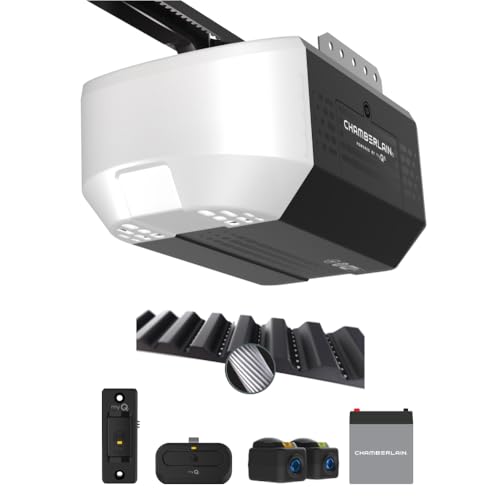
Chamberlain Belt Drive myQ Garage Door Opener, 1/2 HP w/Battery Backup
Included for 'Best Garage Door Openers for Your Home' because the listing specifies 1/2 HP w/Battery Backup, details this guide uses to compare options.
View on AmazonChoose it when noise, app control, and everyday convenience matter more than the lowest purchase price. It is not the right answer for an unusually heavy door simply because its horsepower label looks adequate: opener motors lift a balanced door, and a binding or overweight door should be repaired before a larger opener is installed.
Best quiet premium option: Chamberlain B6753T
The B6753T adds a stronger 1¼-horsepower-equivalent motor, belt drive, battery backup, built-in Wi-Fi, and an integrated wide-angle camera with two-way audio. The camera is useful if you want to check whether the door actually closed or confirm a delivery area, although it adds cost and another connected device to maintain.
This is a good match for a busy household, a garage attached to living space, or a door that needs more capacity than a basic residential unit. Expect to pay approximately $400–$600 for the opener package, depending on included accessories and promotions.
Best for a heavy or frequently used door: LiftMaster 84505R
The LiftMaster 84505R is a premium residential belt-drive opener with a 1¼-horsepower-equivalent motor, battery backup, built-in Wi-Fi, and integrated lighting. LiftMaster products are commonly sold through professional dealers and installed as systems rather than treated as simple shelf purchases.
Its advantages are power reserve, smooth operation, and a robust accessory ecosystem. It makes sense for a large insulated door, a garage used many times each day, or an owner who wants dealer support. A chain-drive LiftMaster with comparable capacity may cost less and can tolerate demanding use well, but it will transmit more mechanical sound and vibration.
Best value chain drive: Genie Chain Drive 550
The Genie Chain Drive 550 is a practical choice when price and basic reliability matter more than near-silent operation. Its chain mechanism is generally suited to standard residential sectional doors, and the package typically includes multiple remotes, wireless keypad support, and a rail system for common 7-foot doors.
Chain drives are not automatically less durable. Their exposed chain and sprocket simply require more attention to lubrication and adjustment, and they tend to sound louder as components age. For a detached garage or a home without rooms directly above the garage, that trade-off can be worthwhile.
Best for limited ceiling space: LiftMaster 8500W-style jackshaft opener
A side-mount jackshaft opener mounts beside the garage door and turns the torsion bar instead of hanging from the ceiling. This preserves overhead storage space and can work well where a conventional rail would interfere with a high-lift door, loft, or low ceiling.
It requires a compatible torsion-spring system, adequate side clearance, and careful installation. It is usually not the best do-it-yourself project because incorrect spring, cable, or force settings can create a dangerous door system. Budget approximately $500–$1,000 before or including professional installation, depending on the door and required accessories.
Drive types: belt versus chain versus jackshaft
- Belt drive: Reinforced rubber belts produce the lowest typical vibration and are the best choice when a nursery, bedroom, office, or living room shares a wall with the garage. Belt replacement is an eventual maintenance cost, but belts do not require chain-style lubrication.
- Chain drive: Chains are often less expensive and can be an excellent choice for heavy doors or detached garages. Expect more sound, particularly from the rail and trolley. Use the lubricant specified by the manufacturer rather than coating every part with thick grease.
- Screw drive: Screw-drive openers have fewer moving parts than some chain systems, but temperature, lubrication, and rail condition affect their performance. They are less common among current premium residential choices.
- Jackshaft: A jackshaft is a mounting arrangement, not merely a stronger motor. It frees ceiling space but depends on a correctly installed torsion bar and costs more.
Capacity, door size, and the horsepower trap
Most residential openers are designed for sectional doors around 7 feet high and up to approximately 350–550 pounds, though the exact limit varies by model, rail, door construction, and manufacturer. Some units support 8-foot doors with an extension kit; the opener package may not include that longer rail.
Do not choose by door weight alone. A properly balanced garage door should stay near mid-travel when disconnected from the opener and should move without binding. The springs carry most of the door’s weight; the opener supplies controlled movement. If the door drops, rises on its own, scrapes the tracks, or requires excessive force by hand, have a qualified garage-door technician correct it before replacing the opener.
For a simple comparison, suppose a garage door opens and closes six times per day. That is about 4,380 cycles per year. A household using the door 12 times daily reaches approximately 8,760 cycles per year. At that usage, battery backup, a DC motor, thermal protection, and a durable trolley can be more valuable than saving $100 on the initial purchase.
Smart features worth paying for
- Built-in Wi-Fi: Lets you check door status, receive alerts, and operate the door remotely. Confirm that the opener supports your home’s Wi-Fi frequency and that the app does not require a subscription for basic controls.
- Battery backup: Keeps the opener usable during a power outage. Many residential systems provide roughly 20–50 door cycles under favorable conditions, but cold temperatures and an aging battery reduce that figure.
- Integrated camera: Adds visual confirmation and sometimes two-way audio. It is helpful, but not essential to safe operation and may have cloud-storage fees.
- Automatic closing: A timer can close the door after a chosen interval. Use it cautiously if children, pets, or vehicles may cross the threshold; photo-eye sensors must remain correctly aligned.
- Rolling-code security: Modern remotes should change the access code after each use, reducing the usefulness of recorded transmissions.
Ownership costs and maintenance
Plan for more than the opener price. Professional installation commonly adds approximately $150–$400, while a jackshaft, unusually tall door, spring replacement, wiring work, or removal of an old unit can increase the total. Replacement backup batteries often cost about $25–$70 and may last two to five years depending on heat, use, and charging conditions.
The parts that commonly wear first are the door rollers, hinges, cables, springs, trolley, chain or belt, and plastic drive gears. In many cases, a noisy opener is reporting a door or roller problem rather than a failing motor. Inspect the rollers and hinges annually, keep the tracks clean but ungreased, test the auto-reverse function monthly, and test the photo-eye sensors by placing an appropriate object in the beam path according to the manual.
Never remove or adjust torsion or extension springs without the right training. These components store substantial energy. Also avoid defeating the photo-eye sensors, using excessive force settings to overcome a sticking door, or lubricating the belt with chain grease.
How to choose in five steps
- Measure the door width and height, and identify whether it is sectional or a one-piece design.
- Check whether the door is balanced and moves freely with the opener disconnected.
- Decide whether vibration or price is the dominant concern; that usually determines belt versus chain.
- Choose capacity based on the manufacturer’s door-size and weight limits, not horsepower marketing alone.
- Add battery backup and Wi-Fi if outages, remote monitoring, or frequent use justify the extra cost.
For most attached garages, a belt-drive opener such as the Chamberlain B4613T is the sensible starting point. Move to a stronger premium belt-drive system such as the Chamberlain B6753T or LiftMaster 84505R for heavy doors, high usage, or integrated camera and lighting needs. Choose a chain drive when value and ruggedness outweigh quietness, and choose a jackshaft only when the door and ceiling layout make a conventional rail impractical.



Write Your Review
No reviews yet. Be the first to share your experience!