
Key takeaways
- Best for one or two sources: Scarlett 2i2 4th Gen
- Best budget option: Scarlett Solo 4th Gen
- Best for a compact home studio: Scarlett 4i4 4th Gen
- Best for expansion without a rack unit: Scarlett 16i16 4th Gen
- Best for a small band: Scarlett 18i16 4th Gen
- Best for drums, ensembles, and permanent studios: Scarlett 18i20 4th Gen
- Best premium alternative: Clarett+ 4Pre or Clarett+ 8Pre
The best Focusrite audio interfaces depend on one question: do you need two inputs for a simple recording rig, four inputs for a small studio, or expandable I/O for drums, bands, and outboard equipment? For most solo musicians, the Scarlett 2i2 4th Gen is the best balance; the Scarlett 4i4 4th Gen suits small MIDI and hardware setups; and the Scarlett 18i20 4th Gen is the practical choice for a full band or permanent rack.
Best Focusrite audio interfaces by recording setup
- Best for one or two sources: Scarlett 2i2 4th Gen
- Best budget option: Scarlett Solo 4th Gen
- Best for a compact home studio: Scarlett 4i4 4th Gen
- Best for expansion without a rack unit: Scarlett 16i16 4th Gen
- Best for a small band: Scarlett 18i16 4th Gen
- Best for drums, ensembles, and permanent studios: Scarlett 18i20 4th Gen
- Best premium alternative: Clarett+ 4Pre or Clarett+ 8Pre
Focusrite interface comparison
| Model | Analog inputs | Analog outputs | Expansion and connections | Power | Best suited to |
|---|---|---|---|---|---|
| Scarlett Solo 4th Gen | 2 total: 1 mic/line and 1 instrument | 2 | USB-C; independent headphone output | USB bus-powered | Voice, guitar, podcasting, one-person recording |
| Scarlett 2i2 4th Gen | 2 mic/line/instrument inputs | 2 | USB-C; two headphone outputs | USB bus-powered | Vocals and instruments recorded together |
| Scarlett 4i4 4th Gen | 4: 2 mic/line/instrument and 2 line | 4 | USB-C, MIDI in/out, additional line outputs | USB bus-powered | Small studios, synths, reamping, monitoring |
| Scarlett 16i16 4th Gen | 8 analog, including 2 front-panel mic/line inputs | 8 | USB-C, MIDI, ADAT and S/PDIF digital expansion | USB-C power; check computer and mobile power limits | Producers who need more routing and future expansion |
| Scarlett 18i16 4th Gen | 8 analog, including 4 mic preamps | 8 | USB-C, MIDI, ADAT and S/PDIF | External power supply | Small bands and larger tracking sessions |
| Scarlett 18i20 4th Gen | 8 mic/line inputs plus digital expansion | 10 analog outputs | USB-C, MIDI, ADAT, S/PDIF, headphone outputs and rack mounting | External power supply | Drums, ensembles and permanent studios |
All of these Scarlett 4th Gen models support recording and playback up to 24-bit/192 kHz, although higher sample rates increase storage use and computer load. The input totals above distinguish physical analog inputs from digital expansion: an ADAT connection can add channels, but only when paired with a separate digital preamp or converter.
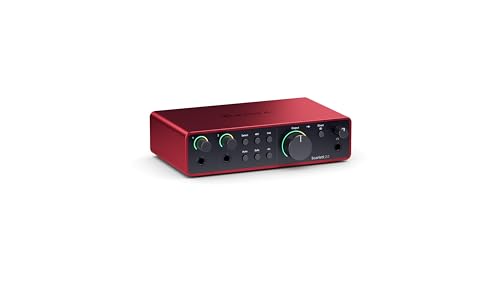
Focusrite Scarlett 2i2 4th Gen USB-C Audio Interface
Included for 'Best Focusrite Audio Interfaces for Every Setup' as a relevant option in this category; details come from the product listing.
View on Amazon
Focusrite Scarlett Solo 4th Gen USB-C Audio Interface
Included for 'Best Focusrite Audio Interfaces for Every Setup' as a relevant option in this category; details come from the product listing.
View on Amazon
Focusrite Scarlett 2i2 Studio 4th Gen USB-C Audio Interface Bundle
Included for 'Best Focusrite Audio Interfaces for Every Setup' as a relevant option in this category; details come from the product listing.
View on Amazon
Focusrite Scarlett Solo Studio 4th Gen USB-C Audio Interface Bundle
Included for 'Best Focusrite Audio Interfaces for Every Setup' as a relevant option in this category; details come from the product listing.
View on AmazonScarlett Solo versus 2i2: the important difference
The Scarlett Solo is the cheapest route into Focusrite’s current range, but its input layout is less flexible than the name “two inputs” suggests. One input is intended for a microphone or line-level source, while the other is primarily an instrument input. That works for a singer who records guitar and vocals separately, but it is not the ideal choice for recording two microphones at once.
The Scarlett 2i2 has two matching combination inputs, each capable of accepting a microphone, line-level device, or instrument. Choose it if you may record two microphones, stereo keyboards, two guitars, or a vocal and instrument simultaneously. It also provides two headphone outputs, which is useful when a performer and engineer need to monitor together.
For many buyers, the modest extra cost of the 2i2 is justified by avoiding an early upgrade. Choose the Solo only when its single microphone input and simple layout match your actual routine.
When the Scarlett 4i4 is worth paying for
The Scarlett 4i4 is a better fit for a producer than for someone who only records one voice. Its two front-panel combination inputs handle microphones, instruments, and line sources, while the additional rear line inputs can remain connected to a synthesizer, drum machine, mixer, or external preamp.
Its four outputs also make it more useful for separate monitor feeds, external effects, reamping, or a hardware-synth setup. MIDI input and output are another practical advantage: you can connect compatible keyboards and controllers without buying a separate MIDI interface.
Do not buy the 4i4 simply because four outputs sound better on paper. If your entire setup is one microphone, one pair of speakers, and headphones, the 2i2 provides the necessary connections with less unused hardware.
16i16, 18i16, or 18i20 for a growing studio?
Choose the 16i16 for routing and expansion
The Scarlett 16i16 is aimed at producers who have outgrown two or four inputs but do not necessarily need eight microphone preamps. It offers multiple analog inputs and outputs, digital connections, and ADAT expansion in a desktop-friendly format. It is a strong choice for a hybrid studio containing several line-level instruments, external processors, or a separate eight-channel preamp.
Its limitation is power and setup complexity compared with a 2i2 or 4i4. More cables, software routing, and digital-clock considerations are involved. It makes sense when those connections solve a real problem, not merely because a higher input count appears more professional.
Choose the 18i16 for small-band tracking
The 18i16 provides four built-in microphone preamps and additional line connectivity, making it more suitable for recording several performers at once. It is a sensible middle ground when eight mic preamps would be excessive but two or four would be restrictive.
Because it uses an external power supply, it is less convenient for mobile laptop recording than a bus-powered interface. In return, it is better suited to a stable desktop or studio installation with multiple connected devices.
Choose the 18i20 when the interface is the studio hub
The Scarlett 18i20 is the clearest choice for a drum kit, rehearsal-room recording, live multitrack capture, or an installation where microphones stay permanently patched. Eight microphone/line inputs, extensive outputs, digital expansion, multiple headphone connections, and a standard rack format make it easier to organize a larger system.
It is not automatically the best-sounding choice for a solo artist. Its value comes from simultaneous inputs and routing convenience. If you record one or two sources at a time, its extra channels add cost, space, and setup work without improving the recording by themselves.
Scarlett versus Clarett+
The Clarett+ range sits above Scarlett in Focusrite’s lineup and is intended for users who place greater value on premium conversion, additional studio-oriented features, and a more refined hardware platform. The Clarett+ 2Pre provides two microphone preamps in a relatively compact format, while the Clarett+ 4Pre and 8Pre suit progressively larger recording systems.
For a first interface, a Scarlett 2i2 or 4i4 usually offers the more sensible value. Consider Clarett+ when you already understand your I/O requirements, use higher-end microphones or outboard equipment, and expect the interface to remain central to the studio for several years. The extra purchase cost is easier to justify when you will use its additional connectivity and premium features regularly.
Decision matrix: which Focusrite should you buy?
| Your situation | Recommended model | Why | Potential drawback |
|---|---|---|---|
| Low budget, occasional solo recording | Scarlett Solo 4th Gen | Small, simple and bus-powered | Not ideal for two microphones at once |
| Regular vocals and guitar or piano | Scarlett 2i2 4th Gen | Two matching inputs and dual headphone monitoring | Limited outputs and no MIDI |
| Home producer with synths or MIDI hardware | Scarlett 4i4 4th Gen | More outputs, line inputs and MIDI | Costs more than needed for basic recording |
| Several line devices and future digital expansion | Scarlett 16i16 4th Gen | Flexible routing and ADAT capability | Requires more planning and cable management |
| Small band or multi-person session | Scarlett 18i16 4th Gen | Four mic preamps plus wider I/O | Needs external power |
| Drums, ensemble or fixed rack studio | Scarlett 18i20 4th Gen | Eight mic inputs and extensive monitoring connections | Large, mains-powered and excessive for solo work |
Power, portability, and ownership considerations
Bus-powered models draw power through USB, so they are convenient with laptops and tidy desktop systems. They are also more sensitive to the quality of a computer’s USB power, especially when used with tablets, phones, hubs, or long adapter chains. If you plan to record away from a desk, verify that your host device and USB-C adapter can provide adequate power.
Externally powered models are less portable but more appropriate for a permanent studio. They avoid relying entirely on the computer’s USB power and accommodate larger I/O designs. Keep the power supply with the interface: replacing a lost adapter requires matching the correct voltage, polarity, and current rather than choosing a generic USB charger.
The parts most likely to cause ownership frustration are not the converters. Connectors can loosen after repeated cable strain, headphone sockets can become noisy when plugs are inserted at an angle, and gain knobs can collect dust. Use short, properly supported cables, avoid placing heavy adapters on the USB connection, and keep unused ports covered in dusty rooms. Do not use contact cleaner or liquid inside the unit unless a qualified technician recommends it.
A practical way to calculate the right input count
List every source you want to record at the same time, then add one or two spare inputs. For example, a singer-songwriter may need one vocal microphone, one guitar pickup, and a stereo keyboard: 1 + 1 + 2 = 4 inputs. A 2i2 would require repeated repatching, while a 4i4 could handle the setup more comfortably. A drum session with eight microphones already uses all eight inputs on an 18i20, leaving no spare channel for a room microphone or talkback source; an ADAT-equipped expansion path may therefore be worthwhile.
This calculation is more useful than choosing by brand or maximum advertised channel count. Buy the smallest Focusrite that covers your simultaneous sources, monitoring outputs, connection type, and power situation, with enough headroom for the equipment you expect to add next.
Final recommendation
Choose the Scarlett 2i2 4th Gen for the broadest range of beginner and home-recording setups. Choose the Solo for genuinely simple one-microphone work, the 4i4 for MIDI and hardware-based production, the 16i16 for expandable routing, and the 18i16 or 18i20 when several microphones must be recorded at once. Move to Clarett+ when premium studio features matter more than the lowest cost. The best Focusrite audio interfaces are not ranked by channel count alone; the right one is the model whose inputs, outputs, connections, and power requirements match the way you record now and the next setup you are likely to build.

Write Your Review
No reviews yet. Be the first to share your experience!