
Key takeaways
- Socket: Confirm support for your exact platform, such as AM4, AM5, LGA1700, or LGA1851. Mounting kits are not interchangeable across every generation.
- Case height: Measure the case’s stated CPU-cooler limit. Leave at least 3–5 mm of practical margin rather than treating the limit as a target.
- RAM height: Standard-height modules are usually easiest. Tall heat spreaders and integrated lighting may require raising the front fan.
- Motherboard layout: Check for interference with the top PCIe slot, VRM heatsinks, and tall motherboard heatsinks.
- Power connector access: Install the CPU power cable before fitting a large tower if the cooler may block access to the connector.
- Fan headers: Two-fan coolers may need a splitter or two motherboard headers. Verify that the headers can supply the fans’ combined current.
The best fan CPU coolers for quiet performance are the Thermalright Phantom Spirit 120 SE for value, Noctua NH-D15 G2 for premium low-noise cooling, Arctic Freezer 36 for compact mainstream PCs, and be quiet! Dark Rock 5 when you want a quiet single-tower design with easier RAM clearance.
Quick comparison
| Cooler | Design and size | Approx. weight | Fan setup | Best suited CPU class | Typical market range |
|---|---|---|---|---|---|
| Thermalright Phantom Spirit 120 SE | Dual tower, about 154 × 125 × 110 mm | About 1,000 g | Two 120 mm fans, up to about 1,500 rpm | Mainstream and high-performance CPUs at a value price | About $35–$50 |
| Noctua NH-D15 G2 | Dual tower, about 168 × 150 × 152 mm with fans | About 1,525 g | Two 140 mm fans, up to about 1,500 rpm | High-wattage CPUs and sustained workloads | About $140–$160 |
| be quiet! Dark Rock 5 | Single tower, about 161 × 136 × 101 mm with fan | About 1,030 g | One 135 mm fan, up to about 2,100 rpm | Quiet mainstream and upper-mainstream systems | About $70–$90 |
| Arctic Freezer 36 | Single tower, about 159 × 104 × 126 mm | About 900 g | Two 120 mm fans, up to about 2,000 rpm | Budget and midrange CPUs | About $30–$45 |
| Cooler Master Hyper 212 Halo | Single tower, roughly 154 × 125 × 73 mm before fan overhang | About 800 g | One 120 mm fan, up to about 2,050 rpm | Entry-level and moderately powerful CPUs | About $35–$55 |
Dimensions and weight can vary slightly by revision, mounting hardware, and whether the manufacturer counts fan clips or protruding components. Check the exact product page before ordering, particularly for a compact case.
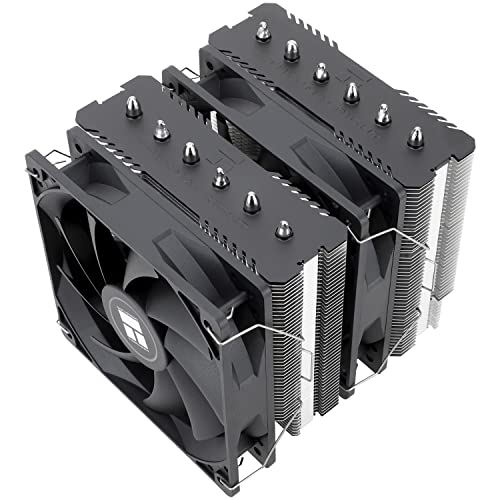
Thermalright Peerless Assassin 120 SE CPU Cooler, 6 Heat Pipes AGHP Technology, Dual 120mm PWM Fans, 1550RPM Speed, for AMD:AM4 AM5/Intel LGA 1700/1150/1151/1200/1851,PC Cooler
Included for 'Best Fan CPU Coolers for Quiet Performance' because the listing specifies 6 Heat Pipes AGHP Technology and Dual 120mm PWM Fans, details this guide uses to compare options.
View on Amazon
Cooler Master Hyper 212 Black CPU Air Cooler, 4 Heat Pipes, PWM Fan
Included for 'Best Fan CPU Coolers for Quiet Performance' because the listing specifies 4 Heat Pipes and PWM Fan, details this guide uses to compare options.
View on AmazonWhich cooler should you choose?
Best value for quiet high-performance cooling: Thermalright Phantom Spirit 120 SE
The Phantom Spirit 120 SE uses two aluminium fin towers, a copper base, and two 120 mm fans. Its dual-tower layout provides substantially more fin area than a basic single-tower cooler, while 120 mm fans are easier to replace and usually create fewer motherboard-clearance problems than large 140 mm models.
It is the strongest choice when cooling capacity matters more than brand extras. At moderate fan speeds, its large heatsink can handle many high-performance desktop processors without the constant high-pitched airflow associated with small stock coolers. Installation is moderately difficult: the motherboard may need to be accessed from behind, and the second fan can interfere with tall memory modules.
Its main weakness is not thermal capacity but fit. The cooler is approximately 154 mm tall, so a case rated for only 155 mm leaves almost no practical margin. Front RAM clearance also depends on fan height; raising the front fan can make the assembly taller than the published specification.
Best premium option: Noctua NH-D15 G2
The NH-D15 G2 is designed for large, sustained CPU loads. Its two dense fin towers and 140 mm NF-A14x25r G2 fans provide a large cooling surface with relatively low rotational speed. The included low-noise adapters can further reduce fan speed, although reducing speed also reduces peak cooling capacity.
This is the most appropriate choice for a powerful processor used for rendering, compiling, simulation, or long gaming sessions, provided the case and memory are large enough. The standard configuration has generous clearance around the socket, but the overall cooler is wide and tall. Some memory configurations require the front fan to be raised, and that can exceed a case’s CPU-cooler height limit.
Installation is more involved than with a single tower because the heatsink is heavy and access around the mounting bars is restricted. Noctua’s mounting system is well documented, but the cooler’s price is difficult to justify for a low-power processor or a system used mainly for web browsing.
Best balanced single-tower design: be quiet! Dark Rock 5
The Dark Rock 5 is a sensible middle ground. Its single tower is easier to position than a dual-tower cooler, and the front fan is less likely to cover four DIMM slots. The 135 mm fan provides more airflow potential than a typical 120 mm fan while keeping the overall footprint narrower than many dual-tower designs.
It suits a quiet productivity or gaming computer using a mainstream processor. It does not have the same sustained-load headroom as the largest dual-tower models, but its simpler layout makes installation and memory compatibility easier. The black coating also gives it a uniform appearance, though the coating does not eliminate the need to check case height.
Best compact mainstream choice: Arctic Freezer 36
The Freezer 36 is a practical choice for a midrange system where price, noise, and RAM compatibility matter. Its two 120 mm fans use a push-pull arrangement, allowing the heatsink to move air effectively without relying on one very fast fan. The single-tower shape leaves more room around the memory slots than most dual-tower coolers.
It is particularly attractive for processors that are efficient at stock settings. With a high-power CPU running unrestricted turbo behavior, temperatures and noise can rise sooner than with a larger dual-tower cooler. Installation is generally easier than with the Phantom Spirit, but the fan clips and mounting brackets still need careful alignment.
Best basic upgrade: Cooler Master Hyper 212 Halo
The Hyper 212 remains useful for entry-level and moderate-power builds because its single-tower design is familiar, affordable, and broadly compatible across common Intel and AMD desktop sockets. The Halo version adds a 120 mm fan and addressable lighting, although lighting is not a cooling advantage.
Choose it when the processor’s heat output is modest or when the goal is to replace a noisy boxed cooler. It is not the best option for an unrestricted high-end CPU: its smaller heatsink has less thermal reserve, so the fan may need to spin faster during sustained workloads.
Cooling capacity versus noise
Heatsink capacity and acoustic performance are closely related but not identical. A larger heatsink can remove the same amount of heat at a lower fan speed. That is why a dual-tower cooler with two slow 120 mm fans can be quieter under load than a small cooler using one fast fan.
Noise also depends on the fan curve, case ventilation, pump noise from other components, and the CPU’s power limits. A cooler advertised with a low maximum noise figure may still become audible if the motherboard is configured to run the fan at maximum speed whenever the CPU briefly boosts.
For quiet operation, set a gradual fan curve rather than reacting to every short temperature spike. A typical starting point is 30–40% fan speed below 60°C, 50–65% around 75°C, and maximum speed only near the processor’s chosen thermal limit. Exact values depend on the CPU and motherboard.
Fit and compatibility checklist
- Socket: Confirm support for your exact platform, such as AM4, AM5, LGA1700, or LGA1851. Mounting kits are not interchangeable across every generation.
- Case height: Measure the case’s stated CPU-cooler limit. Leave at least 3–5 mm of practical margin rather than treating the limit as a target.
- RAM height: Standard-height modules are usually easiest. Tall heat spreaders and integrated lighting may require raising the front fan.
- Motherboard layout: Check for interference with the top PCIe slot, VRM heatsinks, and tall motherboard heatsinks.
- Power connector access: Install the CPU power cable before fitting a large tower if the cooler may block access to the connector.
- Fan headers: Two-fan coolers may need a splitter or two motherboard headers. Verify that the headers can supply the fans’ combined current.
Decision matrix
| Your situation | Recommended type | Why |
|---|---|---|
| Budget build with a midrange CPU | Arctic Freezer 36 | Good fin area and two fans without the size of a large dual tower |
| High-performance CPU under sustained load | Noctua NH-D15 G2 or Phantom Spirit 120 SE | Large thermal mass and more surface area reduce fan-speed requirements |
| Limited RAM clearance | Single-tower cooler such as Dark Rock 5 or Freezer 36 | Less likely to cover the DIMM slots |
| Small case with a tight height limit | Low-profile cooler or a compact single tower | Large towers may not leave enough side-panel clearance |
| First-time builder | Single-tower cooler | Fewer fan clips and less weight to manage during installation |
| Lowest cost per cooling capacity | Phantom Spirit 120 SE | Dual-tower performance at a relatively modest market price |
Installation and maintenance that affect noise
Install the backplate and mounting brackets according to the cooler’s manual, then apply a small central amount of thermal compound unless the instructions specify another pattern. Tighten the heatsink screws alternately, a few turns at a time, so pressure remains even. Mount the fans so they move air from the front of the case toward the rear exhaust fan.
After installation, check that no cable touches a fan blade. In the BIOS or system software, confirm that both fans are detected and that their control mode matches the connector type. A four-pin PWM fan should normally use PWM control; an incorrect setting can leave the fan running faster than necessary.
Dust is the first maintenance issue for most air coolers. Every few months, switch off the computer, hold the fan blades still, and blow dust through the fins with compressed air. Holding the blades prevents them from spinning excessively and generating unwanted electrical back-voltage. Clean the case filters at the same time. Thermal compound usually does not need routine replacement unless the heatsink has been removed, temperatures have changed noticeably, or the compound has dried after several years.
Final verdict
For most buyers, the Phantom Spirit 120 SE offers the best combination of cooling capacity, low-speed acoustics, and price, provided the case and RAM can accommodate a dual tower. Choose the NH-D15 G2 for a premium, long-term high-load system; the Dark Rock 5 for easier single-tower fitting; and the Freezer 36 for a compact, affordable mainstream build. The Hyper 212 Halo is best reserved for lower-power processors or a simple boxed-cooler replacement rather than the quietest high-performance configuration.

Write Your Review
No reviews yet. Be the first to share your experience!