
Key takeaways
- Brush metal chips and grit from the shoe after use; debris can mark the conduit and prevent it from seating correctly.
- Wipe galvanized conduit residue from the groove rather than allowing it to build up into a hard ridge.
- Keep pivot points and ratcheting mechanisms lubricated according to the manufacturer’s instructions.
- Do not hammer the handle to force a bend unless the tool is specifically designed for that method.
- Never use a pipe extension that exceeds the tool’s instructions; excessive leverage can bend the handle or damage the shoe.
- Store aluminum heads dry and protect cast markings from grinding dust and welding spatter.
Best Conduit Benders for EMT and Rigid Conduit
The best conduit benders for EMT and rigid conduit are usually not the same tool: a hand bender with an EMT shoe is ideal for routine electrical metallic tubing, while rigid and IMC require a deeper, stronger shoe or a mechanical bender designed for the thicker wall and larger outside diameter.
Quick picks by job situation
| Situation | Best bender type | Typical conduit range | Approximate tool weight | Why it fits |
|---|---|---|---|---|
| Occasional residential or light commercial work | Cast-aluminum hand bender with EMT shoe | 1/2, 3/4, and 1 inch EMT | 2 to 5 lb per head | Low cost, portable, and sufficient for common offsets and 90-degree bends |
| Frequent service work | Professional ductile-iron or reinforced aluminum hand bender | 1/2 to 1-1/4 inch EMT | 3 to 7 lb per head | Clear markings and stronger handles tolerate repeated bending |
| Small rigid or IMC installation | Dedicated rigid/IMC hand bender or heavy-duty combination bender | 1/2 to 1 inch rigid or IMC | 5 to 12 lb | Deeper groove and higher leverage reduce flattening and slipping |
| Large conduit or production work | Mechanical, ratcheting, or powered bender with interchangeable shoes | 1-1/4 to 4 inches, depending on model | 20 to more than 100 lb | Consistent bend geometry with much less physical effort |
| Very limited storage or ladder work | Compact hand bender with removable handle | 1/2 to 3/4 inch EMT | 2 to 4 lb | Easy to carry, although it sacrifices capacity and leverage |
EMT, rigid, and IMC: choose for the actual material
EMT is thin-wall tubing and is the easiest of the three to bend by hand. Most familiar hand benders are made primarily for EMT. Their shoe grips the outside diameter without crushing the tube, and their markings are arranged around the common 10-degree, 22.5-degree, 30-degree, 45-degree, and 60-degree bends used in electrical work.

Gardner Bender 962 BigBen Aluminum Conduit Hand Bender Head, 1 inch EMT and ¾ inch Rigid IMC, Industry Standard Measurements, Fits (BH-75) Handle
Included for 'Best Conduit Benders for EMT and Rigid Conduit' because the listing specifies 1 inch EMT and ¾ inch Rigid IMC and Industry Standard Measurements, details this guide uses to compare options.
View on Amazon
Klein Tools 51607 Aluminum Conduit Bender Full Assy, 3/4 EMT, 1/2 RMC & IMC
Included for 'Best Conduit Benders for EMT and Rigid Conduit' because the listing specifies 3/4 EMT and 1/2 RMC & IMC, details this guide uses to compare options.
View on Amazon
TEMCo 2 in 1 Dual Shoe Conduit Bender - 1/2" & 3/4" EMT, 1/2" Rigid - 2 Benders in 1 Tool
Included for 'Best Conduit Benders for EMT and Rigid Conduit' because the listing specifies 1/2" & 3/4" EMT and 1/2" Rigid, details this guide uses to compare options.
View on Amazon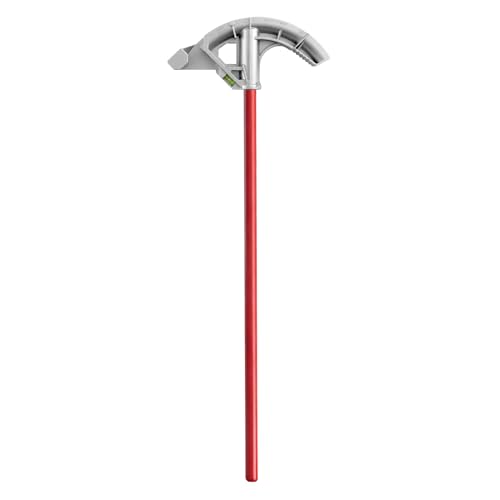
1" Aluminum Conduit Bender for 3/4" & 1" EMT, IMC, RMC& Rigid Pipe
Included for 'Best Conduit Benders for EMT and Rigid Conduit' because the listing specifies IMC and RMC& Rigid Pipe, details this guide uses to compare options.
View on AmazonRigid metal conduit has a thicker wall and is substantially harder to bend. Its outside diameter may be similar to EMT of the same trade size, but the bending force is not. A standard lightweight EMT shoe can slip, distort the conduit, or leave an inaccurate bend when used on rigid. Look for a bender explicitly marked for rigid, a rigid-specific shoe, or a combination tool whose manufacturer lists both materials.
IMC is lighter than rigid but still thicker and stiffer than EMT. Some benders accept both rigid and IMC; others accept only one. Do not assume that a “universal” head fits every conduit type. Check the tool’s capacity chart for the exact trade size and material, particularly at 1-1/4 inches and above.
What separates a good bender from a frustrating one?
Shoe markings and bend accuracy
Clear, deeply cast markings are more useful than a long list of features. The arrow identifies where the conduit mark should be placed for a stub-up. The star, notch, or rim marks are used for back-to-back bends, three-point saddles, and locating the center of a bend. A degree scale helps, but it is not a substitute for the manufacturer’s take-up and deduction marks.
For example, suppose a bender’s 3/4-inch EMT marking specifies a 6-inch take-up for a 90-degree stub-up. To make a stub rise 18 inches from the end of the conduit, mark the conduit at 12 inches, because 18 minus 6 equals 12. Place the arrow on that mark, make the bend, and verify the finished dimension. The actual deduction differs by bender and conduit size, so use the markings on your specific head rather than a memorized number.
Look for markings that remain readable after the shoe becomes dirty or lightly scratched. Raised cast marks generally last longer than shallow paint or printed labels.
Handle leverage
Longer handles provide more leverage, which matters particularly with 1-inch EMT, rigid, and IMC. A short handle is easier to transport but may force you to lean aggressively or use an unsafe extension. A secure handle socket and a straight, rigid shaft are more important than decorative grip material.
For repeated work, a two-piece handle can be useful: remove it for storage, then install it when more leverage is needed. Make sure the connection does not wobble, because play at the handle makes it difficult to hold a precise degree.
Material and durability
Cast aluminum heads are light and corrosion-resistant, making them good for service vehicles and ladder work. They can crack if dropped onto concrete or overloaded with a long improvised pipe. Ductile iron and reinforced cast heads are heavier but usually better suited to repeated force and rigid conduit.
The first parts to suffer are commonly the handle socket, shoe edges, and degree markings. Inspect the groove for burrs or dents: a damaged groove can scrape the conduit or change the bend radius. On powered or ratcheting models, inspect drive teeth, pins, pivot points, and shoe locking mechanisms. These parts may require replacement or lubrication even when the main frame remains sound.
Decision matrix: which style should you buy?
| Your priority | Recommended choice | Trade-off |
|---|---|---|
| Lowest initial cost | Single-size EMT hand bender | You may need another head for each additional conduit size |
| Several EMT sizes on service calls | Separate professional heads or a multi-size system | More equipment to carry, but faster size changes |
| Occasional rigid or IMC work | Dedicated rigid/IMC hand bender for the sizes actually used | Heavier than an EMT-only tool |
| Daily large-conduit production | Mechanical or powered bender with replaceable shoes | Higher purchase cost, storage requirements, and maintenance |
| Accurate offsets in cramped spaces | Compact bender with prominent degree and multiplier markings | Short handles demand more force |
Portability versus capability
A 1/2-inch or 3/4-inch hand bender can be carried easily in a tool bag and is practical for ceiling drops, boxes, and short offsets. A 1-inch head is still portable but takes more room and effort. Heads for 1-1/4-inch rigid or IMC become noticeably heavier, and large conduit quickly moves beyond comfortable hand bending.
If you regularly bend more than one trade size, compare the total kit rather than the weight of one head. A set with four heads weighing 4 pounds each is not a lightweight solution once the handles and storage case are included. Conversely, a mechanical bender may be more economical for frequent large bends because it reduces rework and physical fatigue.
Ownership realities and maintenance
- Brush metal chips and grit from the shoe after use; debris can mark the conduit and prevent it from seating correctly.
- Wipe galvanized conduit residue from the groove rather than allowing it to build up into a hard ridge.
- Keep pivot points and ratcheting mechanisms lubricated according to the manufacturer’s instructions.
- Do not hammer the handle to force a bend unless the tool is specifically designed for that method.
- Never use a pipe extension that exceeds the tool’s instructions; excessive leverage can bend the handle or damage the shoe.
- Store aluminum heads dry and protect cast markings from grinding dust and welding spatter.
The most common accuracy mistake is using the right bender with the wrong reference mark. A stub-up arrow, center-of-bend mark, and back-of-bend star do different jobs. The second common mistake is treating the same trade size as interchangeable across EMT, rigid, and IMC. Confirm both material and size before bending.
Bottom line
Choose an EMT hand bender for routine 1/2- to 1-inch tubing, prioritizing durable markings, a comfortable handle, and a groove that matches the conduit. Choose a dedicated rigid or IMC bender when those materials are more than an occasional exception. For large sizes or daily production, a mechanical or powered unit with replaceable shoes is usually the better long-term investment. The right choice is the one that matches the conduit material, trade size, bend frequency, and carrying conditions—not simply the bender with the most capacity printed on its label.






Write Your Review
No reviews yet. Be the first to share your experience!