
Our Top Picks
 Cable Matters 2-Pack Premium XLR to XLR Cable15 Feet6.32 x 6.32 x 2.38 inches2 PoundsCheck on Amazon
If you buy only one microphone accessory, buy a boom arm rated for your microphone’s real weight — the Rode PSA1+ covers the 0.7–1.1 kg broadcast dynamics most home studios use, per Rode’s published spec sheet. If you record with a low-output dynamic mic such as the Shure SM7B (about −59 dBV/Pa), add an inline preamp like the Cloud Microphones Cloudlifter CL-1 (+25 dB) instead of pushing a budget interface to its gain limit. Everything else on this list solves a narrower problem: plosives, room reflections, cable strain, or desk footprint.
Quick comparison: the 15 picks at a glance
| Pick | Best for | Key specs | Typical price (USD) |
|---|---|---|---|
| Rode PSA1+ boom arm | Best overall | ~0.94 m reach, 0.7–1.1 kg load, captive cable channel | $100–$130 |
| Elgato Wave Mic Arm LP | Small desks, low profile | Sits below eye level, ~1 kg load, magnetic cable covers | $90–$110 |
| Rode DS2 desk stand | Budget desktop start | Weighted round base, short stem, no clamp | $40–$55 |
| Rycote InVision USM shock mount | Isolating condensers | Lyre suspension, no elastic bands, fits ~18–55 mm bodies | $55–$75 |
| Stedman Proscreen XL | Plosive control | Metal mesh, ~150 mm screen, gooseneck clamp | $60–$80 |
| Shure A81WS windscreen | Handheld dynamic mics | Foam, sized for SM7B/SM58-class capsules | $25–$35 |
| sE Electronics RF-X shield | Portable vocal booth | 5-layer filter, clamp mount, folds flat | $100–$140 |
| Cloud Microphones Cloudlifter CL-1 | Low-output dynamics | +25 dB, ~3 kΩ input, phantom powered | $150–$180 |
| GIK Acoustics 242 panel | Room treatment | 24″ × 48″ × 2″, fabric-wrapped, ~4 lb | $100–$160 each |
| Focusrite Scarlett 2i2 4th Gen | Interface | 2 XLR/TRS inputs, up to ~69 dB gain, 24-bit/192 kHz | $200–$260 |
| dbx 286s channel strip | Hardware processing | Mic pre, compressor, de-esser, gate, +48 V | $200–$260 |
| Mogami 2549 XLR cable | Cable reliability | Balanced 2-conductor plus shield, 10–20 ft options | $30–$60 |
| Shure MVX2U | XLR-to-USB adapter | Up to +60 dB gain, USB-C, DSP presets | $120–$150 |
| Behringer Microamp HA400 | Headphone monitoring | 4 outputs, 1/4″ TRS, compact chassis | $25–$40 |
| Hook-and-loop wraps + under-desk tray | Cable management | Reusable 20 mm wraps, 2–3 m tray | $10–$25 |
Mounting and positioning accessories
1. Best overall: Rode PSA1+ boom arm
Suits anyone with a desk roughly 1 m wide or larger who wants the mic off the work surface and out of the keyboard’s vibration path. The PSA1+ adds a captive cable channel and a smoother spring to the original PSA1; per Rode’s spec sheet it is rated for microphones in the 0.7–1.1 kg range, which covers an SM7B, PodMic or RE20. Trade-off: it clamps to the desk edge, so very thick solid-wood or glass tops need a different mount.
Cable Matters 2-Pack Premium XLR to XLR Cable, Microphone Cable, M-F, 15ft
Chosen because it specifies Microphone Cable and M-F.
View on Amazon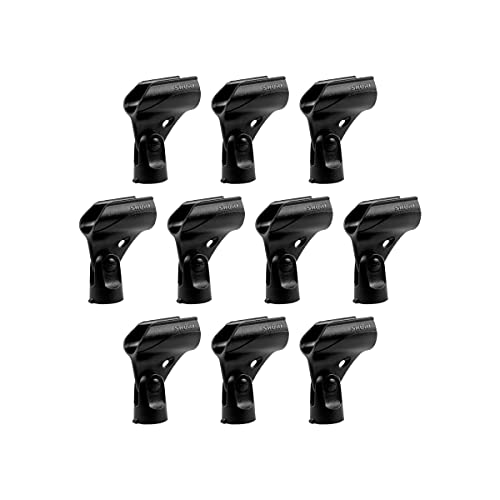
Shure A25DM 10 Pack A25D Microphone Clip Holder for Handheld Microphones
Picked as a relevant option in this category.
View on Amazon
Gator Frameworks Universal Shockmount Pair for Pencil Condenser Microphones – Fits 15-25mm, Perfect for Reducing Vibrations and Handling Noise, Durable Design
Chosen because it specifies Fits 15-25mm and Perfect for Reducing Vibrations and Handling Noise.
View on Amazon2. Best for small desks: Elgato Wave Mic Arm LP
The low-profile design keeps the arm below eye level, so it stays out of the camera frame and out of your sightline during long calls. Cable channels with magnetic covers hide the XLR run, and the load rating is around 1 kg — enough for most broadcast dynamics. Trade-off: shorter reach than a full-size arm, so it suits mics positioned roughly 40–60 cm from the clamp.
3. Best budget desk stand: Rode DS2
A weighted round base needs no clamp, which makes it the practical answer for desks with a drawer rail, a lip, or a glass top. Trade-off: it permanently occupies desk space and passes more keyboard thump into the mic than a clamped arm does, so pair it with a shock mount and keep typing distance.
4. Best shock mount: Rycote InVision USM
Lyre-style suspension replaces elastic bands, so there is nothing to stretch, sag or perish after a year of use — the single most common failure on budget shock mounts. Per the manufacturer, it fits cylindrical mic bodies in roughly the 18–55 mm diameter range. Trade-off: it will not hold square-bodied or very short microphones, and it does nothing about plosives.
Noise, plosive and room control
5. Best pop filter: Stedman Proscreen XL
A metal mesh screen around 150 mm across, positioned 5–10 cm from the capsule, breaks up the air blast behind “p” and “b” sounds without muffling the top end the way nylon mesh can. Trade-off: heavier and more expensive than a nylon filter, so it needs a stable arm or stand.
6. Best windscreen: Shure A81WS
Foam windscreens sized for the SM7B and SM58 capsule family cut breath noise and light air movement during close work. Trade-off: foam slightly dulls the highest frequencies and is a consumable — plan on replacing it every year or two once it hardens or crumbles.
7. Best isolation shield: sE Electronics RF-X
A portable five-layer filter that clamps to a stand and reduces reflections arriving at the capsule from behind and the sides. It helps most in small, hard rooms. Trade-off: it does not fix low-frequency problems, so if your recordings sound boomy, treatment panels will do more than a shield.
8. Best inline preamp: Cloud Microphones Cloudlifter CL-1
Adds +25 dB of clean gain with a high input impedance, letting a 60 dB interface reach the roughly 60 dB an SM7B needs for normal speech. Trade-off: it adds a box and two cable connections, and it is pointless with condensers that already output plenty of level.
9. Best room treatment: GIK Acoustics 242 panel
Fabric-wrapped absorbers measuring 24″ × 48″ × 2″ — mount two behind the microphone and one behind your listening position as a starting point. Trade-off: they need wall mounting, and at 2 inches thick they absorb mid and high frequencies far better than bass.
Signal chain: interfaces, preamps and cables
10. Best interface: Focusrite Scarlett 2i2 4th Gen
Two XLR/TRS inputs with up to about 69 dB of gain, auto-gain setup and 24-bit/192 kHz conversion. It is the default two-mic choice for a home studio. Trade-off: at maximum gain the noise floor rises noticeably, so an SM7B still benefits from an inline preamp.
11. Best channel strip: dbx 286s
Packs a mic preamp, compressor, de-esser, low-frequency enhancer and gate into one rack-width box, which removes a lot of software fiddling. Trade-off: it is analog-only, feeds a line input on your interface, and a badly set gate chops the start of words — set the threshold with the mic open and the room quiet.
12. Best cable: Mogami 2549 XLR
Balanced two-conductor plus shield construction with low capacitance, available in 10 ft and 20 ft lengths. It resists handling noise and interference better than thin generic cable. Trade-off: price. A budget cable usually works fine until its strain relief fails at the connector, which is the first thing to break.
13. Best XLR-to-USB adapter: Shure MVX2U
Up to +60 dB of gain, USB-C output and onboard DSP presets, letting an XLR dynamic mic plug straight into a laptop. Trade-off: one channel only, so it is a solo-recording tool rather than a multi-mic interface.
14. Best headphone amp: Behringer Microamp HA400
Four independent 1/4″ outputs from one stereo input, small enough to sit under a monitor. Useful when two people need to hear the same mix. Trade-off: no per-channel level control beyond each output’s own knob, and the potentiometers feel budget-grade.
Desk footprint and cable management
15. Best cable management: hook-and-loop wraps and an under-desk tray
This is a spec class rather than a single product: reusable 20 mm hook-and-loop wraps for the arm run, plus a 2–3 m under-desk tray for the interface, power brick and spare cable. Together they cost under $25 and eliminate the cable drag that slowly pulls an arm out of position. Trade-off: trays need roughly 30–40 mm of clearance beneath the desk.
How to choose: the numbers that actually decide it
Work backwards from your microphone. Weight determines the mount, sensitivity determines how much clean gain you need, and desk depth determines whether a clamped arm or a desk stand makes sense. The figures below come from manufacturer spec sheets and are approximate.
| Microphone (type) | Weight | Output sensitivity | Clean gain needed for speech | Accessory that closes the gap |
|---|---|---|---|---|
| Shure SM7B (dynamic) | ~765 g | −59 dBV/Pa | ~60 dB | Cloudlifter CL-1 or MVX2U |
| Shure SM58 (dynamic) | ~298 g | −54.5 dBV/Pa | ~55 dB | Interface with 60 dB+ gain |
| Rode PodMic (dynamic) | ~937 g | −57 dB re 1 V/Pa | ~58 dB | Heavy-duty arm plus inline preamp |
| Electro-Voice RE20 (dynamic) | ~737 g | −56.5 dB | ~55 dB | PSA1+ class arm, 2i2 class preamp |
| Audio-Technica AT2020 (condenser) | ~345 g | −37 dB (1.4 mV/Pa) | ~35–40 dB | Any 2i2-class interface |
Gain needs also depend on how far you sit from the capsule and how quiet the room is; a noisy room effectively demands more gain to keep the mic close, which is why treatment comes before extra preamp in most budgets.
Decision matrix by situation
- Total budget under $150: Rode DS2, a foam windscreen, and hook-and-loop wraps.
- Desk narrower than 1 m: Elgato Wave Mic Arm LP rather than a full-size boom.
- Untreated, echoey room: GIK 242 panels first; add an RF-X shield only if you cannot mount anything.
- Low-output dynamic mic: Cloudlifter CL-1, or an interface rated for 60 dB+ of gain.
- Two hosts, one desk: Scarlett 2i2 plus two PSA1+ arms and one shared headphone amp.
- Travel and hotel recording: MVX2U, A81WS windscreen, and a shock mount that packs flat.
Durability: what wears out first
In order of failure, expect elastic shock-mount bands, foam windscreens, cable strain reliefs, and boom-arm springs. Replacing the first three costs little; a sagging spring usually means the arm was overloaded, so check the load rating against your mic plus shock mount and pop filter. Cleaning matters too — foam and fabric surfaces collect dust and should be wiped or replaced rather than washed aggressively, and metal pop filters should be rinsed and fully dried before going back in front of a capsule.
Frequently Asked Questions
Do I need a pop filter if I already use a foam windscreen?
Usually not both. A foam windscreen handles breath and light air movement but is weak against hard plosives at close range, while a mesh pop filter handles plosives but not breath noise. Pick the mesh filter for close vocal work and keep foam for handheld or outdoor use.
How much gain do I really need for a Shure SM7B?
Roughly 60 dB of clean gain for normal speech at 10–15 cm. A Scarlett 2i2 4th Gen reaches about 69 dB but with a rising noise floor near the top, so a +25 dB inline preamp lets the interface run lower and quieter. The same logic applies to any dynamic mic rated near −57 dBV/Pa.
Can a cheap boom arm hold a heavy dynamic microphone?
Sometimes, but check the published load rating rather than the price. A PodMic at roughly 937 g plus a shock mount can exceed what a light arm is rated for, which shows up as the arm slowly sinking mid-session. If your total load is above 1 kg, choose an arm explicitly rated for it.
Does an isolation shield replace acoustic panels?
No. A shield reduces reflections reaching the capsule from behind and the sides, which helps in small hard rooms, but it cannot absorb low-frequency energy that bounces around the whole room. Panels at 2 inches thick address the mid and high range; thicker or corner-mounted treatment is needed for bass problems.
Which accessory should I upgrade first in a budget setup?
The mount, then the room. A stable arm removes handling and keyboard noise, which no preamp can undo, and treatment removes reflections that no filter can fix. Cables and headphone amps come last because they rarely change how a recording sounds.
How do I keep cables from pulling the arm out of position?
Route the XLR along the arm’s own channel or wrap it to the arm every 15–20 cm, then leave a small service loop at the base before the cable drops to the interface. Cables that hang free from the mic end add steady downward pull, which is the usual cause of an arm that drifts after an hour of recording.
FAQ
Do I need a pop filter if I already use a foam windscreen?
How much gain do I really need for a Shure SM7B?
Can a cheap boom arm hold a heavy dynamic microphone?
Does an isolation shield replace acoustic panels?
Which accessory should I upgrade first in a budget setup?
How do I keep cables from pulling the arm out of position?
More from Amazon
Programs that pair well with the guide above. Offers and eligibility are set by Amazon and may change.
Build one list of everything you need for the new arrival and share it with family and friends.
Create a baby registrySet up recurring deliveries of everyday items on eligible products. Terms and savings are set by Amazon.
Explore Subscribe & SaveFree shipping on eligible items, Prime Video and more. Eligible new members can start with a free trial.
Start a Prime free trialAudiobooks and podcasts to listen to on the go. Eligible new members can start with a free trial.
Try Audible freeAs an Amazon Associate we earn from qualifying purchases.





Write Your Review
No reviews yet. Be the first to share your experience!