
Key takeaways
- Active Sleep (REM): Accounts for approximately 50% of an infant’s sleep duration. During this stage, babies twitch, flutter their eyelids, breathe irregularly, and produce vocal grunts or whimpers. Neurological development and memory consolidation occur heavily during active sleep.
- Quiet Sleep (Non-REM): Characterized by rhythmic breathing, complete stillness, and absence of eye movements. Infants in quiet sleep are harder to awaken and experience physical cellular restoration.
What's inside
- Understanding Newborn Sleep Patterns and Biology
- Newborn Wake Windows by Age (0–12 Weeks)
- How to Establish Safe Sleep Habits (The AAP Guidelines)
- Step-by-Step Soothing: The 5 S’s Soothing Method
- Essential Gear for Newborn Sleep Support
- Newborn Sleep Gear Buying Guide: Core Evaluation Pillars
- Frequently Asked Questions About Newborn Sleep
- Final Thoughts on Newborn Sleep
Navigating infant rest can feel overwhelming, but mastering newborn sleep begins with understanding natural biology, wake windows, and safe habits. This comprehensive newborn sleep guide delivers clear, evidence-based methods to soothe overtiredness, optimize sleep spaces, and establish consistent routines for long-term household rest.
- Understanding Newborn Sleep Patterns and Biology
- Newborn Wake Windows by Age (0–12 Weeks)
- How to Establish Safe Sleep Habits (The AAP Guidelines)
- Step-by-Step Soothing: The 5 S’s Soothing Method
- Essential Gear for Newborn Sleep Support
- Newborn Sleep Gear Buying Guide: Core Evaluation Pillars
- Frequently Asked Questions About Newborn Sleep
- Final Thoughts on Newborn Sleep
Understanding Newborn Sleep Patterns and Biology
Newborn babies do not follow a standard adult day-night circadian rhythm at birth. Instead, their rapid neurological development requires sleep in short intervals of two to four hours around the clock. Recognizing these biological sleep cycles helps new parents manage daily feeding routines and prevent chronic overtiredness early.

The 50-Minute Infant Sleep Cycle
Unlike adults who cycle through 90- to 110-minute sleep stages dominated by non-REM rest, newborns experience rapid 50-minute cycles divided almost equally into two primary stages:
- Active Sleep (REM): Accounts for approximately 50% of an infant’s sleep duration. During this stage, babies twitch, flutter their eyelids, breathe irregularly, and produce vocal grunts or whimpers. Neurological development and memory consolidation occur heavily during active sleep.
- Quiet Sleep (Non-REM): Characterized by rhythmic breathing, complete stillness, and absence of eye movements. Infants in quiet sleep are harder to awaken and experience physical cellular restoration.
Because active sleep is inherently noisy and restless, many parents accidentally awaken babies who are merely transitioning between sleep stages rather than actually crying out from hunger.
Fixing Day/Night Confusion
In the womb, babies receive maternal melatonin through the placenta and are rocked to sleep during daytime movement, often becoming active at night. When born, their internal circadian clock requires several weeks of environmental exposure to mature.
- Daytime Protocol: Keep living spaces naturally lit with indirect sunlight during daytime naps. Maintain normal household ambient noise like conversation and gentle background cleaning. Engage actively with your baby during feeding and wake periods.
- Nighttime Protocol: Keep nursery lighting dim, utilizing low-wattage warm or red amber nightlights. Minimize verbal stimulation, avoid direct eye contact during nocturnal diaper changes, and keep feeds calm, dark, and strictly functional.
Newborn Wake Windows by Age (0–12 Weeks)
Tracking wake windows prevents babies from crossing the boundary from comfortable tiredness into hyper-arousal and inconsolable crying. Because newborns process sensory input quickly, their stamina for wakefulness remains very brief during the initial twelve weeks. Use these practical timing benchmarks to structure restful daily naps.
| Age Window | Average Wake Window | Total Sleep (24 Hours) | Typical Nap Count |
| 0–4 Weeks | 30–60 minutes | 15–18 hours | 4–6 variable naps |
| 5–8 Weeks | 45–75 minutes | 14–16 hours | 4–5 naps |
| 9–12 Weeks | 60–90 minutes | 14–15 hours | 3–4 naps |
Identifying Sleep Cues vs. Overtiredness
Timing a nap based solely on clock watching can cause issues if an infant exerts excess energy. Learn to read physical distress and tiredness signals:
- Early Sleepy Cues (Ideal Time to Put Down): Gaze averting, staring blankly into space, quiet disengagement, and subtle reddening around the eyebrows.
- Late Sleepy Cues (Act Immediately): Yawns, rubbing eyes or face, clenched fists, and tense body posture.
- Overtired Signals (Requires Rescue Soothing): Arching the back, furious crying, thrashing limbs, and rooting when not hungry due to cortisol and adrenaline spikes.
How to Establish Safe Sleep Habits (The AAP Guidelines)
Creating a secure physical nursery environment forms the foundation of every safe infant resting strategy. Adhering to the American Academy of Pediatrics sleep standards significantly lowers sudden infant death risks while promoting continuous nighttime comfort. Follow these essential non-negotiable setup rules for every nap and night.
The ABCs of Safe Infant Sleep
- A — Alone: The infant must sleep independently in their own dedicated sleep surface. No pillows, quilts, loose sheets, stuffed animals, or positioners should ever enter the sleep area.
- B — Back: Always place infants flat on their back for every sleep period until one year of age. Even if a baby experiences mild reflux, normal anatomical airway protections prevent choking when lying supine.
- C — Crib or Bassinet: The sleep environment must feature a firm, flat mattress covered with a tightly fitted sheet, meeting federal safety certifications (CPSC/ASTM).
Room Sharing vs. Bed Sharing
The American Academy of Pediatrics (AAP) strongly recommends room sharing—placing the baby’s crib or bassinet directly adjacent to the parents’ bed—for at least the first six months. Room sharing reduces the risk of Sudden Infant Death Syndrome (SIDS) by up to 50% by keeping the infant within easy hearing and visual range while eliminating the entrapment and suffocation hazards associated with adult beds.
Optimal Nursery Climate
- Temperature: Maintain room temperature between $68^\circ\text{F}$ and $72^\circ\text{F}$ ($20^\circ\text{C}$ to $22^\circ\text{C}$). Overheating is a primary risk factor for SIDS.
- Clothing: Dress the infant in one layer more than an adult would comfortably wear in the same room. Check the back of the neck or chest for warmth and moisture; hands and feet naturally feel cooler due to developing circulation.
Step-by-Step Soothing: The 5 S’s Soothing Method
Calming an overstimulated infant requires activating the natural calming reflex that mimics uterine sensations. Developed by pediatrician Dr. Harvey Karp, the renowned five S’s technique progressively relieves newborn distress and gently encourages independent sleep onset. Execute each step sequentially to soothe your fussy baby to sleep.
1. Swaddle
Snug wrapping recreates the continuous physical containment of the womb and prevents the Moro (startle) reflex from waking the infant. Keep hips loose and flexed to allow proper hip joint development, while wrapping arms firmly at the sides.
2. Side or Stomach Position
While infants must always sleep on their back, holding a crying baby securely on their side or draped over an adult forearm across their stomach assists in settling an overactive nervous system before being laid down.
3. Shush
In utero, blood rushing through uterine arteries creates constant white noise louder than a vacuum cleaner (around 80 to 90 decibels). Make a loud, sustained “shhh” sound directly near the infant’s ear at a volume matching their crying, tapering the volume down as they calm.
4. Swing
Provide gentle, rhythmic, micro-motion jiggles (supporting the fragile head and neck thoroughly). Fast, tiny motions mirror the continuous tactile sensations infants experience during maternal movement.
5. Suck
Non-nutritive sucking stabilizes an infant’s heart rate and releases soothing endorphins. Offer a clean pacifier or a clean adult finger once feeding routines are established.
Essential Gear for Newborn Sleep Support
Equipping your nursery with proven, safety-certified sleep gear simplifies bedtime routines and reinforces positive sleep associations. From responsive sound conditioners to ergonomic swaddles, the following parent-tested tools deliver tangible comfort improvements without compromising vital American Academy of Pediatrics standards.
Halo SleepSack Swaddle (100% Cotton) — Best Swaddle for Safe Ergonomics
- Best For: Parents seeking an adjustable, hip-healthy swaddle that transitions smoothly from newborn to rolling stages.
- Key Features: 3-way adjustable wrap (arms-in, hands-to-face, one-or-both-arms-out); inverted bottom zipper for effortless midnight diaper checks; certified “Hip Healthy” by the International Hip Dysplasia Institute; 100% breathable cotton fabric with a 1.5 TOG thermal rating.
- Pros:
- Secure hook-and-loop fasteners stay fastened throughout vigorous leg kicking.
- Inverted zipper allows diaper access without unwrapping the chest swaddle.
- Facilitates an easy transition to an arms-out sleep sack as baby grows.
- Cons:
- Hook-and-loop fasteners produce loud tearing sounds during nighttime adjustments.
- Sizing can feel snug for infants with larger chest circumferences.
- Use Case: Daily nursery naps and nighttime swaddling where parents need dependable startle-reflex prevention with straightforward midnight diaper changes.
- Who It’s For: New caregivers wanting an easy-to-use, medically recognized swaddle that eliminates the hazards of loose muslin blankets.
Yogasleep Rohm Portable White Noise Machine — Best Nursery Sound Machine
- Best For: Households needing consistent acoustic masking both inside the nursery and during on-the-go travel.
- Key Features: Three acoustic profiles (bright white noise, deep white noise, gentle surf); robust acoustic speaker chamber; USB-rechargeable lithium-ion battery; compact 3.5-inch diameter body weighing 3.8 ounces; integrated lanyard for hanging.
- Pros:
- Produces smooth, organic sound masking that muffles household disturbances.
- Highly portable design fits directly onto stroller frames or bassinet rails.
- Runs continuously through the night without unexpected looping interruptions.
- Cons:
- Lacks a digital timer display for parents who prefer programmed intervals.
- Volume control buttons make audible clicks when pressed in silent rooms.
- Use Case: Masking barking dogs, older sibling footsteps, and television noise in apartments or busy family households.
- Who It’s For: Families who need dependable, uninterrupted white noise for nursery naps and weekend travel.
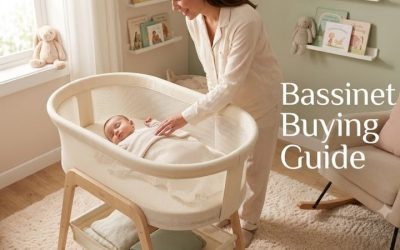
Halo BassiNest Swivel Sleeper 3.0 — Best Bedside Nursery Bassinet
- Best For: Mothers recovering from childbirth who require close bedside proximity with minimal physical bending.
- Key Features: 360-degree swivel joint; patented lowering bedside wall that locks upright; breathable 100% mesh side walls; heavy-duty low-profile base tucking under adult beds; removable bedpod for portable room-to-room resting.
- Pros:
- Swivels completely over adult mattresses, allowing immediate infant comforting.
- Push-down side rail reduces painful abdominal strain during postpartum recovery.
- Full mesh perimeter maximizes airflow and provides clear visibility from pillows.
- Cons:
- Substantial metal base is heavy and cumbersome to assemble or shift across carpets.
- Weight limit maxes out at 20 lbs or when the infant shows signs of pushing up.
- Use Case: Safe bedside room sharing during the initial 0- to 5-month developmental phase.
- Who It’s For: Postpartum parents seeking maximum proximity and safe infant surveillance without resorting to unsafe adult bed sharing.
Newborn Sleep Gear Buying Guide: Core Evaluation Pillars
Navigating endless infant product marketing requires filtering sleep gear through safety, ease of maintenance, and ergonomic function. Before investing in bassinet equipment or swaddle systems, examine these four critical evaluation pillars to ensure each nursery purchase genuinely supports your household sleep goals without added hazard.
Sleep Surface Safety & Firmness
- What: The structural stability, flatness, and resistance to compression of infant mattress pads and bassinet bases.
- Why: Soft, plush sleep surfaces create rebreathing pockets of carbon dioxide and suffocation hazards if a newborn turns their head into the mattress.
- Who: Non-negotiable for every infant caregiver from birth through toddlerhood.
- Trade-off: Firm surfaces often feel uncomfortably hard to adult hands, tempting parents toward unsafe plush toppers.
Thermal Regulation & Breathability
- What: The textile composition (cotton, bamboo, or wool) and thermal overall grade (TOG rating) of swaddles, sheets, and sleepers.
- Why: Newborns lack the physiological ability to sweat efficiently, making overheating a major safety hazard.
- Who: Essential for all climates, especially homes subject to seasonal temperature swings.
- Trade-off: High-breathability single-layer cotton options offer lower insulation and may require precise nursery temperature regulation.
Operational Ergonomics & Maintenance
- What: The inclusion of two-way inverted zippers, machine-washable fabrics, and quiet closures on nursery gear.
- Why: Newborns experience frequent diaper blowouts and spit-up episodes; complicated gear causes unnecessary wakefulness at 2:00 AM.
- Who: Fatigued parents managing repetitive nocturnal feedings and rapid changes.
- Trade-off: Complex closure systems and sound baffles can increase hardware costs and garment wear over time.
Acoustic Fidelity & Sound Safety
- What: The decibel capacity and frequency spectrum delivered by white noise conditioners.
- Why: Sustained audio output above 60 decibels placed near an infant’s head can damage delicate ear canals and auditory development.
- Who: Urban residences, families with multiple pets, or homes with noisy shared walls.
- Trade-off: Maintaining safe sound thresholds (below 60 dB at crib level) requires positioning machines several feet away from the mattress.
Frequently Asked Questions About Newborn Sleep
Caring for a newborn inevitably brings unpredictable nights, confusing sleep cues, and persistent feeding questions. The following clear, evidence-based answers address the most common sleep challenges new parents face during the fourth trimester, helping you navigate regression and nighttime wakes with steady parental confidence.
Can you sleep train a newborn?
Formal behavioral sleep training methods (such as Ferber, extinction, or chair methods) should not be implemented before 4 to 6 months of age. Newborns lack the neurological maturity to self-soothe and have biological caloric requirements requiring regular night feedings. Instead of sleep training, focus on sleep hygiene: distinguishing day from night, pausing before responding to active sleep grunts, and putting baby down drowsy but awake when possible.
When do newborns start sleeping through the night?
Clinically, “sleeping through the night” is defined as a consolidated stretch of 5 to 6 continuous hours. Most infants do not achieve this milestone until they weigh at least 12 to 13 pounds and reach 3 to 4 months of age. Feeding frequency and metabolic rates dictate these intervals; breastfed newborns typically awaken every 2 to 3 hours, while formula-fed infants may stretch to 3 to 4 hours.
How do I know if my baby is crying in their sleep or actually awake?
Because infants spend half their rest cycle in active (REM) sleep, they frequently whimper, grunt, cry out, or open their eyes for brief seconds while remaining fully asleep. If you hear a vocalization, pause and observe for 60 to 90 seconds. If their eyes remain closed and the fussing ceases, they have seamlessly transitioned into the next sleep cycle without needing intervention.
When should we stop swaddling our baby?
Swaddling must cease as soon as your infant shows early signs of attempting to roll over, which can occur as early as 8 weeks. Once an infant rolls onto their stomach while swaddled, they cannot use their arms to push their airway free from the mattress, creating an immediate suffocation hazard. Transition them to an arms-free wearable sleep sack at the first rolling attempt.
Final Thoughts on Newborn Sleep
Cultivating healthy newborn sleep is an ongoing developmental journey grounded in consistent biological routines, safe sleep environments, and patient parental attunement. By honoring wake windows, utilizing proven soothing methods, and trusting your baby’s growth timeline, your family can achieve calm, predictable, and restful nights together.





Write Your Review
No reviews yet. Be the first to share your experience!