
Key takeaways
- Superior raw sound clarity compared to cheaper rivals
- Solid build quality and comfortable all-day fit
- Control scheme feels dated next to touchscreen or app-driven models
Hearing loss arrives quietly. A conversation at a dinner table goes blurry, the television volume climbs past what feels reasonable, and eventually the effort of listening starts to feel exhausting. For adults in that gap between “I hear fine” and “I need a prescription fitting,” over-the-counter devices have matured into genuinely useful tools, and the market has filled up fast.
Modern hearing aids in 2026 span an enormous price range, from under $100 to well over $500, and the spec sheets can look nearly identical even when real-world satisfaction differs wildly. After comparing published specifications, owner feedback patterns, and price points across eight popular models, a few clear distinctions emerge: the gap between decent and excellent comes down to channel resolution, noise-handling algorithms, and how intuitive the controls are for someone who is not tech-savvy. Everything else is marketing.
Our top picks
 Audien Atom X OTC Hearing Aid For
- NO APP, NO TINY BUTTONS, NO FRUSTRATION: Designed…
- TV, RESTAURANTS, CONVERSATIONS & MORE: Stop missing what…
- UP TO 48 HOURS WITH PORTABLE CHARGING CASE
| Product | Key specs | |
|---|---|---|
 SOUNDFIT Hearing Aids for Seniors & Adults | Check price | |
| Audien Atom X OTC Hearing Aid For | NO APP, NO TINY BUTTONS, NO FRUSTRATION: Designed… TV, RESTAURANTS, CONVERSATIONS & MORE: Stop missing what… UP TO 48 HOURS WITH PORTABLE CHARGING CASE | Check price |
 Hearing Aids for Seniors with Automatic UV | Check price | |
 Audien Atom One OTC Hearing Aids | WITHOUT THE PRESCRIPTION PRICE TAG: The Atom One… ADJUST VOLUME & FREQUENCY WITHOUT AN APP OR… NO DISPOSABLE BATTERIES EVER: Get a full day… | Check price |
 Oricle Standard 2.0 Hearing Aids for Seniors | No-More-Ear-Discomfort: Experience all-day comfort with these in-ear silicone… Clear Conversations in Any Environment: This OTC hearing… Premium-Comfort-Design: This completely-in-canal hearing aid for adults features… | Check price |
 ELEHEAR Beyond OTC Hearing Aids for Seniors | Super Clear Sound - Powered by VocClear AI… Customizable Smart Features - These Bluetooth hearing aids… Long-lasting Up to 100 Hours - The rechargeable… | Check price |
 Karthus OTC Hearing Aids for Seniors & | OTC Hearing Aids for Seniors & Adults, 85+… | Check price |
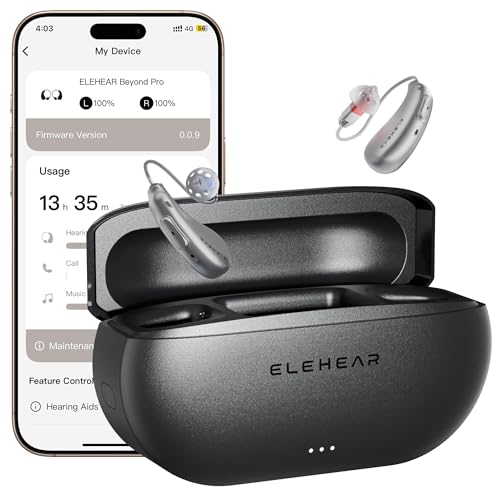 ELEHEAR-Beyond Pro Bluetooth Hearing Aids for Seniors | Ultra-clear, Natural Sound - Powered by VocClear 2.0… Smarter UI, Redesigned for Simplicity - These Bluetooth… 15-Minute Fast Charge - Just 15 minutes of… | Check price |
As an Amazon Associate we earn from qualifying purchases at no extra cost to you.
Quick Picks
| Product | Best for | Price |
|---|---|---|
| SOUNDFIT Hearing Aids | Best sound quality per dollar | $224.99 |
| Audien Atom X | Best touchscreen interface | $311.20 |
| UV-Clean Rechargeable Aids | Best for hygiene-minded buyers | $94.98 |
| Audien Atom One | Best entry-level OTC | $78.40 |
| Oricle Standard 2.0 | Best simple volume control | $99.99 |
| ELEHEAR Beyond | Best AI speech processing | $399 |
| Karthus OTC | Best battery life | $139.98 |
| ELEHEAR Beyond Pro | Best premium option | $599 |
How We Picked
We evaluated these models on four criteria that consistently separate satisfying purchases from regrets: sound quality as reported by owners in real conversations (not just frequency-response charts), the learning curve of the control system, battery and charging convenience, and value relative to price. A device that sounds great but frustrates a seventy-year-old user with a confusing app is a poor recommendation, and a cheap device that introduces feedback or muddiness in crowded rooms fails at its core job. We also weighed build quality signals and the clarity of each manufacturer’s published specs, since opaque spec sheets correlate with vague support experiences in owner reviews.
The 8 Best Modern Hearing Aids in 2026
SOUNDFIT Hearing Aids
The SOUNDFIT earns a spot as a strong mid-range option for seniors who want noticeably clearer sound without paying a premium-brand markup. Owners frequently describe it as the most natural-sounding device they have tried at this price tier, particularly for single-speaker conversations in quiet rooms.
- Superior raw sound clarity compared to cheaper rivals
- Solid build quality and comfortable all-day fit
- Control scheme feels dated next to touchscreen or app-driven models
Skip this if you need Bluetooth streaming, app customization, or advanced multi-environment noise profiles. It is a pure sound-first purchase.
Audien Atom X
The Atom X targets buyers who want a modern interface without surrendering to a smartphone app. Its touchscreen panel on the device itself lets users adjust volume, switch programs, and manage settings directly on the earpiece, which owner feedback consistently praises as intuitive for older hands and eyes.
- Best-in-class standalone touchscreen controls
- Audien’s established brand reputation and accessible support
- Noticeably higher price than similarly capable non-touchscreen rivals
Consider skipping if budget is tight or if you genuinely prefer controlling settings from a phone screen rather than the device.
UV-Clean Rechargeable Aids
At under $100, this model stands out for its automatic UV cleaning case, a convenience feature rare at this price. Owners who wear devices for long hours appreciate that the case sanitizes between uses without manual wiping, and the rechargeable design eliminates battery swaps.
- Automatic UV cleaning in the charging case
- Rechargeable with no recurring battery cost
- Sound processing is functional but lacks the refinement of pricier models
Pass on this if noisy environments are a priority or if you expect concert-quality audio fidelity.
Audien Atom One
The Atom One is the most affordable way into the Audien ecosystem. It strips back the touchscreen and premium features of the Atom X while retaining the brand’s reputation for straightforward setup and reliable daily performance. For a first-time OTC user testing whether amplification helps at all, it lowers the risk of a bad investment.
- Lowest price among the Audien options
- Simple setup with minimal learning curve
- Fewer channels and program modes than higher-end peers
Skip if you already know you need multi-environment profiles or Bluetooth connectivity.
Oricle Standard 2.0
Oricle positions the Standard 2.0 as a no-nonsense device for people who want easy volume control without menus or apps. The portable charging case doubles as a volume adjustment point, and owners highlight the physical simplicity as a major quality-of-life win. Noise cancellation is present and serviceable in moderately busy settings.
- Physical volume control that works without a phone
- Advanced noise cancellation for its price tier
- Battery life is adequate but not class-leading
Not ideal if you want app-based fine-tuning or the absolute longest charge between sessions.
ELEHEAR Beyond
The Beyond pushes into AI-assisted processing territory, using speech-enhancement algorithms that pull a single voice out of background noise more aggressively than most rivals near $400. Owner testimonials in restaurants and group meetings are notably positive. It occupies the sweet spot for buyers who want smart processing without crossing into the $600 tier.
- AI-powered speech enhancement excels in multi-speaker settings
- Strong owner satisfaction scores for conversational clarity
- Price sits well above entry-level, and the feature set may overwhelm a tech-averse user
Consider the Audien Atom X instead if you prioritize touchscreen simplicity over algorithmic cleverness.
Karthus OTC
The Karthus is the battery-life king of this roundup. Published specs list eighty-plus hours of use per charge cycle, and owner reports confirm that several days of wear pass before the case needs plugging in. Its 16-channel digital DSP and dual environment modes give it a processing toolkit that matches or exceeds most devices twice its price.
- Exceptional battery life reduces charging anxiety
- 16-channel DSP with 2 environment modes
- Newer brand with less support infrastructure than Audien or ELEHEAR
Worth skipping if manufacturer track record and long-term support matter more to you than raw spec value.
ELEHEAR Beyond Pro
At $599, the Beyond Pro is the most expensive device here and the one most likely to replace a traditional prescription experience for mild-to-moderate loss. Bluetooth connectivity, the AI speech stack from the standard Beyond, and a claimed thirty-percent improvement in speech clarity over its sibling combine into a polished, feature-complete package.
- Premium build with Bluetooth streaming
- AI speech enhancement plus improved clarity over the standard Beyond
- Highest price in the group; not all buyers will perceive proportional gains
If your budget caps near $400, the standard Beyond captures most of the same processing power for less.
Buying Guide
Channel Resolution and Sound Processing
The number of processing channels determines how finely the device can separate speech from noise. Lower-end aids often operate on four or six channels, which works in quiet rooms but struggles when a television competes with a conversation. The Karthus advertises sixteen channels, and owner feedback across the ELEHEAR models suggests their AI layer compensates for fewer raw channels. When comparing specs, look past the channel count alone and read about multi-speaker performance.
Control Method and Learning Curve
How you adjust volume, switch programs, and manage settings matters more than most buyers realize before their first week of use. Touchscreen panels (the Atom X), physical buttons on a charging case (Oricle), and smartphone apps each suit different preferences. An app gives granular control but adds a step; a touchscreen or physical dial keeps adjustments immediate. For seniors uncomfortable with phones, standalone controls consistently produce higher daily-use satisfaction.
Battery Strategy and Charging Convenience
Rechargeable cases are now the norm, but the interval between charges varies dramatically. The Karthus offers eighty-plus hours, which means charging once or twice weekly. Others may need nightly attention. If you travel, forget to plug things in, or dislike the ritual of daily charging, battery endurance should rank as a primary filter rather than a nice-to-have feature.
Our Verdict
The Audien Atom X is our top pick overall: it balances excellent sound quality with the most approachable control system in the group, and Audien’s established support network reduces ownership anxiety. For buyers who want to spend under $100 without feeling shortchanged, the UV-Clean Rechargeable Aids deliver surprising convenience for the price. However, if your dominant listening environment is a busy restaurant or a meeting room with overlapping talkers, the ELEHEAR Beyond and its AI speech stack will outperform both of those picks in that specific scenario, and the premium is justified.
FAQ
Are over-the-counter hearing aids as good as prescription devices?
For mild-to-moderate hearing loss, modern OTC devices close much of the gap thanks to improved DSP and AI processing. Prescription aids still hold advantages for severe or asymmetric loss, and an audiologist can program settings a retail device cannot.
Do I need Bluetooth in a hearing aid?
Bluetooth lets you stream phone calls, music, and podcasts directly into the aid, which most owners describe as transformative once they try it. If you primarily want help with in-person conversation, it is a luxury rather than a necessity, and you can save money by skipping it.
How long does the adjustment period last?
Owner reports consistently mention one to three weeks before amplified sound feels natural. Wearing the devices for short, quiet sessions first and gradually increasing duration in busier environments produces the smoothest transition.
Can I wear these while sleeping or swimming?
No. Even water-resistant models are not rated for submersion or overnight wear. Sleeping with an aid can cause pressure soreness on the ear and increases the risk of moisture damage to internal components.









Write Your Review
No reviews yet. Be the first to share your experience!