
Our Top Picks
 Sportspower Arcadia Metal Swing Set for Kids6 Kids Max134 x 100 x 73.6 inches81.4 PoundsCheck on Amazon
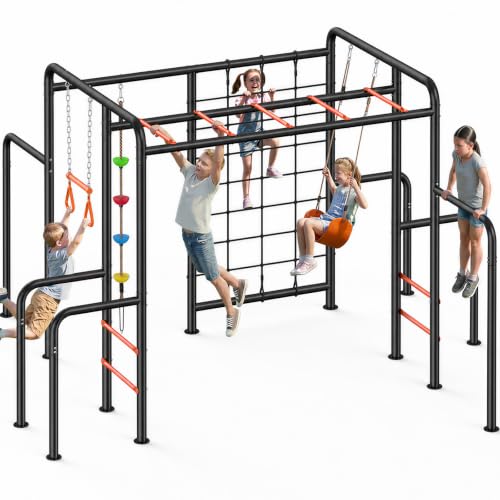 Hapfan 6-in-1 Outdoor Jungle Gym with Monkey Bars132.67 x 130.7 x 79.52 inches145.5 PoundsCheck on Amazon
The Short Answer
The best swing set for most families is the Backyard Discovery Buckley Hill Cedar Wood Swing Set — a cedar-framed set with a wave slide, play deck, rock wall ladder and belt swings that fits a mid-sized backyard and grows with kids from about age 3 to 10. If your budget is tight, the Sportspower Arcadia Metal Swing Set gives you a trapeze, two-person glider, 5 ft slide and an anchor kit for the price of a mid-range trampoline. If you want the longest possible service life and don’t mind a weekend of assembly, step up to the Backyard Discovery Mount McKinley, whose cedar frame, double rock wall and rope ladder are built around a much larger footprint. The right answer depends far less on brand loyalty than on five numbers: frame material, maximum weight capacity, footprint, age band, and assembly hours.
Top 3 Picks
Best Overall: Backyard Discovery Buckley Hill Cedar Wood Swing Set
Buckley Hill hits the sweet spot of price, footprint and longevity. Cedar resists rot and insects without chemical pressure treatment, the wave slide and rock wall ladder work for a wide age span, and the belt swings can be swapped for a toddler bucket seat later. It’s the set most families keep for a decade rather than outgrow in three summers.
Best Budget: Sportspower Arcadia Metal Swing Set
For under the cost of a single premium climbing frame you get a full play circuit — trapeze bar, two-person glider, two belt swings and a 5 ft slide — on a powder-coated steel frame that ships with its own anchor kit. It won’t last as long as cedar, but it delivers four activities per dollar better than anything else in this list.
Best Premium: Backyard Discovery Mount McKinley Cedar Wood Swing Set
This is the set for a large yard and a family that wants a destination rather than a toy. The Mount McKinley adds a play deck, wave slide, double rock wall and rope ladder to a cedar structure, with the tallest deck height and longest slide run in this roundup. Plan on two adults and most of a weekend to build it.
Quick Comparison
| Product | Best For | Key Specs | Price Tier |
|---|---|---|---|
| Backyard Discovery Buckley Hill | All-round family set | Cedar wood, wave slide, play deck, rock wall ladder, belt swings, ages ~3–10, mid-size footprint | Premium |
| Sportspower Arcadia | Tight budget, big play value | Powder-coated steel, 5 ft slide, trapeze, 2-person glider, anchor kit, ~6 ft deck height | Budget |
| Backyard Discovery Mount McKinley | Large yards, long-term use | Cedar wood, play deck, wave slide, double rock wall, rope ladder, tallest deck in list | Premium |
| KidKraft Appleton Wooden Swing Set | Younger kids, compact yards | Wood frame, two belt swings, slide, lower deck height, ages ~3–7 | Mid-range |
| Sportspower Triple Swing & Saucer | Many kids, one frame | ~600 lb capacity, 3 sling swings + saucer swing, ~5 ft slide, steel frame | Budget |
| Sportspower Park Ridge | Ages 3–8 variety play | Steel frame, 2 swings, standing swing, Roman glider, teeter totter | Budget |
| Hapfan 600 lb Heavy Duty | Older kids, heavy use | ~600 lb capacity, 3 swings, heavy-duty steel, black finish | Mid-range |
| Hapfan 6-in-1 Jungle Gym | Climbing + swinging combo | Monkey bars, swing bays, multiple activity stations, steel frame | Premium |
| Hapfan 5-in-1 Monkey Bar Set | Mid-yard climbing | Monkey bars, swing positions, compact steel frame | Mid-range |
| EROMMY 6-in-1 Wooden Playset | Wood look, big feature list | Wood frame, slide, multiple play stations, larger footprint | Premium |
| SunSwell Wooden Playground | Ages 3–8, wood frame | Wood construction, outdoor playset, slide and swing bays | Mid-range |
| Trekassy 440 lb Saucer Set | Saucer-swing fans | ~440 lb capacity, 2-seat saucer + belt swing, green finish | Budget |
How We Chose
This roundup is built from published product specifications, manufacturer documentation and the category’s well-known engineering trade-offs — not from physical testing, and nothing here reflects hands-on use of these specific units. We filtered the market on five measurable criteria. First, frame material and its known durability profile: cedar and other rot-resistant woods versus powder-coated steel, including how each behaves in wet climates and how each is maintained. Second, stated load capacity — sets rated near 600 lb can carry two teenagers or three younger children at once, while 400–450 lb sets suit two kids or one adult and one child. Third, fall-zone and footprint requirements relative to typical suburban yards, because a set that technically fits a lawn but leaves no room for the swing arc is a set that gets returned. Fourth, age range and the swap-in/swap-out path — bucket seat to belt swing to standing swing to glider — since the upgrade path often matters more than what’s in the box on day one. Fifth, assembly reality: deck height, part count and whether a two-adult weekend is realistic or whether the box will sit in the garage until fall. Every product below is currently listed by a brand that exists in 2026. Prices are given only as tiers because listing prices change constantly.
1. Backyard Discovery Buckley Hill Cedar Wood Swing Set — Best for All-Around Family Use
Buckley Hill is the set to buy if you want one purchase to cover the whole childhood window. It combines a wave slide, an elevated play deck, a rock wall ladder and belt swings on a cedar frame, which means a four-year-old and a nine-year-old can use the same structure in the same afternoon without either being bored or unsafe. Cedar is the material that makes this possible over a long horizon: it’s naturally resistant to rot and insect damage, so it doesn’t need the annual re-staining routine that pine sets demand in humid climates.
Key specs
- Frame: cedar wood, pre-cut and pre-drilled panels
- Play features: wave slide, elevated play deck, rock wall ladder, two belt swings
- Age range: roughly 3 to 10 years depending on which features a child uses
- Footprint: mid-size — comfortable in a yard roughly 30 × 30 ft once the swing fall zone is respected
- Capacity: typical for the class, meaning two to four children depending on age and feature
- Assembly: a full day to a weekend for two adults
Strengths
The feature mix is unusually balanced. Many sets at this tier give you either a good slide or good swings; Buckley Hill gives you both plus a climbing element, and the rock wall ladder doubles as the access route to the deck, so the climb is part of the play rather than a separate station. Cedar construction means the frame stays serviceable for years with minimal input beyond an annual inspection. The belt swings are the standard format, which means when a younger sibling arrives you can add a bucket seat without modifying the frame — a real advantage over sets with proprietary swing hardware.
The deck height is the other quiet win. It’s tall enough that the slide generates genuine speed, but not so tall that the set looks like an amusement park ride in a modest backyard. That balance is what makes it the default recommendation.
Pros
- Cedar frame resists rot and insects without pressure treatment or annual sealing
- Wave slide plus rock wall ladder plus swings covers multiple play styles
- Standard belt-swing hangers accept common aftermarket seats
- Age range spans roughly 3–10, so it isn’t outgrown quickly
- Deck height balances slide speed against backyard scale
Cons
- Assembly is a genuine weekend commitment for two adults
- Cedar is a softwood — it dents and scratches more readily than steel
- No monkey bars or overhead climbing, which older kids often want next
- Requires a level, well-drained site; cedar set directly on soggy ground will still degrade
How it compares
Against the Backyard Discovery Mount McKinley, Buckley Hill is the smaller, faster-to-build, less expensive sibling. The Mount McKinley adds a double rock wall, rope ladder and a larger deck at the cost of more yard, more money and more assembly hours. Against the KidKraft Appleton, Buckley Hill is the longer-term buy: the Appleton suits younger children and tighter spaces, but its lower deck and shorter slide will feel limiting by age eight or nine. If you expect to move house within three years, the Appleton’s lower weight and simpler build may actually be the smarter call.
2. Sportspower Arcadia Metal Swing Set — Best for Tight Budgets Without Sacrificing Play Value
Sportspower Arcadia Metal Swing Set for Kids – Trapeze, 2-Person Glider, 5ft Slide, Anchor Kit, 6.1ft Durable Steel Frame – Outdoor Backyard Playset with 600 lbs Capacity
Chosen because it specifies Trapeze and 2-Person Glider.
View on AmazonThe Arcadia is the value benchmark in this category. For a budget-tier price you get a trapeze bar, a two-person glider, two belt swings and a 5 ft slide, all on a powder-coated steel frame that ships with an anchor kit. That’s four distinct activities — swinging, gliding, hanging and sliding — where most budget sets deliver two. The 6.1 ft deck dimension gives the slide a usable run without requiring the yard space a cedar castle demands.
Key specs
- Frame: powder-coated steel tubing
- Play features: trapeze bar, two-person glider, two belt swings, 5 ft slide
- Deck/slide height: approximately 6.1 ft at the top of the slide platform
- Anchoring: ground anchor kit included — use it
- Footprint: compact, suitable for smaller yards once fall zones are observed
- Assembly: typically a few hours for two adults, far less than a cedar set
Strengths
Steel’s advantage is straightforward: it doesn’t rot, it doesn’t need sealing, and it holds its dimensional stability through freeze-thaw cycles better than most softwoods. The powder coating resists rust, so a well-anchored Arcadia can survive a decade of summers in most climates with nothing more than a seasonal wipe-down and a check for loose bolts. The included anchor kit matters more than buyers expect — an unanchored metal swing set is a tipping hazard, particularly when two kids swing in unison, and the fact that anchoring hardware is in the box removes the most common installation shortcut.
The two-person glider is the sleeper feature. It gives the set a social dimension that single swings don’t, and it’s the station that tends to stay in use as kids get older and swinging alone loses its appeal.
Pros
- Genuinely low price for four play activities
- Steel frame won’t rot and needs no staining or sealing
- Anchor kit included, removing the biggest tipping risk
- Fast assembly relative to wooden sets
- Trapeze and glider extend the useful age range
Cons
- Steel will show rust at scratches and welds over time in coastal or very wet climates
- Lower aesthetic ceiling — it reads as equipment, not landscaping
- Slide is shorter and slower than premium wooden sets
- No climbing wall or deck-based play
- Metal surfaces get hot in direct summer sun
How it compares
Against the Sportspower Triple Swing & Saucer, the Arcadia trades capacity for variety. The Triple Swing set is rated around 600 lb and carries three sling swings plus a saucer, making it the better pick for a family with four or more kids who mostly want to swing; the Arcadia is better if you have two or three kids who want different things to do. Against the Trekassy 440 lb set, the Arcadia offers more total activities but the Trekassy set’s saucer and belt combination suits kids who specifically want that flying-dish motion. Against any cedar set, the Arcadia wins on price and setup time and loses on longevity and appearance.
3. Backyard Discovery Mount McKinley Cedar Wood Swing Set — Best for Large Yards and Long-Term Ownership
The Mount McKinley is the biggest commitment in this roundup and, for the right yard, the best long-term value. It’s a cedar set built around a play deck, a wave slide, a double rock wall and a rope ladder. Where Buckley Hill is a balanced family set, the Mount McKinley is a small playground: the deck is taller, the climbing surfaces are more numerous, and the feature count keeps a wider age band engaged for longer.
Key specs
- Frame: cedar wood with pre-drilled, pre-stained components
- Play features: play deck, wave slide, double rock wall, rope ladder, swings
- Deck height: the tallest in this roundup, which drives both slide speed and yard requirements
- Footprint: large — realistically needs a yard of roughly 35 × 35 ft or more including fall zones
- Age range: broad, roughly 3 to 10+, thanks to multiple climb difficulty levels
- Assembly: a full weekend for two adults, possibly more
Strengths
Two climbing surfaces at different difficulty levels is the feature that justifies the size. A five-year-old uses the rock wall; an eight-year-old uses the rope ladder or the harder rock wall route; a three-year-old uses the lower steps and the deck. That gradient is what prevents the set from becoming furniture by year three. The wave slide benefits directly from the taller deck — longer run, more speed, more repeat trips.
Cedar again does the long-term work. With an annual inspection of bolts, brackets and swing hardware, a cedar set at this scale is a decade-plus purchase, and the components most likely to wear — swing seats, rope, swing hangers, slide hardware — are the ones you can replace individually.
Pros
- Multiple climbing difficulty levels keep a wider age band engaged
- Tallest deck means the longest, fastest slide in this comparison
- Cedar resists rot and insects with minimal maintenance
- Large feature count reduces the “I’m bored” problem
- Individual wear parts are replaceable without replacing the set
Cons
- Needs a large, level, well-drained yard
- Highest price tier here and the longest assembly by far
- Moving house with it is impractical — a permanent-installation purchase
- More surface area means more annual inspection work
- Softwood dents; heavy teens on the deck will leave marks
How it compares
Against Buckley Hill, the Mount McKinley is strictly more set for strictly more money and space. If your yard is comfortably over 30 ft in both directions, the extra climbing surfaces justify the step up. Against the EROMMY 6-in-1 wooden playset, the Mount McKinley is the more established cedar design with a longer track record; the EROMMY offers a comparable feature-count premise at a similar tier, so the deciding factors are footprint fit and which climbing configuration suits your kids. Against the Hapfan 6-in-1 jungle gym, the split is material: steel for the climbers, cedar for the sitters and sliders.
4. KidKraft Appleton Wooden Swing Set — Best for Younger Kids in Compact Yards
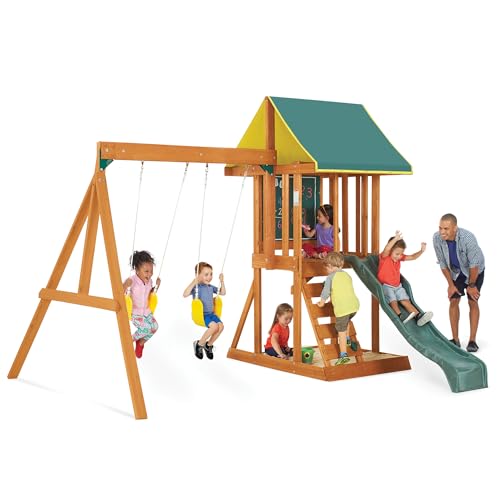
KidKraft Appleton Wooden Swing Set, (Amazon Exclusive)
Chosen because it specifies (Amazon Exclusive).
View on AmazonThe Appleton is the right answer for families with toddlers and early-elementary kids who don’t have room — or budget — for a full cedar castle. It’s a wooden swing set with belt swings and a slide on a lower, more compact frame, sized so that a preschooler can reach everything without help but a parent can still stand next to the structure comfortably.
Key specs
- Frame: wood, with a lower profile than the cedar sets above
- Play features: belt swings, slide
- Age range: approximately 3 to 7 years
- Footprint: compact — one of the easier sets here to place in a modest yard
- Assembly: typically a half-day to a day for two adults
- Capacity: appropriate for two to three younger children
Strengths
Scale is the entire point. A low deck and short slide are features, not compromises, when your children are four and six: everything is reachable, falls are shorter, and the set doesn’t dominate the garden. The wooden frame gives a warmer look than steel tubing, and the simpler structure means fewer bolts to re-tighten each spring. It’s also light enough that repositioning it — or moving it with the family — is realistic in a way the Mount McKinley never will be.
Belt swings on a standard hanger again mean a bucket seat can be added, which extends the set’s usefulness downward to a two-year-old with adult supervision.
Pros
- Compact footprint fits smaller yards
- Low deck height is safer and more accessible for younger children
- Simpler, faster assembly than full cedar sets
- Light enough to relocate
- Standard swing hangers accept toddler bucket seats
Cons
- Outgrown by roughly age eight
- Fewer features — no rock wall, no climbing element
- Wood requires inspection and periodic refinishing depending on climate
- Shorter slide produces less speed than premium sets
- Not built for heavy or simultaneous multi-child use
How it compares
Against the SunSwell wooden playground, both target the 3–8 band in a wood frame, so the decision comes down to which feature layout fits your yard and which brand’s assembly documentation you find clearer. Against Buckley Hill, the Appleton is the shorter-horizon purchase — cheaper and easier now, limiting in three or four years. Families who know they’ll still be in the same house when their kids are ten should stretch to Buckley Hill. Families renting, or with a genuinely small yard, should not.
5. Sportspower Triple Swing & Saucer Backyard Swing Set — Best for Many Kids, One Frame
If the problem you’re solving is “four children who all want to swing at once,” this is the set. It’s rated around 600 lb and carries three sling swings plus a saucer swing on a roughly 5 ft slide-equipped frame. That’s four usable swing positions — an unusually high count for the price tier, and the saucer gives younger or less confident kids a seat they can lie back in.
Key specs
- Frame: steel, powder-coated
- Capacity: approximately 600 lb total
- Swing positions: three sling swings plus one saucer swing
- Slide: approximately 5 ft
- Footprint: wide rather than deep — the four swing bays spread horizontally
- Assembly: a few hours for two adults
Strengths
The 600 lb rating is the headline, and it’s not marketing decoration: it’s what allows three kids and a parent, or two teenagers, to use the set simultaneously without the frame flexing uncomfortably. Steel construction keeps maintenance minimal, and the saucer swing serves a genuinely different purpose from the sling seats — it’s the station toddlers and sensory-seeking kids gravitate toward, and it’s often the one that stays in use longest.
The wide, shallow footprint is worth noting: because the play area spreads sideways rather than back, this set can fit along a fence line where a square cedar set could not.
Pros
- ~600 lb capacity supports simultaneous multi-child use
- Four swing positions for the price of a two-swing set
- Saucer swing suits toddlers and older kids alike
- Steel frame needs no sealing or staining
- Wide rather than deep footprint suits fence-line placement
Cons
- No climbing feature or elevated deck
- Slide is short
- Steel surfaces heat up in sun and may rust at scratches over years
- Saucer swing hardware and ropes are wear items that need periodic replacement
- Wide span still requires generous lateral clearance for safe swinging
How it compares
Against the Arcadia, this set trades feature variety for outright capacity and swing count. Choose the Triple Swing if swinging is the main event and you have three or more kids; choose the Arcadia if you have two or three kids who want a glider and a trapeze as well as swings. Against the Hapfan 600 lb heavy-duty set, both target the same high-capacity niche, but the Hapfan leans toward older, heavier users while this Sportspower unit is configured more for younger children in numbers.
6. Sportspower Park Ridge Metal Swing Set — Best for Ages 3–8 Variety Play
Park Ridge is the set that maximises the number of different things a small child can do on a single steel frame. It carries two swings, a standing swing, a Roman glider and a teeter totter, which means five distinct activities for a price in the budget tier. For a family with two or three kids aged three to eight, that breadth is the point.
Key specs
- Frame: powder-coated steel
- Play features: two swings, standing swing, Roman glider, teeter totter
- Age range: approximately 3 to 8 years
- Footprint: wide — five stations spread laterally
- Assembly: a few hours for two adults
- Capacity: suitable for several young children at once
Strengths
The teeter totter and Roman glider are the differentiators. Both are two-person, face-to-face activities, which means they generate cooperative play rather than parallel play — a meaningful difference when you have siblings close in age. The standing swing adds a third motion type, and the two conventional swings cover the basics. Few budget sets pack this many play modes onto one frame.
Steel keeps setup and maintenance simple, and the whole structure is light enough that two adults can reposition it before anchoring.
Pros
- Five distinct activities on one frame
- Two-person glider and teeter totter encourage cooperative play
- Budget-tier price
- Steel frame requires no wood treatment
- Fast assembly compared with wooden sets
Cons
- Wide footprint requires lateral yard space
- No slide, no deck, no climbing element
- Age ceiling around eight — older kids will want more
- More moving parts means more joints to inspect and re-tighten
- Steel aesthetics suit equipment-style yards rather than landscaped ones
How it compares
Against the Arcadia, Park Ridge trades the slide and trapeze for a teeter totter and standing swing — essentially the same budget spend, different activity mix. If your kids love sliding, buy the Arcadia. If they love interactive two-person play, buy the Park Ridge. Against the Trekassy 440 lb set, Park Ridge offers more stations but a lower weight ceiling, so it suits younger and lighter children.
7. Hapfan 600 lb Heavy Duty Swing Set — Best for Older Kids and Heavy Use
The Hapfan heavy-duty set exists for a specific problem: children who are too big for a budget set but not old enough to stop swinging. With a roughly 600 lb capacity and three swings on a black heavy-duty steel frame, it’s built around older kids, teenagers and adults who want to swing alongside them without the frame complaining.
Key specs
- Frame: heavy-duty steel, black finish
- Capacity: approximately 600 lb
- Swing positions: three swings
- Age range: broad — works for older children and adults
- Footprint: moderate, focused on swing clearance rather than feature stations
- Assembly: a few hours for two adults
Strengths
Heavier-gauge steel is the difference you feel immediately: less flex under load, less wobble at full swing amplitude, and less long-term deformation at the joints. For a family with a ten-year-old and a thirteen-year-old, that matters more than any climbing feature. The black finish also ages better visually than lighter-toned metal, hiding scuffs and the beginnings of surface rust.
Because it’s swing-only, there are fewer components to fail. The wear items are the swing seats, the hanger hardware and the chains or ropes — all replaceable, all inexpensive.
Pros
- ~600 lb capacity suits older children and adults
- Heavy-gauge steel reduces flex and long-term deformation
- Simple swing-only design means fewer failure points
- Black finish hides scuffs and surface rust
- Long service life with basic annual inspection
Cons
- No slide, climbing wall, glider or deck
- Higher price than entry-level metal sets
- Steel will still rust at untreated scratches in wet climates
- Requires firm anchoring to prevent tipping under dynamic load
- Little for a three- or four-year-old to do besides swing
How it compares
Against the Sportspower Triple Swing & Saucer, the Hapfan is the more robust frame with a higher practical load ceiling, but it lacks the saucer swing and the slide. Against the Hapfan 5-in-1 monkey bar set, this unit is swing-focused while the 5-in-1 adds overhead climbing — the choice is simply whether your kids want to climb or swing. Against any cedar set, the Hapfan wins on capacity-per-dollar and loses on play variety.
8. Hapfan 6-in-1 Outdoor Jungle Gym — Best Premium Pick for Climbing-First Families
Hapfan 6-in-1 Outdoor Jungle Gym with Monkey Bars, Swing Sets for Backyard
Chosen because it specifies Swing Sets for Backyard.
View on AmazonThe Hapfan 6-in-1 is the climbing-focused premium option. It combines monkey bars with swing positions and additional activity stations on a steel frame, aimed at kids who treat a swing set as a climbing structure with a swing attached rather than the other way around.
Key specs
- Frame: steel
- Play features: monkey bars, swing bays, multiple additional activity stations (six functions in total)
- Age range: broad, weighted toward school-age children
- Footprint: substantial — monkey bars require a long, unobstructed run
- Assembly: most of a day for two adults
- Capacity: designed for multiple children across stations
Strengths
Overhead climbing is the single feature most likely to keep an eight- to eleven-year-old engaged, and it’s the feature most swing sets omit. Monkey bars also build upper-body strength in a way slides and swings never will, which is why families with active kids often consider them non-negotiable. Combining them with a swing bay means the structure serves two age groups at once: younger kids swing, older kids traverse.
Steel construction keeps maintenance low, and the modular station layout means children rotate rather than queue.
Pros
- Monkey bars extend the useful age range beyond typical swing sets
- Multiple activity stations reduce queuing with several kids
- Steel frame won’t rot and needs no sealing
- Appeals strongly to active school-age children
- Builds upper-body strength through functional play
Cons
- Premium price tier
- Monkey bars demand a long, clear, safely-surfaced run underneath
- Overhead equipment requires more diligent adult supervision
- Longer assembly than swing-only frames
- Younger children will need the swing stations rather than the bars
How it compares
Against the Hapfan 5-in-1, the 6-in-1 adds stations and typically a longer climbing run; the 5-in-1 is the more compact choice for a smaller yard. Against the EROMMY 6-in-1 wooden playset, the split is material and aesthetics rather than function — steel for climbing durability, wood for a garden-friendly look. Against the Mount McKinley, the Hapfan is the climber’s set while the Mount McKinley is the slider-and-deck set; few yards can host both.
9. EROMMY 6-in-1 Wooden Swing Set — Best Wooden Alternative in the Premium Tier
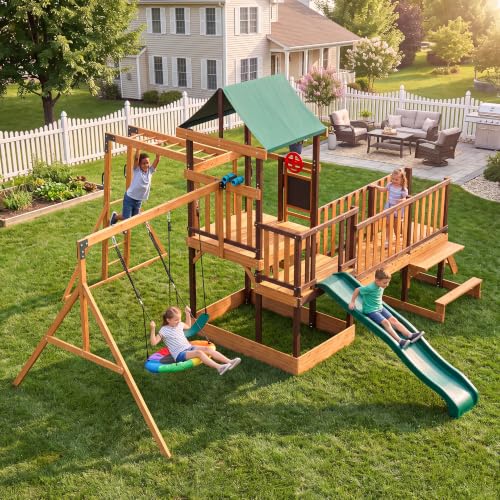
EROMMY Wooden Swing Set for Backyard, 6-in-1 Outdoor Playset with Slide
Chosen because it specifies 6-in-1 Outdoor Playset with Slide.
View on AmazonThe EROMMY 6-in-1 is the wooden counterpart to the steel jungle gyms: a wood-framed outdoor playset with a slide and multiple play stations, aimed at families who want the premium feature count without a steel structure dominating the garden view.
Key specs
- Frame: wood
- Play features: slide plus multiple play stations across six functions
- Age range: broad, roughly 3 to 10
- Footprint: larger — comparable to other six-function sets
- Assembly: a full day or more for two adults
- Capacity: multiple children across stations
Strengths
Wood gives the set a warm, landscaped appearance that steel cannot match, and it’s noticeably quieter in use — no metallic ring when kids land on a platform. The six-function layout keeps multiple children occupied simultaneously, and the slide anchors the younger end of the age range while the climbing stations serve older kids.
A wooden structure at this scale is also easier to modify or repair. Boards can be replaced, sanded or refinished individually, which means the set’s service life isn’t determined by its weakest factory component.
Pros
- Wood frame looks like part of the garden, not equipment
- Quieter in use than steel structures
- Six play functions for a wide age band
- Individual boards can be sanded, refinished or replaced
- Slide suits younger children while climbing stations serve older ones
Cons
- Premium tier price
- Wood needs periodic inspection and refinishing depending on climate
- Long assembly
- Large footprint
- Wood surface is softer than steel and will show dents
How it compares
Against the Mount McKinley, both are premium wooden multi-function sets; the deciding factors are footprint fit and which specific stations suit your children, since the Mount McKinley leans toward deck-and-slide play while the EROMMY leans toward variety. Against the Hapfan 6-in-1, this is the wood-versus-steel decision in its purest form. Against SunSwell, the EROMMY is the larger, more feature-heavy set.
10. Hapfan 5-in-1 Playground Set with Monkey Bars — Best Mid-Range Climbing Set

Hapfan Swing Sets for Backyard with Monkey Bars,5 in 1 Playground Set
Chosen because it specifies 5 in 1 Playground Set.
View on AmazonThe Hapfan 5-in-1 is the middle path: monkey bars and swing positions on a steel frame at a mid-range price, in a package that usually fits where the larger six-function sets won’t. It’s the right answer for a family that wants overhead climbing but has a yard that tops out around 25 to 30 ft.
Key specs
- Frame: steel
- Play features: monkey bars, swing positions, five functions total
- Age range: roughly 3 to 10
- Footprint: moderate — smaller than the 6-in-1 versions
- Assembly: several hours to a day for two adults
- Capacity: two to four children depending on station
Strengths
This set hits the practical compromise that most families actually need. You get the climbing feature that keeps older kids interested, the swings that serve everyone, and a footprint that doesn’t consume the whole lawn. Mid-range pricing means the money goes into the frame and the bars rather than decorative extras.
As with other steel sets here, maintenance is minimal and wear items are limited to seats, hangers and hardware.
Pros
- Monkey bars at a mid-range price
- Moderate footprint suits smaller yards than six-function sets
- Steel frame needs no wood treatment
- Broad age appeal from preschool to pre-teen
- Simple, well-understood maintenance routine
Cons
- Fewer stations than the 6-in-1, so more queuing with four or more kids
- Shorter monkey bar run than premium climbing sets
- Steel aesthetics
- No slide on most configurations
- Anchoring is essential under dynamic climbing load
How it compares
Against the Hapfan 6-in-1, this is the compact, cheaper version of the same idea — buy the 5-in-1 if your yard is under about 30 ft, and the 6-in-1 if you have room and kids who’ll use every station. Against the Hapfan 600 lb heavy-duty swing set, the 5-in-1 adds climbing at the cost of some swing capacity. Against the Sportspower Arcadia, this is the upgrade for families who’ve discovered their kids prefer climbing to sliding.
11. SunSwell Wooden Outdoor Playground — Best Mid-Range Wooden Set for Ages 3–8

SunSwell Swing Sets for Backyard Kid Ages 3-8 Wooden Outdoor Playground
Picked as a relevant option in this category.
View on AmazonSunSwell’s wooden playground targets the same 3–8 band as the KidKraft Appleton but with a fuller feature set, occupying the middle of the wooden-set market. It’s the pick for families who want a wood frame, a slide and swing bays, and aren’t ready to commit to a premium cedar castle.
Key specs
- Frame: wood
- Play features: slide, swing bays and additional play elements
- Age range: approximately 3 to 8 years
- Footprint: moderate — between the Appleton and the premium cedar sets
- Assembly: roughly a day for two adults
- Capacity: two to four children
Strengths
The value proposition is simple: wooden aesthetics and a broader feature set than entry-level wood sets, without the premium-tier price. It’s the natural upgrade for a family whose first budget metal set has been outgrown, or for parents who’ve decided against steel for aesthetic reasons. Assembly is manageable in a day, and the wooden frame can be refinished over time.
Pros
- Wood frame at a mid-range price
- Broader feature set than entry-level wooden sets
- Suits ages 3–8 well
- Manageable one-day assembly
- Refinishable wooden surfaces
Cons
- Outgrown around age eight or nine
- Wood requires inspection and periodic care
- Fewer premium features than cedar castle sets
- Moderate footprint still needs proper fall-zone clearance
- Not designed for heavy multi-child simultaneous use
How it compares
Against the KidKraft Appleton, SunSwell offers more features at a similar position in the market — the trade-off is assembly time and footprint. Against Buckley Hill, it’s the mid-point: more affordable and faster to build, but with a shorter useful life and fewer climbing options. Against the EROMMY 6-in-1, SunSwell is the smaller, lower-tier wooden option.
12. Trekassy 440 lb Saucer & Belt Swing Set — Best Budget Saucer-Swing Set
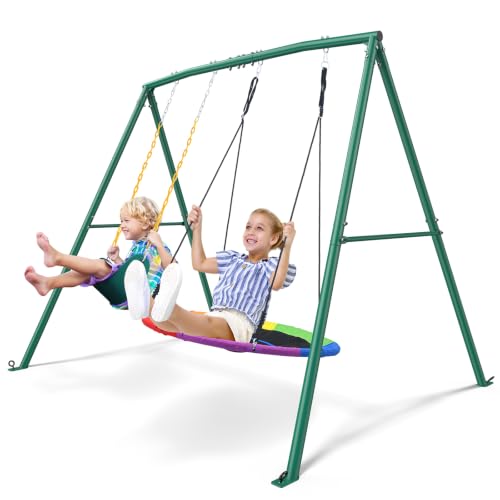
Trekassy 440lbs Swing Sets for Backyard, 2 Seat Saucer & Belt Swing - Green
Chosen because it specifies 2 Seat Saucer & Belt Swing and Green.
View on AmazonThe Trekassy set is the specialist: a two-seat saucer swing plus a belt swing on a frame rated around 440 lb, finished in green. If your kids have tried a saucer swing and won’t accept anything else, this is the cheapest way to get one at home.
Key specs
- Frame: metal, green finish
- Capacity: approximately 440 lb
- Swing positions: two-seat saucer swing plus one belt swing
- Footprint: compact
- Age range: broad, though the saucer suits younger children especially well
- Assembly: a couple of hours for two adults
Strengths
The two-seat saucer is the whole argument. It lets two children swing face-to-face or side-by-side, it accommodates lying down, and it’s the station toddlers and sensory-seeking kids choose first. The 440 lb rating is lower than the 600 lb sets here, but it’s ample for two young children plus occasional adult use. Compact dimensions and short assembly make it a realistic purchase for a renter or a small yard.
Pros
- Two-seat saucer swing at a budget price
- Compact footprint suits small yards
- Quick assembly
- Saucer design suits toddlers through early elementary ages
- Green finish blends with planting better than black or silver
Cons
- Lower ~440 lb capacity than the heavy-duty sets
- Only two swing positions
- No slide, climbing element or glider
- Saucer ropes and fabric are wear items needing periodic replacement
- Limited appeal for children over about nine
How it compares
Against the Sportspower Triple Swing & Saucer, Trekassy trades capacity and swing count for a lower price and a smaller footprint. Against the Arcadia, it gives up the slide and glider but wins on price and on the saucer specifically. Against the Hapfan 600 lb set, it’s the lighter-duty, cheaper, more toddler-oriented choice.
How to Choose
Choosing a swing set is a five-variable optimisation problem: frame material, capacity, footprint, age band and assembly tolerance. Get those five right and brand barely matters.
Frame material: the decision that determines service life
Cedar and other rot-resistant woods are the long-term winners. They resist moisture, insects and fungal decay without pressure treatment, they don’t conduct heat the way metal does, and they can be sanded and refinished. Expect a decade or more from a well-maintained cedar set. The trade-offs are cost, weight and assembly time: cedar sets are heavier, more expensive and typically take a full day or a weekend for two adults. Cedar is also a softwood, so it dents — a teenager landing hard on a wooden deck will leave a mark.
Powder-coated steel is the value winner. It doesn’t rot, it needs no sealing, it assembles faster, and it costs substantially less for the same number of play stations. The failure mode to plan for is rust at scratches, weld points and any spot where the coating is chipped. In dry climates, a powder-coated steel set can last many years with minimal attention. In coastal or persistently wet climates, budget for annual inspection and touch-up painting, and expect the frame to be the limiting factor rather than the play components.
Untreated or lightly treated pine sits between the two: cheaper than cedar, but it will need periodic sealing or staining to survive more than a few seasons in a wet climate. If a wooden set’s listing doesn’t specify cedar, assume some maintenance is required.
Weight capacity: match the number to your worst-case scenario
Capacity ratings assume total distributed load, not one user. The practical bands in this category:
- Around 440 lb: two young children, or one child plus one adult. Suitable for ages 3–8.
- Around 600 lb: three children, or two teenagers, or two adults. This is the threshold where a set stops feeling like a kids’ toy.
- Unstated capacity on a budget wooden set: assume two to three children of elementary age or younger, and don’t let a teenager use it as a swing.
Calculate your real requirement by adding the weights of the two heaviest people likely to use the set at once, then adding 30–50% margin for dynamic load — a swinging body generates considerably more force than its static weight.
Footprint and fall zones: the calculation most buyers skip
The structure’s dimensions are not the space it needs. For safe use, you need clearance in every direction from any moving component:
- In front of and behind swings: allow roughly twice the pivot height in each direction. A set with a 7 ft swing beam needs about 14 ft of clear run front and back — that’s 7 ft forward and 7 ft back at minimum, more for older, higher-swinging kids.
- Slide run-out: allow at least the slide length plus a few feet beyond the end for deceleration.
- Between stations: at least 3 ft of separation so kids don’t collide mid-motion.
- Overhead: check for branches, cables and roof overhangs above the monkey bars and the swing arc.
A worked example: a set with a 6 ft slide, a 7 ft swing beam and a 4 ft deck footprint needs roughly 24 ft × 20 ft of usable, level lawn once you account for the swing arc and slide run-out. If your candidate space is 20 × 20 ft, a compact two-swing set or a saucer set will fit comfortably; a full cedar castle will not.
Surface matters too. Grass is the default, but it compacts and wears into bare mud under swings. Loose-fill surfacing — wood chips, engineered wood fibre or rubber mulch — should be maintained at a depth of roughly 9 inches for equipment with a fall height around 6–7 ft and more for higher decks. Whatever you choose, rake it back under the swings periodically, because it migrates.
Anchoring: non-negotiable for metal sets
Any steel swing set must be anchored. Ground anchors or concrete footings prevent the frame from walking, tipping or lifting when two children swing in phase. Many budget Sportspower sets ship with anchor kits — use them, and if your set doesn’t include one, buy one. For wooden sets, anchoring matters less because the mass of the structure resists tipping, but it’s still worth doing if the set sits on a slope or in an exposed, windy location.
Age range and the upgrade path
Buy for the child you’ll have in three years, not the one you have now. A set purchased for a three-year-old should still work when that child is eight. That means:
- Ages 2–4: bucket or full-bucket swing seats, low deck, short slide, no overhead climbing without close supervision.
- Ages 4–7: belt swings, slide, rock wall or ladder, low monkey bars.
- Ages 7–11: standing swings, trapeze bars, gliders, full-height monkey bars, higher decks.
- Ages 11+: swings and climbing dominate; slides lose appeal. Capacity becomes the limiting factor.
Standard swing hangers are a genuine advantage because they let you swap a belt seat for a bucket seat and back again. Proprietary hanger systems lock you into one manufacturer’s accessories.
Assembly: budget the hours honestly
Assembly time correlates strongly with part count and deck height. As a working guide: a simple metal two-swing set takes two adults a few hours; a metal set with a slide, glider and trapeze takes most of a day; a mid-size wooden set takes a full day; a large cedar castle takes a full weekend, sometimes two. Add time for site preparation — levelling the ground, laying weed fabric or surfacing — which is often a half-day on its own and is rarely mentioned in product listings.
You’ll need two adults for anything with a deck or monkey bars, because long beams and tall frames are unmanageable solo. Pre-drilling is standard on the better wooden sets and saves real time. Sort hardware before you start; mixing up similar bolts is the single most common cause of a stalled build.
Maintenance: what actually wears out
Across both material types, the components that fail first are remarkably consistent:
- Swing seats and saucer fabric: the fastest wear item, typically a few seasons of hard use. Replace when fabric fades, cracks or the attachment points fray.
- Ropes, chains and hanger hardware: inspect every season for rust, fraying and elongation. Replace rather than repair.
- Slide hardware and fasteners: check that all fasteners are seated and that the slide-to-deck join hasn’t loosened.
- Wooden frames: check annually for splinters, checking, soft spots and insect damage. Refinish or seal as climate demands. Pay particular attention to ground-contact posts, which rot first.
- Steel frames: touch up any scratch or chip in the powder coating before rust establishes. Check weld points and bolt holes for corrosion.
Common mistakes to avoid: skipping the anchor kit on a metal set; installing on a slope or over tree roots; placing the set under overhead power or phone lines; leaving insufficient swing clearance and letting kids hit a fence; buying for the current age rather than the next three years; and not budgeting for surfacing at all.
A simple decision matrix
- Tight budget, two or three kids, want variety: Sportspower Arcadia.
- Tight budget, four or more kids who mainly want to swing: Sportspower Triple Swing & Saucer.
- Tight budget, kids who love saucer swings: Trekassy 440 lb set.
- Tight budget, kids who love two-person interactive play: Sportspower Park Ridge.
- Small yard, young children: KidKraft Appleton.
- Mid-size yard, ages 3–8, wood preferred: SunSwell wooden playground.
- Older or heavier kids who mainly swing: Hapfan 600 lb heavy-duty set.
- Want climbing but the yard is modest: Hapfan 5-in-1.
- Want maximum climbing, large yard, steel: Hapfan 6-in-1 jungle gym.
- Want maximum variety, large yard, wood: EROMMY 6-in-1 or Mount McKinley.
- One purchase to last a decade, home is permanent: Backyard Discovery Buckley Hill.
- Biggest possible set, no space constraints: Backyard Discovery Mount McKinley.
Frequently Asked Questions
What’s the safest type of swing set for young children?
For children under five, the safest configuration is a low deck, a shallow-angle slide, bucket-style swing seats and no overhead climbing elements. Safety is governed less by the material than by fall height and surfacing: the lower the highest accessible platform, the lower the risk, and loose-fill surfacing maintained at roughly 9 inches of depth under and around the equipment absorbs impact far better than grass. Cedar and steel frames are equally safe when properly anchored and maintained — the important thing is that the set is anchored, sits on level ground, and has full fall-zone clearance in every direction.
How much space do I really need for a swing set?
More than the product dimensions suggest. Add roughly the swing beam height in front of and behind the swings — so a 7 ft beam needs about 7 ft of clear run each way — plus the slide length and several feet of run-out beyond the slide exit, plus at least 3 ft between stations. In practice, a compact two-swing set fits in about 20 × 20 ft of usable lawn, a mid-size set with a slide needs roughly 24 × 24 ft, and a full cedar castle with multiple climbing elements wants 35 × 35 ft or more. Overhead clearance matters just as much: check for branches and cables above the swing arc and any climbing bars.
Do metal or wooden swing sets last longer?
It depends on climate and maintenance rather than material alone. Cedar sets routinely last a decade or more because the wood resists rot and insects naturally, and damaged boards can be repaired or replaced. Powder-coated steel sets can match that in dry climates, but they’re vulnerable to rust wherever the coating is scratched or chipped, which makes coastal and persistently wet environments harder on them. The honest generalisation: cedar lasts longer and costs more; steel costs less and needs more vigilance about rust. In both cases the frame usually outlives the swing seats, ropes and hanger hardware, which are the real consumables.
How long does assembly actually take?
Budget by complexity, not by brand. A basic metal swing set is a few hours for two adults. A metal set with a slide, glider and trapeze takes most of a day. A mid-size wooden set takes a full day. A large cedar set with a deck, slide and multiple climbing surfaces takes a full weekend or more. Add half a day for site preparation — levelling, laying surfacing — and plan on two adults for anything involving tall frames or long beams, since those components can’t safely be raised by one person.
Can adults use a kids’ swing set?
Only if the frame is rated for the load. Sets rated around 600 lb generally accommodate an adult swinging alongside a child, and the heavier-duty steel frames in particular are built for that kind of use. Entry-level wooden sets and lower-capacity metal sets (around 440 lb) are intended for children, and adult use will accelerate wear at the hanger points and can cause frame flex. Remember that dynamic load exceeds static weight — a swinging adult generates considerably more force than their body weight, so keep a substantial margin.
What maintenance does a swing set need each year?
Once a year, at the start of the season, work through a checklist: tighten every bolt and fastener; inspect swing hangers, chains and ropes for wear and replace anything frayed or elongated; check swing seats for cracking or faded fabric; examine the slide and its fasteners; and check the anchor points are still firm. On wooden sets, look for splinters, soft spots and insect damage, and refinish or seal as your climate requires — ground-contact posts rot first, so inspect those closely. On steel sets, touch up any scratched or chipped coating before rust takes hold. Then re-level your loose-fill surfacing, since it migrates out from under the swings over a season.
Is a saucer swing or a belt swing better for toddlers?
Both work, but they serve different purposes. A saucer swing lets a toddler lie back or sit with legs supported, and because it’s a shared platform, an adult or older sibling can often ride with them — which is why toddler-focused sets frequently pair a saucer with a belt swing. A belt swing is the more versatile long-term seat and, on standard hangers, can be temporarily replaced with a bucket seat for the youngest users. If you have one toddler, a belt swing with an added bucket seat is the more flexible starting point. If you have a toddler plus older kids, a saucer-and-belt combination serves everyone at once.
Do I need to anchor my swing set?
Yes for metal sets, and it’s strongly advisable for wooden ones on slopes or in exposed locations. An unanchored steel frame can lift, walk or tip when two children swing in phase, which is a genuinely common accident pattern. Ground anchor kits or concrete footings solve it, and many budget metal sets include anchoring hardware in the box. Wooden sets resist tipping through sheer mass, but anchoring still prevents the structure from shifting over years of use, and it’s the difference between a set that stays true and one that gradually settles out of level.
The Bottom Line by Situation
If you have a permanent home and a yard of at least 30 × 30 ft, buy the Backyard Discovery Buckley Hill and treat it as a decade-long purchase — it’s the most balanced set here across features, age range and durability. If your yard is big enough for a destination rather than a toy, the Mount McKinley justifies its size with the tallest deck and the widest climbing gradient in this roundup.
If money is tight, the Sportspower Arcadia delivers the most play value per dollar, with the Triple Swing & Saucer as the alternative when sheer capacity and swing count matter more than variety. Small yard or young children? The KidKraft Appleton is the right scale. Older or heavier kids who mainly want to swing? The Hapfan 600 lb heavy-duty set. Kids who climb more than they slide? The Hapfan 6-in-1 or the more compact 5-in-1. And if a saucer swing is the one feature your children won’t compromise on, the Trekassy 440 lb set gets you there for the least money.
Whichever you choose, anchor it, level the ground, budget for loose-fill surfacing under the swings, and measure your fall zones before you order — not after the boxes arrive.
FAQ
What’s the safest type of swing set for young children?
How much space do I really need for a swing set?
Do metal or wooden swing sets last longer?
How long does assembly actually take?
Can adults use a kids’ swing set?
What maintenance does a swing set need each year?
Is a saucer swing or a belt swing better for toddlers?
Do I need to anchor my swing set?
More from Amazon
Programs that pair well with the guide above. Offers and eligibility are set by Amazon and may change.
Build one list of everything you need for the new arrival and share it with family and friends.
Create a baby registrySet up recurring deliveries of everyday items on eligible products. Terms and savings are set by Amazon.
Explore Subscribe & SaveFree shipping on eligible items, Prime Video and more. Eligible new members can start with a free trial.
Start a Prime free trialAudiobooks and podcasts to listen to on the go. Eligible new members can start with a free trial.
Try Audible freeAs an Amazon Associate we earn from qualifying purchases.


Write Your Review
No reviews yet. Be the first to share your experience!